Monday, December 28, 2015

Review of Selwyn Pieters, Pieters Law Office more important, challenging and interesting work in 2015

By Selwyn A. Pieters, B.A., LL.B., L.E.C.
Lawyer & Notary Public (Ontario, Canada)
Attorney-at-Law (Republic of Guyana, Island of Trinidad)
Created December 28, 2015

This is a review of my year of litigation. In 2015 my journey through litigation took my through several practice areas including education law, human rights, police law, criminal law, civil litigation, administrative, constitutional and public law. I won some, I lost some, I resolved some and other cases were litigated on principles so that whether lost or won, the important issue was the principle and standing up for justice.

Constitutional and Public law

McAteer et al. v. Attorney General of Canada 36120 – Constitutional – freedom of expression – Citizenship Oath to Queen Elizabeth II  - Leave to Appeal to the Supreme Court of Canada was denied. See, McAteer, et al. v. Attorney General of Canada, 2015 CanLII 8563 (SCC). See also McAteer v. Canada (Attorney General), 2014 CarswellOnt 10955, 2014 ONCA 578, 121 O.R. (3d) 1, 242 A.C.W.S. (3d) 772, 27 Imm. L.R. (4th) 216, 376 D.L.R. (4th) 258 affirming McAteer, Topey, Dror-Natan v. Canada (Attorney General)  2013 CarswellOnt 13165, 290 C.R.R. (2d) 332, 20 Imm. L.R. (4th) 121, 117 O.R. (3d) 353, 2013 ONSC 5895, E.M. Morgan J. (Ont. S.C.J.). See also Roach et al. v. Canada 2012 CarswellOnt 7799, 2012 ONSC 3521 (ON S.C.). The applicants' position in this case was the Oath to the Queen in the Citizenship Act violates sections 2(a) and (b) Charter of Rights and Freedoms and cannot be saved by section 1. So the Oath Challenge failed. Mr. Dror Bar-Natan took the oath of citizenship in November 2015 and immediately renounced it upon receiving his citizenship certificate.

Taylor-Baptiste v. OPSEU is one of the more significant labour and employment law cases in 2015. It was argued at the Court of Appeal by my friend Ranjan Agarwal. http://www.casselsbrock.com/…/Top_10_Employment___Labour_La… I argued the case at the Human Rights Tribunal and my colleague Ranjan Agarwal argued at the Divisional Court and the Court of Appeal. The Ontario Court of Appeal dismissed the appeal in  in the case of Taylor-Baptiste v. Ontario Public Service Employees Union, 2015 ONCA 495 affirming  Taylor-Baptiste v. Ontario Public Service Employees Union, 2014 ONSC 2169 (Div. Ct.) and Taylor-Baptiste v. Ontario Public Service Employees Union et al, 2014 ONSC 5218 (costs). Counsel at the Court of Appeal and Divisional Court was Ranjan Agarwal and Amanda McLaughlin of Bennet Jones. At the Human Rights Tribunal I represented Correctional Manager Mariann Taylor-Baptiste in the ground-breaking competing rights case of Taylor-Baptiste v. Ontario Public Service Employees Union, 2012 CarswellOnt 8965, 2012 HRTO 1393, 2012 C.L.L.C. 230-022 reconsideration denied in 2013 CarswellOnt 1033, 2013 HRTO 180, 2013 C.L.L.C. 230-019 at the HRTO. The case is now at the Supreme Court of Canada on an Application for Leave to Appeal

Human Rights Law


In January 2015 Lawyers for the Center for Research-Action on Race Relations, the National Council of Canadian Muslims, the Canadian Muslim Lawyers Association, and the South Asian Legal Clinic of Ontario intervened at the Supreme Court of Canada in a case of alleged racial profiling of a Pakistani Pilot Javed Latif. Human Rights lawyers including Preet K. Bell, Ranjan K. Agarwal, Selwyn A. Pieters, Faisal Bhabha, Khalid M. Elgazzar, Faisal Mirza, Aymar Missikala participated as counsel in Quebec (Commission des droits de la personne et desdroits de la jeunesse) v. Bombardier Inc. (Bombardier Aerospace TrainingCenter), 2015 CarswellQue 6297, 2015 CarswellQue 6298, 255 A.C.W.S. (3d) 79, 2015 SCC 39 (CanLII). The Supreme Court of Canada rendered its decision in July 2015 dismissing the appeal but upholding the reasoning of the Ontario Court of Appeal in the Peel Law Association v. Pieters, 2013 CarswellOnt 7881, 2013 ONCA 396, 228 A.C.W.S. (3d) 204, 116 O.R. (3d) 81, 306 O.A.C. 314, 9 C.C.E.L. (4th) 233, [2013] O.J. No. 2695(Ont. C.A.).

Rohan Roberts application is in the early stages of the Human Rights Tribunal of Ontario processes. The complaint is alleging racial profiling in the provision of services by the Toronto Police Services Board, Ryan D’ena and Andrew Keown. This is a walking whilst Black case involving allegations of police harassment, brutality and racial profiling.

The decision on the merits in Lewis v. Toronto Transit Commission was released. Mr. Lewis, an African-Canadian male, filed an Application under section 34 of Part IV of the Human Rights Code, R.S.O. 1990, c. H.19, as amended, alleging discrimination with respect to employment because of race, colour, place of origin and reprisal. The application was dismissed: Lewis v.Toronto Transit Commission, 2015 CarswellOnt 3092, [2013] O.H.R.T.D. No. 2137, 2015 HRTO 256, CHRR Doc. 15-0756 (Whist).

Criminal Law

I am involved in drugs, guns and gang case "Project Rx". In that case over 70 persons were arrested by police officers in a joint forces operation. The preliminary Inquiry was completed in October 2015 and my client K.C. was discharged. The issue in that case was possession of firearms and drugs. 

Recently I was counsel in two cases where Black men in the Jane and Finch communities in Toronto were harassed then when they question that harassment, they were terrorized, brutalized and to add further injury charged with assault police, resist arrest or obstruct police. The charges were withdrawn in both instances of Michael Duru and Rohan Roberts. When such instances occur, we taken the view that it is a total abuse of their office. And, as I said before, using the courts and the justice system inappropriately to legitimize racial profiling. 

On March 16, 2015 the Court of Appeal decision in the long-standing racial profiling case of R. v.Steele, 2010 ONSC 5397 released by Justice Kathryn Feldman, Justice Janet Simmons and Justice Gladys Pardu: C53511 - R. v. Steele, 2015 CarswellOnt 3334, 2015 ONCA 169, [2015] O.J. No. 1253 (Ont. C.A.). Leave to the Supreme Court of Canada denied:  R. v. Steele, 2015 CanLII 43092 (SCC). In this case, the Court of Appeal ruled that a passenger has no rights to privacy in a motor vehicle during a traffic stop.

Civil Litigation

Bogiatzis v. Davis - Client died unexpectedly in the middle of preparation for examination for discoveries. This was quite shocking.

CV-14-512539 - Lam v University of Western Ontario Board of Governors, 2015 ONSC 5281 (CanLII), <http://canlii.ca/t/gkvc2>    and Lam v. The University of Western Ontario Board of Governors et al., 2015 ONSC 1642 (CanLII), <http://canlii.ca/t/ggplq>. Two attempts by the Defendants to have the claim struck without leave to amend failed. The matter now moves to discoveries.

CV-13-491631-00A1 P.P., v.OCSDA v. J. H, T. F. and A. R. litigation involving minors on a field trip arranged and supervised by their school.

Police Law (hybrid Human Rights)

In Afzal v. Regional Municipality of Peel Police Services Board The applicant, a police officer filed an Application under s. 34 of the Human Rights Code, alleging discrimination with respect to employment because of race, colour, place or origin, ethnic origin. He later retained counsel to assist him with the process.

Bartol v. Waterloo Police Services Board  - This was an application where a Dispatch officer alleged discrimination against her in employment on the basis of disability contrary to sections 5(1) and 9 of the Human Rights Code. The application also alleged that the employer took retaliatory action against her in contravention of section 8 of the Code.

Education Law

I represented former Toronto District School Board (TDSB) Director Christopher "Chris" Spence before the University of Toronto Tribunal in respect to plagiarism allegation in respect to his PhD Thesis. 


Dispute Resolution
For 2015 I have settled numerous cases through the mediation process at the Human Rights Tribunal of Ontario. Other cases involving employment law were settled in direct negotiations with employers' counsel.

International Law

Walter Anthony Rodney Commission of Inquiry in Georgetown, Guyana. The Government of Guyana terminated the evidentiary phase after the elections of May 2015. Closing arguments were made in July 2015 and the final report may be released on January 31, 2016.


On April 20, 2014, when the Guyana Trades Union Congress (GTUC)] announced its participation in the Walter Rodney Commission of Inquiry, it concluded its press statement by saying “Guyana and Guyanese deserve closure to this chapter of our history and an end brought to use of Rodney’s name as a wedge. The GTUC is prepared once again to play its part to the achievement of this end.” The Walter Rodney Commission of Inquiry took up a lot of my time and efforts in 2015. The fact remains that the taxpayers spent $400 Million dollars. Further, the fact remains that a lot of time and effort of a lot of people were put into that Commission. As well, the fact is there needs to be closure for the Rodney Family, the Burnham Family, the Smith's Family, people like Ogunseye (who faithfully attended most of the proceedings including closing arguments), The PNC persons (who felt their characters were at issue) and many others who need that aspect of Guyanese history to be done and historically wrapped up. The sensible thing is to provide the time required to complete that report. The Commissioners are paid to Inquire and Report. Its taxpayers money, let it be done. Presenting the report at [January] month's end closes the matter..... We can then move on [in] 2016 without the Rodney name being used as a wedge, as Lincoln Lewis describes it.

Saturday, December 05, 2015

Race, HIV transmission or exposure and Criminal Justice: would it be different if Charlie Sheen was Johnson Aziga or Michael "Tiger Mandingo" Johnson?

By Selwyn A. Pieters, B.A., LL.B., L.E.C.
Lawyer & Notary Public (Ontario, Canada)
Attorney-at-Law (Republic of Guyana, Island of Trinidad)
Created December 04, 2015

Charlie Sheen is White, Anglo, Saxon, Protestant. He is part of the establishment, very wealthy and has not been criminally charged despite the allegations similar in nature to Aziga and Johnson. Aziga and Johnson are Black, poor, not part of the establishment and had the resources of the state deployed against them in an unprecedented way.

A question for the Jury in Aziga was "Would your ability to judge the evidence in this case without bias, prejudice or partiality be affected by the fact that the individual charged is a black Canadian citizen who was born in Uganda, has HIV (Human Immunodeficiency Virus), and the alleged victims, including the two deceased women, are white?" R. v. Aziga, 2008 CanLII 29780 (ON SC). This was the first HIV Positive murder case in the world and I was concerned that the right questions was asked of jurors so that the jury was truly impartial.

On April 4th, 2009, Aziga, a Black Ugandan-Canadian male, was convicted, by a Hamilton, Ontario court composed of judge and jury, of two counts of first degree murder, 10 counts of aggravated sexual assault, and 1 count of attempted aggravated sexual assault. All charges arise from fact situations where the applicant, being HIV positive had unprotected sexual intercourse with women without informing them of his HIV status. He was subsequently declared a dangerous offender and is serving an indeterminate sentence in a Federal Prison. See, R. v. Aziga, 2010 ONSC 3683, [2010] OJ No 2763 (QL) and R. v. Aziga, 2011 ONSC 4592 (CanLII).

Michael Johnson, an African-American male, was convicted, by a St. Charles, Missouri court composed of judge and jury, of being HIV positive had unprotected sexual intercourse with men without informing them of his HIV status thereby recklessly exposing them to the HIV virus. He was sentenced to 30 years to life in prison. Johnson was a college athlete (wrestler), who was hooking up with men in his area mostly through social networks created for sexual encounters. He was represented by a public defender.

I am not a proponent of the criminalization of HIV. However, I do take the view that persons aware of their HIV Positive status who consciously fail to disclose that status and have unprotected sex must be held accountable equally. Black people in Canada and the United States of America form the bulk of the persons criminalised under the various laws in respect to HIV disclosure. The laws should not be unevenly applied based on one's race, wealth and/or status in society.

In Ontario, for example, there is a "guideline for Crown Attorneys relating to the prosecution of HIV exposure and transmission cases." However, this document is not publicly available so that the various considerations taken into account by Crown Attorneys are absent from public scrutiny or perview.

Charlie Sheen's case is now the litmus test by which American Justice will be view on the criminal prosecution or the lack thereof of HIV.

***
Selwyn A. Pieters was appointed Co-counsel on January 25, 2008 in R. v. Johnson Aziga, charged with 2 counts of first-degree murder and 13 counts of aggravated sexual assault. My work on the file resuled in three important and significant judicial decisions: See, R. v. Aziga [2008] O.J. No. 2431, 78 W.C.B. (2d) 87; R. v. Aziga; 2008 CarswellOnt 4300 and R. v. Aziga [2008] O.J. No. 3052, 78 W.C.B. (2d) 410. I got off the record on this file on August 06, 2008.


Thursday, October 08, 2015

If you are a Black Shopper "Don't Bend Down" Decision in McCarthy v. Kenny Tan Pharmacy Inc.

By Selwyn A. Pieters, B.A., LL.B., L.E.C.
Lawyer & Notary Public (Ontario, Canada)
Attorney-at-Law (Republic of Guyana, Island of Trinidad)
Created October 07, 2015

“Racism, and in particular anti-Black racism, is a part of our community’s psyche. A significant segment of our community holds overtly racist views. A much larger segment subconsciously operates on the basis of negative racial stereotypes. Furthermore, our institutions, including the criminal justice system, reflect and perpetuate those negative stereotypes.”  R. v. Parks, 1993 CanLII 3383 (1993) 15 OR (3d) 324; 24 CR (4th) 81; 84 CCC (3d) 353; [1993] OJ No 2157 (QL); 21 WCB (2d) 121; 65 OAC 122  (Ont. C.A.), p. 369.

Civil Servant and Ph.D. student Mary McCarthy, realized the painful reality of "Shopping Whilst Black" when she made a late night run shortly after 10:00 p.m, to Kenny Tan Pharmacy Inc., a franchise of Shoppers Drug Mart. In an application filed with the Human Rights Tribunal of Ontario Ms. McCarthy "alleged that a staff person subjected her to racial profiling and discrimination by falsely accusing her of shoplifting, searching her bag, and failing to apologize to her when the search disclosed that she had not shoplifted anything." McCarthy v. Kenny Tan Pharmacy Inc., 2013 HRTO 159, para. 2,

This case also dealt with the reality in a multicultural society of whether a South Asian (Brown) person would discriminate against an African (Black) person?

[88] In its closing submissions, the respondent store argued that Ms. Balachandra could not have racially profiled and discriminated against the applicant because she is also a racialized woman. Ms. Balachandra is South Asian. I disagree. In my view, it is not in dispute among well-informed, reasonable persons that racial stereotypes about persons of Black African descent exist in South Asian communities in both South Asia and Canada. Furthermore, South Asian individuals in Canada who hold such stereotypes and are in positions of power in employment, services or housing undoubtedly have the capacity to discriminate against Black individuals. I am not suggesting that this makes it more likely that Ms. Balachandra discriminated against the applicant, but I also do not accept that, because she is South Asian, it is impossible or less likely that she discriminated against the applicant. I dealt with a similar issue in Armstrong v. Anna's Hair & Spa, 2010 HRTO 1751 at paras. 52-55, and Bageya v.Dyadem lntemational, 2010 HRTO 1589 at para. 136.
The experience, particularly, in the Commonwealth Caribbean of widespread racism, racial tensions and social discord between South Asians and Black, particularly in the Republic of Guyana and the Republic of Trinidad and Tobago, illustrate that racial tensions between South Asians and Black people are a reality and that Black people can be discriminated against by South Asians and the reverse. In Trinidad and Guyana, Black people are stereotyped by South Asians as "thieves" and "robbers", it is no surprise that such stereotypes would be carried to Canada and the same unnecessary stereotyping would pervade.

In the end the Tribunal found that Ms. McCarthy was racially profiled and that her treatment on the night in question violated the Human Rights Code.

A one day hearing took place on September 19, 2013, at which a credibility shootout between the applicant and the respondents in respect to the time the event in question took place. The Respondent in order to undermine the applicant's case claimed the incident occurred after store closing: McCarthy v. Kenny Tan Pharmacy Inc., 2013 HRTO 1663 (CanLII), This is significant as it would have put the applicant in the place of a trespasser rather than a shopper on legitimate business. A receipt was crucial to the resolution of this point of dispute and reinforce the necessity for patrons to obtain receipts for items purchased, regardless how small the amount:
[2]           The applicant, who identifies as African Canadian, filed an Application under s. 34 of the Human Rights Code, R.S.O. 1990, c. H.19, as amended (the “Code”), which alleged that the respondent discriminated against her with respect to services and facilities because of her race and colour.  Specifically, she alleged that a staff person in a Shoppers Drug Mart store subjected her to racial profiling and discrimination by aggressively and rudely demanding that she open her backpack, looking inside her backpack, and walking away without apologizing.
[3]           The respondent filed a Response, which denied the allegation of racial profiling and discrimination.  The respondent stated that a store employee approached the applicant and asked to see the contents of her purse because of the applicant’s behaviour (she appeared to be crouching down, taking an item from the store shelf, and putting the item in her purse), not because of her race and colour.  The respondent stated that the employee was polite, courteous and respectful to the applicant.
[4]           As the parties are aware, at the hearing, there was a dispute between the parties as to when the alleged incident occurred.
[5]           The applicant provided the respondent with notice well in advance of the hearing that her position is that the alleged incident occurred between 10:10 and 10:29 p.m. on May 22, 2011 when the store was open, and that she has a receipt to prove it.  However, the applicant did not produce the receipt in advance of the hearing or at the hearing.
[6]           The respondent, on the other hand, did not dispute the applicant’s position on this matter prior to the hearing and when it cross-examined her at the hearing, it did not bring to her attention that its witnesses would be disputing her position.  However, when the respondent called its witnesses, its main witness testified that the alleged incident occurred shortly after midnight on May 23, 2011 when the store was closed.

The Tribunal resumed the hearing with a directive that the Applicant produce the receipt. The applicant produced the receipt that showed the time she attended the store was indeed during store opening.

In its analysis of the legal principles the Tribunal relied upon Peel Law Association v. Pieters, 2013 CarswellOnt 7881, 2013 ONCA 396, 228 A.C.W.S. (3d) 204, 116 O.R. (3d) 81, 306 O.A.C. 314, 9 C.C.E.L. (4th) 233, [2013] O.J. No. 2695(Ont. C.A.):
(a) The prohibited ground or grounds of discrimination need not be the sole or the major factor leading to the discriminatory conduct; it is sufficient if they are a factor;
(b) There is no need to establish an intention or motivation to discriminate; the focus of the enquiry is on the effect of the respondent's actions on the complainant;
(c) The prohibited ground or grounds need not be the cause of the respondent's discriminatory conduct; it is sufficient if they are a factor or operative element;
(d) There need be no direct evidence of discrimination; discrimination will more often be proven by circumstantial evidence and inference; and
(e) Racial stereotyping will usually be the result of subtle, unconscious beliefs, biases and prejudices.
McCarthy v. Kenny Tan Pharmacy Inc., 2015 HRTO 1303, para. 53. See also, Pieters v. Toronto Police Services Board, 2014 HRTO 1729 (HRTO), para. 71.

The Tribunal also relied on the recent Supreme Court of Canada decision in Quebec (Commission des droits de la personne et des droits de la jeunesse) v. Bombardier Inc. (Bombardier Aerospace Training Center), 2015 SCC 39 (SCC), para. 33, which adopted the OHRC's definition of Racial Profiling:
[33]                          ......The concept of racial profiling was originally developed in the context of proceedings brought against the police for abuse of power, but it has since been extended to other situations:
                    Racial profiling is any action taken by one or more people in authority with respect to a person or group of persons, for reasons of safety, security or public order, that is based on actual or presumed membership in a group defined by race, colour, ethnic or national origin or religion, without factual grounds or reasonable suspicion, that results in the person or group being exposed to differential treatment or scrutiny.
                    Racial profiling includes any action by a person in a situation of authority who applies a measure in a disproportionate way to certain segments of the population on the basis, in particular, of their racial, ethnic, national or religious background, whether actual or presumed. [Emphasis added.]
(Commission des droits de la personne et des droits de la jeunesse, Racial Profiling: Context and Definition (2005 (online)), at p. 13; see also Ontario Human Rights Commission, Policy and guidelines on racism and racial discrimination (2005 (online)), at p. 19.)
The Tribunal, having analyzed the evidence provided at the hearing found the applicant was racially profiled and the explanation of the respondent was illogical, incredible and butressed by lies:

[90] To sum up, the following evidence provides a basis to draw the inference that
Ms. Balachandra racially profiled and discriminated against the applicant during her
interactions with her in the respondent store:
• There were significant inconsistencies between the Response to the
Application, Ms. Balachandra's written witness statement, and .her oral testimony with respect to what occurred.
• Ms. Balachandra did not see the applicant put a store product in her
bag, but strongly believed that she had done so, which was completely illogical. She was unable to offer a reasonable explanation for this
strong belief.
• Ms. Balachandra was rude to the applicant from the outset of her
interaction with her by not identifying or introducing herself to the
applicant, speaking to her in an elevated voice, and demanding that she open her backpack.
• Ms. Balachandra's action in directly confronting the applicant and
searching her backpack inside the store was contrary to the respondent store and Shoppers Drug Mart's policy on dealing with suspected
shoplifting.
• Despite having been employed by the respondent store for almost five years, and having had to deal with shoplifting incidents during most of
her shifts, Ms. Balachandra was unable to provide a single example
where she directly confronted and searched the bag of a non-Black
individual inside the store.
• After discovering that there was no store product in the applicant's
backpack, Ms. Balachandra continued to be rude tothe applicant by not  apologizing to her. She was unable to offer a reasonable explanation
why she did not apologize, and her behaviour was contrary to how she normally behaves, which is to be polite.
• Ms. Balachandra lied when she testified that the incident occurred
shortly after midnight when the respondent store was closed. She
concocted this allegation at the last minute in an attempt to protect
herself and bolster the respondent store's case.
• Ms. Balachandra tried to evade the applicant's allegation of racial·
profiling and discrimination by falsely testifying that she "did not notice
that the applicant was Black when she first saw and spoke to her in the respondent store.
• Ms. Balachandra was unable to offer a credible, non-discriminatory
explanation for how she treated the applicant.
See Peel Law Association, above, at para. 128, where the Ontario Court of Appeal found that similar evidence was an ample basis to support an inference of racial profiling and discrimination.
[91] For the above reasons, I am satisfied that the applicant has established, on a balance of probabilities, that her race and colour were a factor in how Ms. Balachandra treated her in the respondent store. In my view, although the applicant's race and colour were not the sole factor, they were a factor, and moreover, a significant factor, in the adverse treatment. Furthermore, in view of the fact that Ms. Balachandra is an employee of the respondent store, the respondent store is liable for her conduct. See s. 46.3(1) of the Code.
In  Peel Law Association v. Pieters, the Court of Appeal place particular significance to a false explanation as a pretext to discriminate holding that:
[72]      And so it is in discrimination cases. The question whether a prohibited ground is a factor in the adverse treatment is a difficult one for the applicant. Respondents are uniquely positioned to know why they refused an application for a job or asked a person for identification. In race cases especially, the outcome depends on the respondents’ state of mind, which cannot be directly observed and must almost always be inferred from circumstantial evidence. The respondents’ evidence is often essential to accurately determining what happened and what the reasons for a decision or action were.
[73]      In discrimination cases as in medical malpractice cases, the law, while maintaining the burden of proof on the applicant, provides respondents with good reason to call evidence. Relatively “little affirmative evidence” is required before the inference of discrimination is permitted. And the standard of proof requires only that the inference be more probable than not. Once there is evidence to support a prima facie case, the respondent faces the tactical choice: explain or risk losing.
[74]      If the respondent does call evidence providing an explanation, the burden of proof remains on the applicant to establish that the respondent’s evidence is false or a pretext.
[77]     The shifting of the evidential burden does not put the respondents in the position of having to prove a negative. Rather, it puts them in the position of having to call affirmative evidence on matters they know much better than anyone else – namely, why they made a particular decision or took a particular action. [Emphasis added.]
McCarthy by singularly producing her receipt demolished the case of the respondent that was built on a pack of lies.

In racial profiling cases the first step, which is crucial is establishing liability, if a case is successful at that point then the next step is to argue for a variety of other legally appropriate remedies, financial and non-monetary.

In terms if remedies, Ms. McCarthy was awarded $8000.00. The Tribunal's reasoning on how it arrived at that relatively modest quantum is instructive:

[98] Tribunal decisions that have considered incidents involving racial profiling and/or
discrimination with respect to services have made awards ranging from $2,000 to
$20,000. See, for example, Peel Law Association v. Pieters, 2010 HRTO 2411
($2,000); Phipps v. Toronto Police Services Board, 2009 HRTO 1604 ($10,000);
Simpson v. Oil City Hospitality Inc., 2012 AHRC 8 ($15,000); Direk v. Coffee Time
Donuts, 2009 HRTO 1887 ($15,000); Longboat v. 708179 Ontario Inc., 2012 HRTO
2170 ($15,000); and Nassiah v. Peel (Regional Municipality) Services Board, 2007
HRTO 14 ($20,000). 
[99] None of the above decisions are closely analogous to the case at hand, but, in
my view, the ones that are most analogous and relevant with respect to the appropriate
quantum to be awarded to the applicant for injury to dignity, feelings and self-respect
are Pieters, Simpson, and Direk. In Pieters, this Tribunal found that the librarian/administrator of a lawyers' lounge racially profiled and discriminated against
two Black lawyers when she demanded that they produce identification to prove that
they were lawyers, and awarded each applicant $2,000 for injury to dignity, feelings and
self-respect. In Simpson, a Human Rights Tribunal of Alberta found that the respondent
refused the complainant entry to its nightclub because he is Asian, and awarded him
$15,000 for general damages. In Direk, this Tribunal found that the respondent coffee
shop's owner made discriminatory comments about Turkish people, and called the
police on the applicant because he is Turkish. The Tribunal awarded the applicant
$15,000 for injury to dignity, feelings and self-respect. 
[100] In my view, the quantum that should be awarded to the applicant for injury to
dignity, feelings and self-respect in the case at hand lies somewhere between the
quantum awarded in Pieters, and the quantum awarded in Simpson and Direk. The
quantum should be higher than in Pieters because it is a far more serious violation of
the Code to be falsely accused of being a thief and subjected to a bag search in a store
because of race and colour than to be asked for identification in a lawyers' lounge
because of race and colour, but not as high as in Simpson, where the applicant was
refused a service because of his race, and in Direk, where the police were called on the
applicant because of his place of origin and ethnic origin. 
[101] I find, overall, after considering the extremely serious violation of the Code, the
applicant's individual circumstances, and the relevant case law, that the $8,000 that the
applicant requested is an appropriate award of compensation for injury to dignity,
feelings and self-respect.
The remedies particularly the financial remedy awarded by the Tribunal is woefully inadequate and a licence to discriminate. Its great that Ms. McCarthy has a positive decision but with a remedial order of $8000.00, which is nuisance value money, as respondents terms such figures, I have a pessimestic view of that decision of this nature can result in the changing hearts and minds particularly when controlling for the costs mentally, physically and financially of applicants litigating such cases.

The Peel Law Association v. Pieters case was highly contested and litigated as well. Peel Law Association incurred over $200,00.00 costs for their legal representation and paying a Damage Award and Cost Award to the successful applicants. The applicants also incurred a substantial cost burden in funding the litigation all the way to the Court of Appeal: See, Noble v. Peel Law Association, 2009 CarswellOnt 3496, 2009 HRTO 805 (CanLII)  (Vice Chair B. Eyolfson); Noble v. Peel Law Association2009 CarswellOnt 1758; 2009 HRTO 357 (CanLII)  (Vice Chair K. Joaquim); Pieters v. Peel Law Association2010 CarswellOnt 9354, [2010] O.H.R.T.D. No. 2398, 2010 HRTO 2411 (CanLII) (Vice Chair E. Whist); PeelLaw Association v. Pieters2012 CarswellOnt 2026, [2012] O.J. No. 684, (2012), 288 O.A.C. 185, 2012 ONSC 1048, 213 A.C.W.S. (3d) 729 (Div. Ct.) (Chapnik, Hockin and Hoy JJ); Peel Law Association v. Royal Insurance, 2013 ONSC 2312, [2013] 116 O.R. (3d) 312 (Donohue, J.); Peel Law Assn. v. Pieters, 2012 CarswellOnt 8616 (Gillese, Epstein, Feldman JJ.A.); Peel Law Association v. Pieters, 2013 ONCA 396, [2013] 116 O.R. (3d) 812013 CarswellOnt 7881, 2013 O.J. No. 2695, 228 A.C.W.S. (3d) 204  (Cronk, Juriansz and Pepall JJ.A.). 


The broader point is these cases have little consequences on respondents behavior due to the imbalance of resources to litigate these cases. A significant amount of financial, legal  and human resources are available to Corporate Respondents in Human Rights Applications. It is rare for Aplicants to have access to the financial resources of respondents to litigate these cases. Thus, with the absence of award of legal costs to the successful Applicant and the very modest financial awards to successful Applicants, one sense of dignity is never really restored and in fact it is undermined such that a Respondent controlling for the rare chance that an Applicant can successful win a racial profiling case at the Human Rights Tribunal has a license to discriminate and harass Black people whether they are walking, shopping, driving, riding and working under whatever guise suits their fancy. 

The paucity of positive human rights decisions, particularly in respect to racial profiling, has led to a pessimistic view amongst some human rights litgants and applicant counsel on human rights tribunals and there ability to effectively and meaningfully adjudicate human rights disputes and provide meaningful remedies for Applicants/Complainants.

Thursday, September 03, 2015

Submissions by Selwyn A. Pieters to MSGCS on Police Street Checks


By Selwyn A. Pieters, B.A., LL.B., L.E.C.
Lawyer & Notary Public (Ontario, Canada)
Attorney-at-Law (Republic of Guyana, Island of Trinidad)
Created August 31, 2015


On June 16, 2015, Ontario's Minister of Community and Correctional Services announced that the province intends to develop a set of rules to govern police street checks. In furtherance of this objective, it is holding consultations with various stakeholders.

As a lawyer who represented persons facing the brunt of this practise in civil courts, before the Human Rights Tribunal and in Criminal litigation, I set out a chart of my jurisprudential journey so that these issues are not considered in the abstract but rather having regard to what obtains in our courts and tribunals in respect to this process of racial oppression.

Selwyn Pieters written submissions on MSGCS Ontario Police Street Check Consultation (Racial Profiling), August 31, 2015

Wednesday, August 05, 2015

Walter Rodney Commission of Inquiry - Oral and Written Submissions

By Selwyn A. Pieters, B.A., LL.B., L.E.C.
Lawyer & Notary Public (Ontario, Canada)
Attorney-at-Law (Republic of Guyana, Island of Trinidad)
Created August 05, 2015 Updated February 03, 2016

The Report of the International Commission of Inquiry into the death of Dr. Walter Rodney aka the Rodney Commission of Inquiry or Rodney COI is scheduled to be delivered to H.E. David Arthur Granger, President of the Co-operative Republic of Guyana on February 08, 2016. Initially the President provided the Commission with a deadline of November 30, 2015 in which to produce its findings and recommendations. However, extensions were provided to enable the Commission to complete its work.

On June 13, 2013, the thirty-third anniversary of the June 13, 1980 explosion that killed Dr. Walter Rodney, the Government of the Republic of Guyana announced that it has approved the establishment of an International Commission of Inquiry into the death of Dr. Walter Rodney.

In February 2014, the then President of the Republic of Guyana, His Excellency, Donald Ramotar, appointed The Walter Rodney Commission of Inquiry. Three
Commissioners were sworn in to probe the matter: Sir. Richard L. Cheltenham, K.A.,
Q.C., Ph.D – Chairman (Barbados); Mrs. Jacqueline Samuels-Brown, Q.C. (Jamaica)
and Mr. Seenath Jairam, S.C. (Trinidad).

The Commission’s mandate established by its terms of reference  was:-

(i) To examine the facts and circumstances immediately prior, at the time of, and subsequent to, the death of Dr. Walter Rodney in order to determine, as far as possible, who or what was responsible for the explosion resulting in the death of Dr. Walter Rodney;
(ii) To inquire into the cause of the explosion in which Dr. Walter Rodney died, whether it was an act of terrorism, and if so, who were the perpetrators;
(iii) To specifically examine the role, if any, which the late Gregory Smith, Sergeant of the Guyana Defence Force, played in the death of Dr. Walter Rodney and if so, to inquire into who may have counselled, procured, aided and or abetted him to do so, including facilitating his departure from Guyana after Dr. Walter Rodney’s death;
(iv) To examine and report on the actions and activities of the State, such as, the Guyana Police Force, the Guyana Defence Force, the Guyana National Service, the Guyana People’s Militia and those who were in command and superintendence of these agencies, to determine whether they were tasked with the surveillance of and the carrying out of actions, and whether they did execute those tasks and carried out those actions against the Political Opposition, for the period 1st January, 1978 to 31st December, 1980;
(v) To examine, review and report on earlier investigations and enquiries done on and into the death of Dr. Walter Rodney.

The first session of public hearing commenced on April 28, 2014 and concluded on
May 02, 2014.

The last session of public hearing in which evidence was elicited from witnesses commenced at 0930 hours on March 23, 2015 and concluded on March 27, 2015. The main witness Donald Rodney, first appeared on January 30, 2015 and continued his evidence from March 23, 2015.  His evidence was followed by another significant witness Anne Wagner, the sister of William Gregory Smith.

The Commission has not seen fit to create a repository of important evidence, submissions, news reports and other documents relative to the Commission. This blog therefore is the most comprehensive collective of material in relation to the work of the Rodney Commission of Inquiry.

Final Sitting of the Walter Rodney Commission of Inquiry


A final sitting of the Walter Rodney Commission of Inquiry took place from the 27th July, 2015 to 31st July, 2015.

Monday 27th and Tuesday 28th July, 2015 was allocated to the attorneys for interested parties to provide oral submissions.

Walter Rodney Commission of Inquiry - Written Arguments of Counsel for the People's National Congress

Basil Williams and Selwyn A. Pieters, Written Submissions of the People's National Congress, July 23, 2015

Walter Rodney Commission of Inquiry - Oral Arguments of Counsel for the People's National Congress
PNC Counsel Submissions Part 1


PNC Counsel Submissions Part 2

PNC Counsel Submissions Part 3

PNC Counsel Submissions Part 4

PNC Counsel Submissions Part 5

Walter Rodney Commission of Inquiry - Arguments of Counsel for the Commission and Counsel for the Immediate Family of Dr. Walter Rodney


*****
Selwyn A. Pieters and Brian M. Clarke, Written submissions of the Guyana Trades Union Congress, July 24, 2015

Andrew Pilgrim, Q.C., Closing argument of the Immediate family, July 24, 2015

Keith Scotland, Closing Argument of Donald Rodney, July 24, 2015

Latchmie Rahmahat, Closing Argument of Commission Counsel, July 28, 2015

Christopher Ram, Closing Argument on behalf of the Working People's Alliance, July 28, 2015.


*****

RESOURCES AND BACKGROUND MATERIAL

Guyana Gazette, July 11, 2015

Exhibit List, Walter Rodney Commission of Inquiry

Walter Rodney, The Struggle Goes On Walter Rodney Speech (20.7.1979)

Magistrate Edwin Pratt, Report of the inquest into the deathWalter Rodney, 1988

International Commission of Jurists (ICJ) Report, May 1995

David A. Granger, National Defence: A Brief History of the Guyana Defence Force, 1965 – 2005, Georgetown, Guyana : Free Press, "On Paramountcy"

Special Branch, Guyana Police Force, Gregory Smith (re Walter Rodney)April 1980.

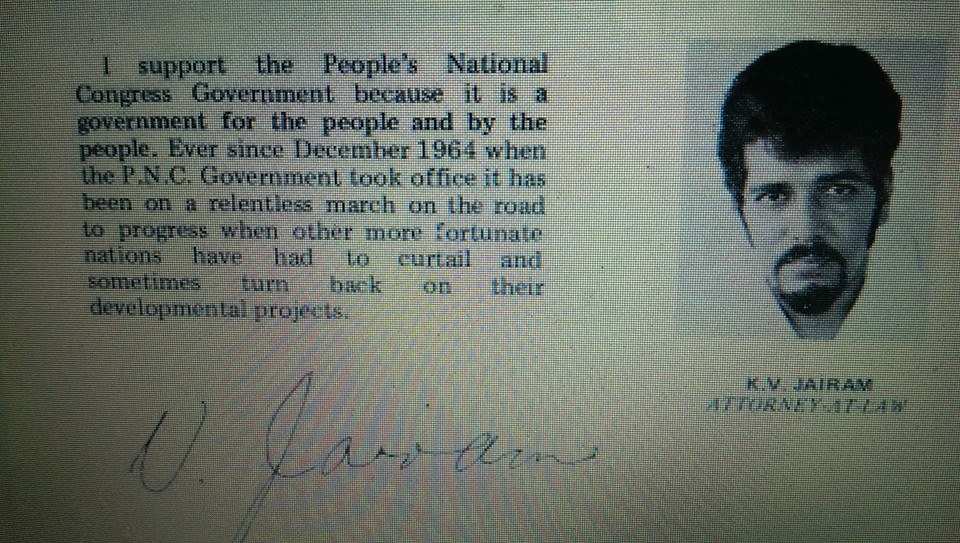
K.V. Jairam, Why I joined the P.N.C.

WARCOI Verbatim Report - Preliminary Arguments and Final Closing Arguments, July 27, 2015

GDF Colonel to head Special Organised Crime Unit, September 06, 2014, Kaieteur News
Evidence of Lt_Col_Sydney Charles James August 25, 2014
Evidence of Lt_Col_Sydney Charles James August 26, 2014
Evidence of Lt_Col_Sydney Charles James August 27, 2014
Evidence of Lt_Col_Sydney Charles James August 28, 2014

Transcript of Evidence of Jocelyn Dow August 29, 2014

Transcript of Evidence of Ms. Karen DeSousa and Tacuma Ogunseye, August 4, 2014

Walter Rodney COI, August 4, 2014 - Part 1, Stabroek News, August 4, 2014
Walter Rodney COI, August 4, 2014 - Part 2, Stabroek News, August 4, 2014
Walter Rodney COI, August 4, 2014 - Part 3, Stabroek News, August 4, 2014
Walter Rodney COI, August 4, 2014 - Part 4, Stabroek News, August 4, 2014
Walter Rodney COI, August 4, 2014 - Part 5, Stabroek News, August 4, 2014
Walter Rodney COI, August 4, 2014 - Part 6, Stabroek News, August 4, 2014
Walter Rodney COI, August 4, 2014 - Part 7, Stabroek News, August 4, 2014

Transcript of Evidence of Gerry Gouveia  June 26, 2014 and June 27, 2014.
Walter Rodney COI, June 26, 2014 - Part 1, Stabroek News, June 26, 2014
Walter Rodney COI, June 26, 2014 - Part 2, Stabroek News, June 26, 2014
Walter Rodney COI, June 26, 2014 - Part 3, Stabroek News, June 26, 2014
Walter Rodney COI, June 26, 2014 - Part 4, Stabroek News, June 26, 2014
Capitol News, June 26, 2014
GINA, June 26, 2014
Demerara Waves, Rodney Inquiry: Gerry Gouveia believes he transported Gregory Smith to Kwakwani, June 26, 2014
Gouveia flew plane that spirited Smith away — Guyana Times, June 26, 2014
Kaieteurnewsonline, Chairman has shown his bias – Harmon, June 27, 2014

The evidence of Joe Hamilton June 13, 2014

The evidence of Major-General (retd) Norman McLean  on June 05, 2014

Excerpts of May 30, 2014 and June 02, 2014 evidence of Eusi Kwayana 
See also Transcript of evidence of Tacuma Ogunseye June 25, 2014;
Transcript of evidence of Dr. Nigel Westmaas June 30, 2014July 01, 2014.

Shaun Michael Samaroo Articles in the Guyana Chronicle:
March 28, 2015, Hanoman discredits Wagner’s testimony, Guyana Chronicle;   March 26, 2015 Wagner to unveil secret list of ‘big names’ – Says assassination suspect Gregory Smith revealed list of names connected to Dr Walter Rodney’s assassination Guyana Chronicle; January 28, 2015 Robert Allan Gates makes stunning claim at Rodney Commission –McLean, Lewis, Roberts vital to dark Rodney plot Guyana Chronicle; November 14, 2014 article "Special Report on the Rodney Commission of Inquiry by Shaun Michael Samaroo, Detailing PNC State machinery violence against WPA at Rodney Commission" Guyana Chronicle; November 07, 2014, Special Report on the Rodney Commission of Inquiry by Shaun Michael Samaroo, At Rodney COI… Gopaul, Williams ‘brawl’ in dramatic face-off Guyana Chronicle; October 31, 2014, Special Report on the Rodney Commission of Inquiry by Shaun Michael Samaroo, Remote trigger detonated bomb that killed Rodney, Guyana Chronicle; August 07, 2014 Special Report on the Rodney Commission of Inquiry by Shaun Michael Samaroo, Commission Chairman slams Basil Williams’ propaganda idea Guyana Chronicle; August 06, 2014, Special Report on the Rodney Commission of Inquiry by Shaun Michael Samaroo, Police files reveal PPP sought peaceful resolution to PNC dictatorship, Guyana Chronicle; August 05, 2014, Special Report on the Rodney Commission of Inquiry by Shaun Michael Samaroo, Laurie Lewis wrote, mailed Teekah death threat, Guyana Chronicle; June 5, 2014 Shaun Michael Samaroo, Granger was Army Liaison to GPF in Gregory Smith probe : – Says former Army Chief-of-Staff McLean, Guyana Chronicle; June 03, 2014 Corbin delivered guns to House of Israel, Guyana Chronicle...

In the Sky’s Wild Noise (documentary about Walter Rodney)

Jamaica Hansard. 1968-1969. Proceedings of the House of Representatives of Jamaica October 17, 1968 (Rodney Affair 01, 02, 03) - "National Security of Jamaica"

Why We're Backing Burnham and the P.N.C. [at The] Guyana General Elections, Monday, December 15, 1980

Abrams v The Members of the Governing Body of Anglican Schools (1960), 2 WIR 187

Ramson –v- A.G. (1979) 28 WIR 191

Ramson –v- Barker (1982) 33 WIR 183

Copyright © 2015 Selwyn Pieters. All rights reserved. Please use citation if using or relying on my analysis.

********

Selwyn A. Pieters, B.A. (Toronto), LL.B. (Osgoode), L.E.C. (U.W.I). Lawyer & Notary Public (Ontario). Attorney-at-Law (Republic of Guyana and Republic of Trinidad and Tobago).

Pegasus Guyana - Ants and Roach Infested Rooms

By Selwyn A. Pieters, B.A., LL.B., L.E.C.
Lawyer & Notary Public (Ontario, Canada)
Attorney-at-Law (Republic of Guyana, Island of Trinidad)
Created August 05, 2015

I post this video taken on August 04, 2015 at the Pegasus Hotel in Georgetown Guyanaand these pictures taken one year ago in August 2014, where I experienced a problem with a roach infestation problem at the Pegasus Guyana. I expected to see much improvement in 2015, however, lo and behold, in 2015 very little has changed including customer service.


From: Selwyn Pieters
To:  susan Isaacs @pegasushotelguyana.com
 Cc: reservations @pegasushotelguyana.com
 Date: Monday, August 03, 2015 08:02 pm
 Subject: Pegasus

Good evening Susan,

I was hoping I would not have to write you this trip but I do have to. As you know I was in 2007, and I had an invasion of ants in the room. Not sure how house-keeping would have missed that. I spent Sunday and part of Monday in Berbice. When I returned Monday evening there were scores of fine ants in the room. I called down to the reception desk to relay my concerns about 4:15 p.m. I requested that housekeeping spray the room and bring a mop to mop up the ants. One hour later no one arrived. I went down to the front desk, to see the duty manager. It took a while waiting. So I left and took a walk outside the hotel. When I returned I waited for some time for the duty manager and had to return to the room since the duty manager did not come to the front desk. He arrived at 6:22 p.m. I was then moved to room 3006 shortly after 6:30 p.m.

The excuse that the on-call manager provided for no seeing me earlier was simply not acceptable. What can be more important (apart from an emergency such as a fire or robbery or medical emergency) than responding to a customer whose room is swarmed with ants?

I stayed at the Pegasus this trip because I had to old family members who I brought along on holidays and I thought this would be good. I am very disappointed.

My aunty who stayed in room 715 complained that her luggage was piflfered and belongings stolen. She was also concerned that the housekeeping staff left two bath towels in the room and showed up late almost every evening with a washclothe. It seemed very irregular to her.

This cannot be the best customer service that Pegasus can offer. It just cannot be....

Yours very truly,

Selwyn A. Pieters, B.A., LL.B., L.E.C.
Lawyer & Notary Public


Thursday, July 23, 2015

Supreme Court of Canada Releases Significant Decision on Proving Discrimination based on Race/Ethnicity (CDPDJ AND LATIF V. BOMBARDIER)

By Selwyn A. Pieters, B.A., LL.B., L.E.C.
Lawyer & Notary Public (Ontario, Canada)
Attorney-at-Law (Republic of Guyana, Island of Trinidad)
Created July 23, 2015

“Discrimination can take a variety of forms. Although some of them are easy to identify, others are less obvious, such as those that result from unconscious prejudices and stereotypes or from standards that are neutral on their face but have adverse effects on certain persons. The Charter of human rights and freedoms, CQLR, c. C‑12 (“Charter”), prohibits the various forms of discrimination and creates a remedy for victims of discrimination.”  Commission des droits de la personne et des droits de la jeunesse, et al. v. Bombardier Inc. (Bombardier Aerospace Training Center), et al. 2015 SCC 39, para. 1.

The Supreme Court has release its decision in Commission des droits de la personne et des droits de la jeunesse, et al. v. Bombardier Inc. (Bombardier Aerospace Training Center), et al. 2015 SCC 39 a case of racial/ethnic discrimination in employment that will have national ramifications for all discrimination cases. The significant issue of importance to human rights practitioners and litigants is "whether Court of Appeal erred in requiring proof of causal connection between ethnic origin and exclusion?" In other word, do the modified "causal" which is imported from the Civil Code makes it virtually impossible to prove discrimiantion by importing a standard that has no place in human rights law?

The facts in this case revolves around a Canadian pilot of Pakistani background, Mr. Javed Latif, who in 2004 was offered a job to pilot Bombardier Challenger aircrafts and was denied training (which took place in Quebec, Canada and Texas, U.S.A) by Bombardier due his being listed as a security threat by U.S. authorities. (In order to access training under a U.S. Federal Aviation Authority license, he had to pass a security check required by the U.S. government’s Alien Flight Students Program given that part of the training was to be offered in the U.S.).

As a result, Mr. Latif was denied employment and had problems finding work as a pilot. He filed a complaint of ethnic discrimination with the Quebec Human Rights and Youth Rights Commission, which upheld his case and brought it before the Human Rights Tribunal. In 2009, the Tribunal ruled in his favour and ordered Bombardier to pay him $385,000 in damages and to cease using U.S. national security screening criteria when dealing with Canadian applications for a pilot training license.

Bombardier appealed the ruling to the Quebec Court of Appeal, which quashed the Tribunal's decision in the fall of 2013. The Human Rights Commission obtained leave to appeal the Court of Appeal decision to the Supreme Court, seeking the latter’s clarification on a number of issues.

One of these issues is whether the Quebec Court of Appeal erred in requiring proof of a “causal connection” between the prohibited ground of ethnic origin and the discrimination experienced by the victim. Canadian jurisprudence on discrimination usually merely requires evidence that a prohibited ground, such as race or gender, was one of the factors in a discriminatory action or practice; this is a lower threshold to prove discrimination than that of “causal connection”.

In 2013, the Ontario Court of Appeal rejected a similar test in the ground-breaking racial profiling case of Peel Law Association v. Pieters, 2013 CarswellOnt 7881, 2013 ONCA 396, 228 A.C.W.S. (3d) 204, 116 O.R. (3d) 81, 306 O.A.C. 314, 9 C.C.E.L. (4th) 233, [2013] O.J. No. 2695(Ont. C.A.). In that case, which involved the racial profiling of two Black lawyers (one of whom was prominent human rights lawyer Selwyn Pieters) and a student, two of whom had dreadlocks,  the Ontario Court unanimously maintained a more liberal position and ruled against the lower Court’s requirement of a “causal nexus between the arbitrary distinction based on a prohibited ground and the disadvantage suffered.”

As the only Quebec intervener in the Bombardier case, Center for Research-Action on Race Relations (CRARR) called for a “consistent, uniform and unequivocal evidentiary requirement for assessing discrimination claims … to guide all equality-seeking individuals and groups as well as all courts and tribunals in Quebec (and) in the rest of Canada.”

In upholding the decision of the Court of Appeal, the Supreme Court of Canada cited with approval Mr. Justice Juriansz's reasoning in Peel Law Association v. Pieters as well as the reasoning in Moore v. British Columbia (Education), 2012 SCC 61 (SCC), as the appropriate test required to prove discrimination:
[49]                          In a recent decision concerning the Human Rights Code, R.S.O. 1990, c. H.19, the Ontario Court of Appeal found that it is preferable to use the terms commonly used by the courts in dealing with discrimination, such as “connection” and “factor”: Peel Law Assn. v. Pieters, 2013 ONCA 396, 116 O.R. (3d) 80, at para. 59. In that court’s opinion, the use of the modifier “causal” elevates the test beyond what is required, since human rights jurisprudence focuses on the discriminatory effects of conduct rather than on the existence of an intention to discriminate or of direct causes: para. 60. We agree with the Ontario Court of Appeal’s reasoning on this point. Moreover, this Court used the term “factor” in a recent decision concerning British Columbia’s human rights code: Moore, at para. 33.
 [50]                          It is more appropriate to use the terms “connection” and “factor” in relation to discrimination, especially since the expression “lien causal” has a specific meaning in the civil law of Quebec. In civil liability matters, the plaintiff must establish on a balance of probabilities that there is a causal relationship between the defendant’s fault and the injury suffered by the plaintiff: J.‑C. Royer and S. Lavallée, La preuve civile (4th ed. 2008), at para. 158. The Quebec courts have defined this causal relationship as requiring that the damage be a logical, direct and immediate consequence of the fault. This rule therefore means that the cause must have a [translation] “close” relationship with the injury suffered by the victim: J.‑L. Baudouin, P. Deslauriers and B. Moore, La responsabilité civile (8th ed. 2014), at para. 1‑683.
[51]                          A close relationship is not required in a discrimination case under the Charter, however. To hold otherwise would be to disregard the fact that, since there may be many different reasons for a defendant’s acts, proof of such a relationship could impose too heavy a burden on the plaintiff. Some of those reasons may, of course, provide a justification for the defendant’s acts, but the burden is on the defendant to prove this. It is therefore neither appropriate nor accurate to use the expression “causal connection” in the discrimination context.
 [52]                          In short, as regards the second element of prima facie discrimination, the plaintiff has the burden of showing that there is a connection between a prohibited ground of discrimination and the distinction, exclusion or preference of which he or she complains or, in other words, that the ground in question was a factor in the distinction, exclusion or preference. Finally, it should be noted that the list of prohibited grounds in s. 10 of the Charter is exhaustive, unlike the one in the Canadian Charter : City of Montréal, at para. 69.

On the issue of social context evidence, the Supreme Court of Canada held that:

 It cannot be presumed solely on the basis of a social context of discrimination against a group that a specific decision against a member of that group is necessarily based on a prohibited ground under the Charter. In practice, this would amount to reversing the burden of proof in discrimination matters. Evidence of discrimination, even if it is circumstantial, must be tangibly related to the impugned decision or conduct. As a result, it was not open to the Tribunal in this case to conclude that B’s decision constituted prima facie discrimination under the Charter. The conclusion in this case does not mean that a company can blindly comply with a discriminatory decision of a foreign authority without exposing itself to liability under the Charter. This conclusion flows from the fact that there is simply no evidence of a connection between a prohibited ground and the foreign decision in question.
This again was emphasized in Pieters as well:
[121]   In this case, I am not persuaded that any unfairness resulted from the Vice-Chair’s reference to Nassiah. The reference did not affect his disposition of what I regard to be the main issue in the case—whether the appellants’ race and colour were factors in their selection for questioning. At most they played a minor role in his finding that their race and colour were factors in the manner in which they were questioned. After referring to Nassiah, the Vice-Chair was careful to point out he had “already” made findings about the manner in which the librarian had questioned the appellants. The librarian had “interrupted [the first appellant] while he was on the telephone and, it appears, did not introduce herself to the applicants and [the articling student]”. Furthermore, “[f]rom all the evidence, including the personal respondent's testimony of how she generally carried out this function”, the Vice-Chair concluded that “the blunt and demanding manner in which she asked her questions was not how she would approach and question persons that she imagined were lawyers and had a right to be in the lounge”. These findings of fact relate to the particular encounter in this case; they are not based on generalizations drawn from social science.

Unfortunately for Mr. Latif the Court held that he had not discharged the legal burden of proving discrimination on a balance of probabilities, and that a prohibited ground of discrimination is one factor involved in the decisions or actions on the part of the employer that are alleged to constitute a violation of the Quebec's Charter.

Mr. Selwyn Pieters, co-counsel for CRARR, and CRARR's Executive Director Fo Niemi will be available for comment on the Supreme Court decision.
- 30 -

Information: Selwyn Pieters: (416) 787-5928
Fo Niemi: (416) 808-6119
CRARR

Wednesday, June 17, 2015

Case history of racial profiling and carding in Ontario: Selwyn Pieters


By Selwyn A. Pieters, B.A., LL.B., L.E.C.
Lawyer & Notary Public (Ontario, Canada)
Attorney-at-Law (Republic of Guyana, Island of Trinidad)
Created June 17, 2015

“Racism, and in particular anti-Black racism, is a part of our community’s psyche. A significant segment of our community holds overtly racist views. A much larger segment subconsciously operates on the basis of negative racial stereotypes. Furthermore, our institutions, including the criminal justice system, reflect and perpetuate those negative stereotypes.”  R. v. Parks, (1993) 15 OR (3d) 324; 24 CR (4th) 81; 84 CCC (3d) 353; [1993] OJ No 2157 (QL); 21 WCB (2d) 121; 65 OAC 122  (Ont. C.A.), p. 369.

I am one of the leading lawyers in Ontario on the carding and racial profiling file. I therefore take this opportunity to chart my own journey in the quest for a juster justice system and the elimination of lawless law enforcement. Twenty three years after Carlton Parks decision very little has changed in respect to the lot of Black males in Toronto and Ontario in respect to our interactions with law enforcement, Courts and Tribunals. I recently litigated a carding incident of lawyering whilst Black arising out of a carding incident in a lawyers' lounge up to the Court of Appeal: Peel Law Association v. Pieters, 2013 CarswellOnt 7881, 2013 ONCA 396, 228 A.C.W.S. (3d) 204, 116 O.R. (3d) 81, 306 O.A.C. 314, 9 C.C.E.L. (4th) 233, [2013] O.J. No. 2695(Ont. C.A.) and most recently R. v. Steele 2015 CarswellOnt 3334, 2015 ONCA 169, [2015] O.J. No. 1253 (Ont. C.A.). Leave to the Supreme Court of Canada denied:  R. v. Steele, 2015 CanLII 43092 (SCC).

Selwyn argued numerous case of racial profiling in Criminal Courts including: R. v. Agil, Chambers, Fullerton, Jimale and Brown 2011 CarswellOnt 18099 (Ont. CJ. July 14, 2011, Khawley J.) [Carding led to a big gun, drugs and gang case that I successfully litigated in Toronto... Project Threadbare the Judge called it because of the lack of evidence]; R. v. Steele, 2010 ONSC 233 (ON S.C.) and R. v. Egonu, 2007 CanLII 30475 (ON SC) - Driving while black and R. v. Bramwell-Cole [2010] O.J. No. 5838 (ON S.C.) - walking while black. Charges of cause disturbance and assault police can be pretextual racial profiling charges: R. v. Roach, 2005 O.J. No. 5278 (Ont. C.J.) (Criminal Law - Causing a Disturbance); R. v. Ramsaroop, 2009 CarswellOnt 5281, 2009 ONCJ 406 (Ont. CJ.); R. v. Taylor, 2010 CarswellOnt 6584, 2010 ONCJ 396, [2010] O.J. No. 3794 (Ont. CJ.).


M. (R.) was a case involving a youth 14 years old who was arrested four time by Toronto Police all based on racial profiling and improperly targeted him for arrest and detention based on Code-related grounds. He has no convictions yet was targetted, carded, arrested, detained, on several occassions. His case was fiercely litigated by Toronto Police and the reported decisions stand as a monument to the challenges litigants face in litigating racial profiling:
M. (R.) v. Toronto Police Services Board, 2013 CarswellOnt 12134, 2013 HRTO 1472
M. (R.) v. Toronto Police Services Board, 2013 CarswellOnt 11941
M. (R.) v. Toronto Police Services Board, 2013 HRTO 1102
M. (R.) v. Toronto Police Services Board, 2013 HRTO 73
M. (R.) v. Toronto Police Services Board, 2012 CarswellOnt 11158
M. (R.) v. Toronto Police Services Board, [2011] O.H.R.T.D. No. 618, 2011 HRTO 410
M. (R.) v. Toronto Police Services Board, 2011 ONCJ 143, 2011 CarswellOnt 1980, 2011 ONCJ 143, 274 C.C.C. (3d) 272 (Ont. CJ.)
M. (R.) v. Toronto Police Services Board, 2010 CarswellOnt 9121, 2010 HRTO 2349
M. (R.) v. Toronto Police Services Board was settled to the satisfaction of all parties and the terms of settlement reached remain confidential.

Carding by Toronto Police killed Dwayne Manning: Manning v. Toronto Police Services Board, 2014 HRTO 1409 (CanLII). This became one of my most difficult and challenging case. As Dwayne Manning continued to be carded and harassed his confidence was shaken and his mental health declined. He took his life in 2014.

My most satisfaction came from my face-off with three police officers who shattered my confidence in Toronto Police as an entity that respects that rights of citizens. Pieters v. Toronto Police Services Board, 2014 HRTO 1729 (CanLII). In this case, I witnessed racialized violence against two Black males and intervened. I took this case to the HRTO with no regrets.