By Selwyn A. Pieters, B.A., LL.B., L.E.C. Lawyer & Notary Public (Ontario, Canada) Attorney-at-Law (Republic of Guyana, Island of Trinidad) Pieters Law Office Created April 06, 2017
In Elmardy v Toronto Police Services Board, 2017 ONSC 2074 (CanLII), <http://canlii.ca/t/h314g>, a Divisional Court panel awarded $50,000.00 Charter damages and $25, 000.0 punitive damages award plus $20,000 costs against Toronto Police Services Board and Police Constable Pak.
This was a typical carding case: [11] The police gave the Appellant no reason for his detention and he was not advised of his right to counsel. During the incident, the police filled out a card, known as a 208 card or field information report, for the Appellant. Part of the information to be included on the card was the Appellant’s skin colour, which was filled in as “black,” and his birth place, which was filled in as “Sudan.” The police did not explain to the Appellant that he was being “carded.”
The analysis in this case showed the Divisional Court was alive and in tuned to the dynamics of racial profiling:
[19] The only reasonable inference to be drawn from the fact that both officers, without any reasonable basis, suspected the Appellant of criminal behaviour, is that their views of the Appellant were coloured by the fact that he was black and by their unconscious or conscious beliefs that black men have a propensity for criminal behaviour. This is the essence of racial profiling.
[20] In this case, the officers’ unreasonable beliefs about the Appellant caused them to assault the Appellant, unreasonably search him and forcibly restrain him. In other words, instead of presuming his innocence, they assumed and acted as if he were guilty and dangerous. He must be violating his bail and he must be carrying a gun. These assumptions, for which there is no explanation other than the colour of the Appellant’s skin, caused them to blatantly and aggressively violate the Appellant’s constitutional rights.
[21] The trial judge found that the officers’ real motivation for stopping the Appellant was so that they could “card” him by filling in information on a 208 card. This begs the question of why the officers would single the Appellant out for “carding.”
[22] However, the trial judge also found that the officers lied about why they stopped the Appellant and “backfilled” a purpose after the fact. Lying about the real reason for a stop is another basis for drawing the inference that what motivated the stop was the Appellant’s race and colour. As noted in Brown, at para. 45, the inference that a police officer is lying about why she or he singled out an individual for attention is a circumstance that is “capable of supporting a finding that the stop was based on racial profiling.” Such a finding becomes even more compelling when, as here, the “lies” that the police chose to tell about why they stopped the individual are based on racial stereotypes, such as the belief that black men are more likely to be on bail and more likely to be carrying weapons.
[23] Contrary to the finding of the trial judge that there is no evidence from which one can draw the inference that the conduct of the police officers was racially motivated, there is no other reasonable inference that is available from all of the evidence. The explanation the officers gave for their behaviour was both rejected by the trial judge and infected with racial stereotypes. Given this, there can be no issue that the Appellant’s right to equal protection and equal benefit of the law without discrimination based on race under s. 15 of the Charter was also violated.
"The Appellant was an innocent man who had fled his country looking for a society in which his rights would be respected. Instead of finding the respect to which he is entitled, he was subjected to humiliating, violent and oppressive behaviour from one of this city’s police officers, all because of the colour of his skin. Further, when questioned about their behaviour the police officers were found to have lied to the Court, conduct that can seriously undermine the administration of justice."
Hopefully the Human Rights Tribunal would take note of this decision and start to up its awards in these cases.
on April 22, 2016 on or
about 1:50 p.m. whist Chief Prison Officer Patrick Crawford, of the Guyana
Prison Service, was in the witness box I was handed a document on the
Commission’s letterhead titled “PRESS RELEASE”. That release had already been
circulated to the media without my knowledge.
When the Chairman berated me publicly on April 05, 2016 for a matter that really was put to bed the following day by the very News Source, it distracted me from my focus on a witness. See, Commission Chairman and Prison Attorney clash over video evidence, April 5, 2016 (date accessed: April 22, 2016). Today, another witness Mr. R. was to provide evidence and I could not continue as I felt sick to my stomach reading the Retired Justice James Patterson's press release that he put out to the public and provided to me in the presence of my client’s representatives and a witness in the midst of the proceedings in open court. These are two actions on the part of that retired justice that created a hostile and poisoned atmosphere in his courtroom. This action on April 22, 2016 is akin to serving a person with a writ whilst a witness is in a witness box in a courtroom: See, Curling v. Victoria Tea Co Ltd., 38 C.H.R.R. 216, 2000 CanLII 20870 (ON HRT), 2000 CanLII 20870 (ON H.R.T.).
Judges speak through their Judgments not through a"Press Release" that is provided to the media and then served on counsel in that very Judge Courtroom in the presence of a witness, the media, the public, the other side and all present.
Putting out a press release without using the formal processes that the law provides to a Justice to deal with any perceived issues in his/her courtroom brings the administration of justice into disrepute. It means an attack on the integrity of "Officers of the Court", the very Court that the Justice has inherent jurisdiction to control its processes.
James Patterson wrote:
These proceedings unfortunately have given rise for what we know in the vernacular as “grandstanding”. Liberties were taken. Mr. Selwyn Peters, Counsel for the Joint services and Fire Service, was ferried away by his enthusiasm and made statements which, by any objective view, constitute a breach in civility and an affront to the Commission. In very short order Mr. Peters approached the Chairman and was profuse in his apologies for his delict. The apology was unconditional and was well received.
Mr. Christopher Ram, on the other hand, who appeared for the Bar Association as an interested party obtained “good standing” from the Commission to conduct his brief. Mr. Christopher Ram was equally fierce on behalf of his clients, an amorphous lot though they be. The Commission has been unusually charitable to Mr. Christopher Ram whose forte clearly is not the art of the advocate. His appearance has been pro bono, for the public good, and such appearances are clearly to be commended. The Commission applauds Mr. Christopher Ram for his initiatives.
In his haste to issue a press release attacking counsel for all sides appearing before him he could not even get the spelling of my name right. It is Pieters not Peters. I also have several comments to make in response to retired Justice James Patterson’s press release about me.
Throughout the two weeks that the inmates of the Georgetown Prison were testifying before the Commission of Inquiry, inflammatory comments were peddled in the press that attacked the reputation and integrity of senior members of the Joint Services who I was retained to represent. We could not allow that to stand unchallenged.
As was reported in the media, on Day 11 of the Commission’s sittings inmate
Collis Collison took the witness stand. Allegations were made about the conduct
of officers that were untrue. I clarified the truth in respect to the conduct
of the officers with reference to a video that existed that presented objective
evidence of what took place at the material date, time and place. I went up to
the Commission’s Secretariat that day with my laptop and showed the Chairperson Justice Patterson the video from my computer. The Commission Counsel inserted a DVD into her
device and showed a short clip that did not correspond to the very label on my
disk. I followed up with the Guyana Prison Service representatives and was told that the entirety of all videos including surveillance videos were turned over to the Commission of Inquiry and soon after a request was made to the Guyana Prison Service.
On day 12 of the Commission Sittings (when Carl Brown was in the
witness box) the Chairman entered the hearing, and similarly to April 22, 2016, where I
was not given advance notice of a press release being sent out by the
Commission, presented an article to me from News Source, that spoke to a video
that existed that was shown to the media and asked me to comment. I commented
on my interaction with the press the day prior. The Chairman was upset and the
entire interaction between him and I was captured nationally and
internationally because of the matter in which he chose to address it. I
apologized to him because it is in my nature to apologize to any person that I
may have unintentionally offended. I also have a lot of respect for the panel
collectively.
I disagree with Justice Patterson, for reasons that will be seen below that there were any breaches of civility on my part. I could have ignored his comments and conduct or respond to it and I responded appropriately and professionally.
Justice Patterson never checked with the source of the article. News Source had obtained and seen the video
of the encounter with Collison and the Officers well before I was retained by
the Prison Service or even in the Cooperative Republic of Guyana:
News Source saw a
copy of the video of the prison unrest and reported on it long before Mr.
Pieters became involved in the Commission of Inquiry and long before he arrived
in Guyana.
The Attorney never
showed any video related to the Prison Unrest to News Source.
News Source was
able to view a video recording of the prison unrest that appeared to have been
captured by a prison officer.
See, Commission Chairman and Prison Attorney clash over video evidence, April 5, 2016 <http://newssourcegy.com/news/commission-chairman-and-prison-attorney-clash-over-video-evidence/> (date accessed: April 22, 2016).
On the day that the Chairman was upset about the video he allowed me to
be verbally abused by Carl Brown. I also challenged inflammatory statements Carl Brown made about Commissioner Erskine. The Chairperson, instead of warning Mr. Brown, responded he cannot control what comes out of a witness mouth.
Mr. Dexter Todd later that day launched an attack on me. Go to 7:20 of this video
and onward: <https://www.youtube.com/watch?v=jMkub_ZqMV0>. All of that was in front of the National and
International media and I have the video footage of it all. I was NOT allowed
to respond to Todd’s abusive missive “I will not hear you” was Justice
Patterson’s words.
The Secretariat and the Commission Chairperson himself after I was
retained as counsel continued to by-pass counsel, instead communicating
directly with the Prison Director and the OC of the Georgetown Prison. I was
advised by the OC Mr. Pilgrim that the COI had all of the relevant video
footage. I believed him and still do have no reason to doubt the veracity of
what he told me. I learnt that the videos was sent to the Commission in
electronic downloadable format. It appears that the entirety of a video was not
downloaded. When I was told of it by Commission Secretary, I directed the
Prison Officer assigned to assist me to immediately turn the DVD over to the Secretariat.
During the exchange with the Chairperson when I explained to him my
understanding on the video issue he said in a very condescending tone “I chose
to believe you.” I made it very clear as a lawyer and an officer of the Court
if he did not believe me I was prepared to resign immediately. My integrity and
my word is what I have as a lawyer and I will not allow it to be impugned when
there was no evidentiary basis to support an assertion. I did not know the
Commission did not download the entirety of the prison video and that was my
word. My word is my bond.
I mentioned to the Chairperson that this issue of communicating
directly with the client outside of the knowledge of the lawyer poses
difficulties and that I should be copied on all communications to my client.
That practice of communicating with the clients without copying me continued.
It presented difficulties to me and the clients. An example being an ill
officer being directed to report to the Commission the next business day whilst
on sick leave. Another is the Director of Prisons being directed to provide
evidence to the Commission that very next business day without speaking to his
lawyer or providing a will-say statement.
I addressed that issue with the Commission on April 08, 2016:
On another note, a
copy of the letter from the Commission Chairperson to the Director of Prisons
was forwarded to my attention. Unfortunately, that schedule that the Commission
sent to the Director after its counsel left the jurisdiction is simply not
just. No discussion was held with the Prison Counsel in the case management
conference in respect to the Guyana Prison Services witnesses. Those witnesses
will be made available from April 18, 2016.
It is the usual
protocol that represented clients are communicated with through their counsel,
while I cannot dictate to a Tribunal how it wishes to conduct its affairs that
is how I know it since I have been practicing law. I am uncomfortable that I
usually learn of the Tribunal’s correspondence to my clients only after the
clients have forwarded them to me. That is not and cannot be acceptable in any
quasi-judicial or judicial forum. I will be much obliged that I be copied on
any correspondence to my clients so that I can properly be accountable to the
Tribunal as an Attorney-at-law.
The Chairperson wrote:
The Chairman of
the Commission, caught in the cross fire of the fierce contending parties, has
on a regular basis incurred the wrath of both counsel that is to say, Mr.
Christopher Ram and Mr. Selwyn Pieters, as each pressed their client’ case with
understandable vigour.”
In respect to me, my significant concern that appears to be Mr. Ram’s
concern is the chairman’s inflexible
approach in arbitrarily imposing a 20 minute time-limit for cross-examination
of witnesses when some witnesses would, obviously require more time than
others. In the following days after the
20 minutes time limit was imposed the Commission either sat half-day or not at
all.
The chairman Justice Patterson issued a press release that does the profession in Guyana harm. The instant where and when Mr. Ram walked out of the Commission of Inquiry where he believed that his work was hampered is not new. A lawyer similarly walked out of the Linden Commission of Inquiry in 2012. In terms of the 2012 walkout I was reminded by another colleague present that "Mr. Hughes withdrawal was after a bizarre and excessive reprimand from the Chairman. On his return his cross examination by Minister Rohee was severely and frequently unfairly interrupted and curtailed by Mr. Knight."
Lawyers walked out of the Rodney Commission of Inquiry when they were subjected to bias and excessive interjections by the Chairperson and the panel members. In the Linden COI and the Rodney COI, these issues were not dealt with by Press Releases but within the jurisdiction of the COI and resolved so that the lawyers could return and protect their clients interest. In other words, the Commissions recognized the lawyers had a job to do and struck a balance that worked for all concerned.
Prior to the issuance of the "press release" from Justice Patterson I reached out quietly to Christopher Ram and the Chairperson, through his Secretary, to see whether the gap could be bridged. Mr. Ram's response was positive. I then wrote to the Commission through its Secretary:
From: Selwyn Pieters
Sent: Wednesday, April 20, 2016 7:36 PM
To: Teshanna Cox
Cc: Christopher Ram ; Glen Hannoman; Law Office of DEXTER TODD ; Selwyn pieters
Subject: Guyana Bar Association President Withdrawal
Good evening Ms. Cox,
We have been down the road in other Commissions where counsel left a Commission of Inquiry in a huff in the heat of battle over objections sustained or other rulings by the Commission. That occurred today in another COI. Obviously the Guyana Bar Association is an important stakeholder. Some middle ground may be able to be reached in a pre-hearing conference in Chambers. I have spoken to Mr. Ram and he is willing and able to attend in Chambers to meet with the Commissioners. I am reaching out to see whether or not the Commissioners can hold a pre-hearing conference tomorrow with all counsel.
I have enclosed the clips from the Linden Commission of Inquiry:
Nigel Hughes withdraws from Linden COI after refusing to retract inappropriate remark
https://www.youtube.com/watch?v=_57Io17aREo
Attorney Nigel Hughes returns to Linden Commission of Inquiry
https://www.youtube.com/watch?v=MvXitIc4PGA
I am a member of the Guyana Bar and member of the Guyana Bar Association so I do respect the work of the Bar Association and it contribution to the COI vis-a-vis its members.
Please convey my thoughts to the Commission.
The very evening of April 20, 2016, Commission Secretary responded to me as follows:
4/20/16, 9:04 PM - Ms Tashana Cox: Hi
4/20/16, 9:04 PM - Ms Tashana Cox: I just spoke to Chairman
4/20/16, 9:16 PM - Selwyn Pieters: And what is his thinking?
4/20/16, 9:43 PM - Ms Tashana Cox: He said no
4/20/16, 9:43 PM - Ms Tashana Cox: He thinks that Ram's statement was made to publicly embarrass the court
4/20/16, 9:43 PM - Ms Tashana Cox: Well...
4/20/16, 9:43 PM - Ms Tashana Cox: And if he wants to re enter, he needs to be a man enough and make a public announcement
4/20/16, 9:44 PM - Ms Tashana Cox: Commissioners were pretty peeved this afternoon about the entire incident
4/20/16, 9:44 PM - Ms Tashana Cox: Chairman especially was upset at Ram's "short fuse"
4/20/16, 9:45 PM - Selwyn Pieters: I understand that why I sent Hughes YouTube video from Linden COI so that he knows to apologize to the panel.
4/20/16, 9:52 PM - Ms Tashana Cox: Very well. Let's see how that goes.
I heard nothing further from the Commission until the issuance of the Press Release.
Professionalism goes both ways. In all of the instances cited above, I
was not treated professionally or with civility.
Little to no legal recourse exist to deal with a retired Justice who has crossed the line with lawyers and his colleagues.
I have been through worst abuse in my legal
career and I will never ever “yield to the conduct and manners of the gutter.”
Fortunately, for the period in question, all of the video footage are on my
youtube channel and all and sundry are welcome to review each and every minute.
The only time I showed some frustration was on Day 12 when I was not only
subject to what was described above but also had my cross-examination of an
important witness curtailed to 20 minutes and in language that was not
particularly polite. Again, and thankfully, the entirety of these footage are
on my youtube channel.
Toronto-based Human and Civil Rights Lawyer Selwyn Pieters has been granted standing to provide legal representation to the Guyana Prison Service, Guyana Police Force and Guyana Fire Service in the Commission of Inquiry constituted for the purpose: “to enquire into all the circumstances surrounding the death of seventeen (17) Prisoners namely from the Camp Street Prison, Georgetown on the morning of Thursday 3rd of March,2016 to report the findings and conclusions to the Minister of Public Security and to make recommendations on any action that should be taken to avoid any recurrence”
“The government has the prerogative to choose who its legal counsel are and who it repose confidence in to represent the interest of the state and state bodies. Certainly the loss of 17 lives are quite tragic. Certainly we want to get to the truth of what occurred. Certainly we want tangible and meaningful recommendations to improve the prison system and to make it much better to ensure there is no further loss of lives so that prisoners are while in state custody can be treated in an humane manner, can be safe , while the public is protected and secured” says Selwyn Pieters
Video Recording of the Testimony of Witnesses
The Terms of Reference
(1) The Inquiry will investigate, examine and report on:
· Examine the causes, circumstances and conditions that led to the disturbances on the morning of the 3rd of March, 2016 that resulted in the death of 17 Prisoners on the morning of the 3rdof March, 2016 and any other subsequent disturbances at the Camp Street Prisons, Georgetown.
· Inquire into the nature of all injuries sustained by the Prisoners during the disturbances on the morning of the 3rdof March, 2016 and any other subsequent disturbances.
· Determine whether the conduct of the staff of the Guyana Prisons Service who were on duty on the morning of the 3rd of March, 2016 and thereafter was in compliance with the Standard Operating Procedures of the Guyana Prisons Service.
Determine whether the deaths of the 20 prisoners was as a result of the negligence, abandonment of duty ,disregard of instructions, inaction of the Prison Officers who were on duty on the night of the 2nd of March,2016 and the morning of the 3rd of March,2016.
(2) Recommendations
The Commission shall determine comprehensive and plausible recommendations to ensure the safety of the prisons.
(i) Examine and make findings and recommendations to improve the physical infrastructure of the prison;
(ii) The existing security arrangements in respect of the custody, management and control of prisoners.
(iii) The appropriate treatment of prisoners in compliance with legal and other requirements.
(iv) To prevent a recurrence of any such disturbances.
(3) Rules of Procedure
(i) The Inquiry must consider the views of stakeholders including:
· Staff of the Prisons and their Unions;
· Members of the Judiciary;
· Prisoners accommodated within the Camp Street Prisons
· Staff of the Ministry of Health and the Ministry of Social Protection and Human Services;
· Any other stakeholders the Inquiry deems appropriate.
(ii) This commission shall render its report, findings and recommendations to the Minister of Public Security no later than the 31st of March, 2016.
(iii) This Inquiry shall be conducted continually at the (Venue) and in such other places as the Honourable Chairman may determine.
(iv) The Inquiry shall be held in public, with reservation nevertheless to the Commissioners to exclude any persons/persons if they deem fit for the due conduct of the Inquiry, the preservation of Order or for any other reason.
(v) The Commission shall commence work on the …..day of March,2016 and the said Chairman shall take appropriate steps to ensure that the Commission complete its work and submit its report within the aforesaid time.
(vi) The Chairman and one other Commissioner shall constitute a quorum.
(vii) Subject to the above, this Commission shall establish and regulate its own procedures for the conduct of the Inquiry and shall be governed by the aforesaid provisions of the Constitution of Guyana, the Commissions of Inquiry Act, Chapter 19:03, the High Court Act, Chapter 3:01and any other Laws enabling.
Attorney-at-Law (Republic of
Guyana, Island of Trinidad)
Pieters at the site
where Yatim was gunned down
On July 27, 2013, Constable James Forcillo a member of the
Toronto Police Service, together with several police officers converged on a
streetcar that was stopped at Dundas Street and Bellwoods Avenue, in response
to an emergency alarm from the Toronto Transit Operator who was driving the 505
streetcar. Yatim was alone in the streetcar having allegedly threatened passengers
who were sitting in close proximity to him.
Forcillo issued expletive laden commands to Yatim. Yatim
responded with his own expletive laden words. Forcillo fired three shots at
Yatim as he allegedly made a step forward on the streetcar in disobedience to
Forcello's command. That pathology
report stated that the shots fired in this volley killed Yatim. That is not the
end of the story. Whilst Yatim fell on the floor of the streetcar and was
dying, Constable Forcillo fired six more shots at Yatim. The six shots were not
lethal.
Constable Forcillo was arraigned before the Jury and tried
for the following offences:
1) Second degree murder;
2) Manslaughter;
3)Attempted murder
4) Aggravated assault.
The first two charges relates to the first volley of three
rounds fired at Sammy Yatim on the streetcar whilst he was close to the
streetcar door with a knife in his hands. The third and fourth charges relate
to the six shots fired after a pause and during the time that Yatim lay helpless on the floor of the streetcar dying.
On January 25, 2015, Constable James Forcillo was found
guilty by a eleven (11) member mixed jury in a Superior Court Trial presided
over by The Honourable Edward F. Then.
The defence in this case raised the justification for the
use of force under section 25 of the Criminal
Code and self-defence under section
34 of the Criminal Code. From all
appearance the jury accepted the defence contention that there was some doubt
that Forcillo's conduct amounted to second degree murder and/or manslaughter.
The jury however accepted the Crown's contention that
Forcillo's conduct beyond a reasonable doubt established the specific intent
offence of attempted murder. Constable Forcillo therefore was found to have
intended to kill Yatim when he fired the six second volley of shots that were
not lethal.
In R. v. McArthur, 2004 CanLII 8759, 182 CCC (3d) 230; 19 CR
(6th) 38; [2004] OJ No 721 (QL); 184 OAC 108 (ON CA),
<http://canlii.ca/t/1gk4v>, Doherty J.A. explains that:
47. Under our law, a person can only
be convicted of attempted murder if he or she intended to kill. The moral
culpability of the attempted murderer is at least equal to that of a murderer.
He or she avoids a murder conviction and the automatic sentence of life
imprisonment not because of any mitigating factor, but because through good
fortune, the victim was not killed.
48. A conviction for attempted murder
will almost inevitably result in a lengthy penitentiary term...
In Ontario, it is rare that police officers who has shot
citizens whilst in the line of duty are convicted. In this case, the Crown's
strategy to charge on second degree murder was criticized as an overcharge for
which conviction by a jury would be a "herculean task". On the other
hand, the Crown's splitting the conduct of Constable Forcillo into two distinct
component resulted in accountability and the resulting criminal liability with the
finding of guilt.
It is reported that Constable Forcillo will be seeking a
stay of the proceedings prior to sentencing the principal basis is that he
cannot be convicted of a crime when the very basis of the crime is the training
he received as a police officer. A state actor raising argument that he is not deserving of a convicting whilst acting on behalf of the state and in the course of his duties as the premise of a stay application is quite
novel. However, a stay is an exceptional remedy that is rarely granted. So there is little to no reason to believe this argument will prevail.
Sage advise
In this criminal prosecution the objective video and audio evidence, the
testimony of numerous eye witnesses and the pathology report made a different.
The finding of guilt, in my view, makes it clear that a badge, gun and state
power is not a licence to kill. Police officers are required to exercise sound judgment, mental discipline and respect the right to life, even when dealing with encounters that could potentially be violent.
The reaction to the verdict on television and on social
media, particularly twitter, was stark and contrasting:
Toronto Police Association President Mr. Mike McCormack
expressed his disappointment, stated that the verdict created a chill and that
a stay will be sought on the basis that Constable Forcillo acted consistent
with his training. Toronto Police Service Chief Mark Saunders, was combative
and surly in his presser. He contradictory to Mike McCormack, praised the
superior system of training that Toronto Police has for its officers. He
refused to answer some of the questions posed to him by journalists. He announced
that Forcillo would be suspended with pay pending the outcome of the criminal justice
process. Julian Falconer, counsel to the mother of Sammy Yatim,
triumphantly thundered that the era of police impunity has come to an end. No
longer is the police word against a hapless citizen’s but the police evidence
not has to be squared against objective video and photographic evidence and its
credibility is assessed on that basis. Jeff Hershberg @LawyerToronto Criminal Defence Lawyer “The police often
tout video surveillance as amazing and proves guilt. When posted online in
#Forcillo case, it's trial by YouTube.” Chris Marriott @chrismarriott “The absurdity of Canadian
"Justice": Convicted of attempted murder when you're on video
actually committing murder.” Wendy Gillis, Journalist “No matter which way #Forcillo
decision goes, verdict is hugely significant for police accountability, police
use of force & video evidence.” Desmond Cole @DesmondCole
“Every day, people who work with the public de-escalate dangerous
situations without guns, without killing.” Andray @AndrayDomise
“If anything is "chilling" about any of this, it's what the
mouthpiece of TO officers just told us about their mindset.”
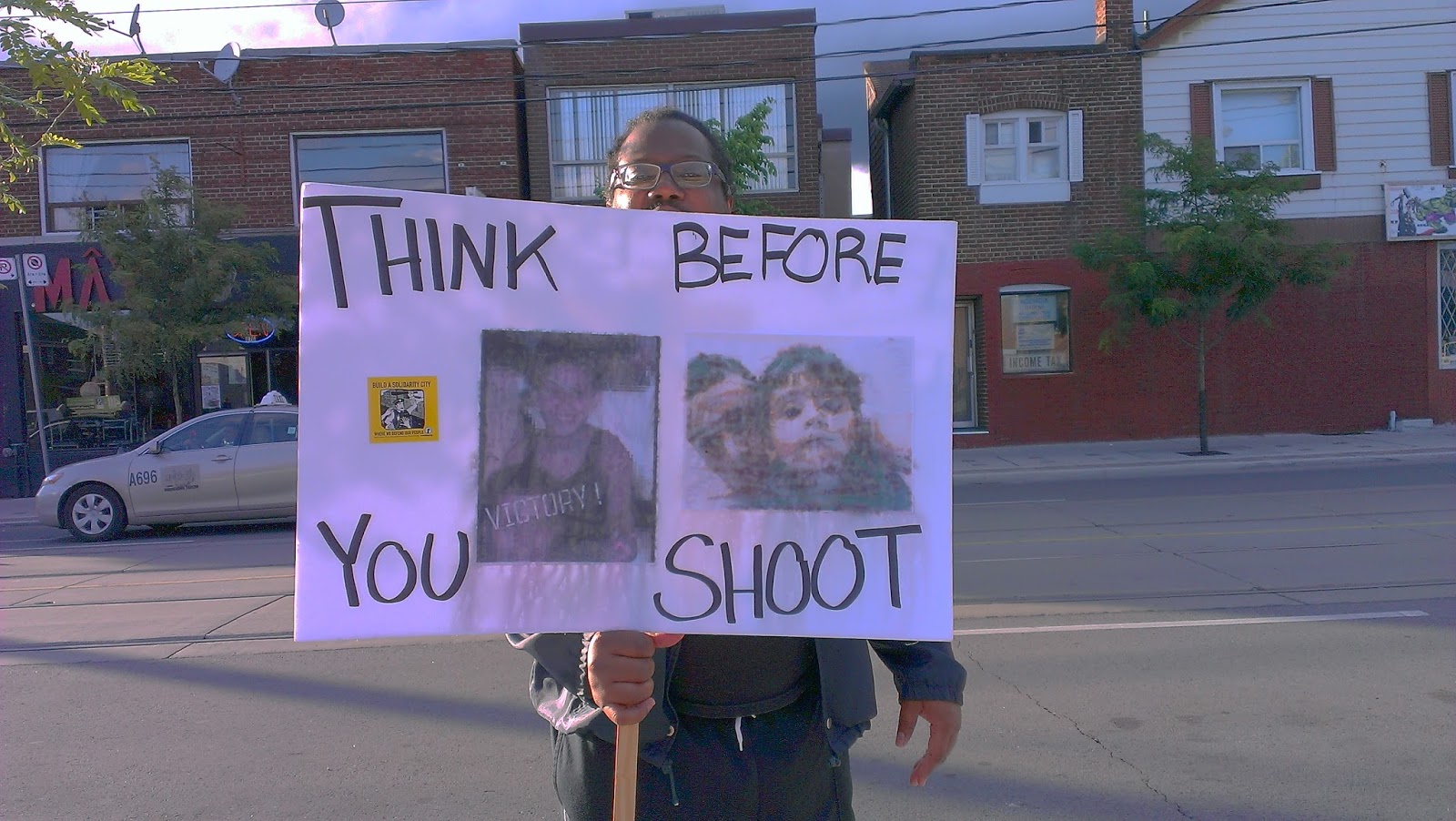
Police officers do need to think before they shoot. Police officers
do need to resort to less lethal options in the use of force continuum and
escalate only as necessary. Police officers need to de-escalate rather than
escalate situations. Those are the implications of a guilty finding in this
case on criminal liability.
It can be expected however that the the funders of Constable Forcillo's legal
team will exhaust all appeal routes to keep him from being convicted and sentence
to a lengthy term of penitentiary. A conviction and sentence to jail time will
inevitably result in the loss of his employment as a police officer.
****
In August 2013, I provided legal commentary on the Sammy Yatim homicide on a Streetcar by Police Constable James Forcillio, on CP24, CTV, CBC Television, CBC Radio, Toronto Star, Global National:
By Selwyn A. Pieters, B.A., LL.B., L.E.C. Lawyer & Notary Public (Ontario, Canada) Attorney-at-Law (Republic of Guyana, Island of Trinidad) Created August 05, 2015
I post this video taken on August 04, 2015 at the Pegasus Hotel in Georgetown Guyanaand these pictures taken one year ago in August 2014, where I experienced a problem with a roach infestation problem at the Pegasus Guyana. I expected to see much improvement in 2015, however, lo and behold, in 2015 very little has changed including customer service.
From: Selwyn Pieters
To: susan Isaacs @pegasushotelguyana.com
Cc: reservations @pegasushotelguyana.com
Date: Monday, August 03, 2015 08:02 pm
Subject: Pegasus
Good evening Susan,
I was hoping I would not have to write you this trip but I do have to. As you know I was in 2007, and I had an invasion of ants in the room. Not sure how house-keeping would have missed that. I spent Sunday and part of Monday in Berbice. When I returned Monday evening there were scores of fine ants in the room. I called down to the reception desk to relay my concerns about 4:15 p.m. I requested that housekeeping spray the room and bring a mop to mop up the ants. One hour later no one arrived. I went down to the front desk, to see the duty manager. It took a while waiting. So I left and took a walk outside the hotel. When I returned I waited for some time for the duty manager and had to return to the room since the duty manager did not come to the front desk. He arrived at 6:22 p.m. I was then moved to room 3006 shortly after 6:30 p.m.
The excuse that the on-call manager provided for no seeing me earlier was simply not acceptable. What can be more important (apart from an emergency such as a fire or robbery or medical emergency) than responding to a customer whose room is swarmed with ants?
I stayed at the Pegasus this trip because I had to old family members who I brought along on holidays and I thought this would be good. I am very disappointed.
My aunty who stayed in room 715 complained that her luggage was piflfered and belongings stolen. She was also concerned that the housekeeping staff left two bath towels in the room and showed up late almost every evening with a washclothe. It seemed very irregular to her.
This cannot be the best customer service that Pegasus can offer. It just cannot be....
Yours very truly,
Selwyn A. Pieters, B.A., LL.B., L.E.C.
Lawyer & Notary Public
By Selwyn A. Pieters, B.A., LL.B., L.E.C. Lawyer & Notary Public (Ontario, Canada) Attorney-at-Law (Republic of Guyana, Island of Trinidad) Created June 17, 2015
“Racism, and in particular anti-Black racism, is a part of our community’s psyche. A significant segment of our community holds overtly racist views. A much larger segment subconsciously operates on the basis of negative racial stereotypes. Furthermore, our institutions, including the criminal justice system, reflect and perpetuate those negative stereotypes.” R. v. Parks, (1993) 15 OR (3d) 324; 24 CR (4th) 81; 84 CCC (3d) 353; [1993] OJ No 2157 (QL); 21 WCB (2d) 121; 65 OAC 122 (Ont. C.A.), p. 369.
I am one of the leading lawyers in Ontario on the carding and racial profiling file. I therefore take this opportunity to chart my own journey in the quest for a juster justice system and the elimination of lawless law enforcement. Twenty three years after Carlton Parks decision very little has changed in respect to the lot of Black males in Toronto and Ontario in respect to our interactions with law enforcement, Courts and Tribunals. I recently litigated a carding incident of lawyering whilst Black arising out of a carding incident in a lawyers' lounge up to the Court of Appeal: Peel Law Association v. Pieters, 2013 CarswellOnt 7881, 2013 ONCA 396, 228 A.C.W.S. (3d) 204, 116 O.R. (3d) 81, 306 O.A.C. 314, 9 C.C.E.L. (4th) 233, [2013] O.J. No. 2695(Ont. C.A.) and most recently R. v. Steele 2015 CarswellOnt 3334, 2015 ONCA 169, [2015] O.J. No. 1253 (Ont. C.A.). Leave to the Supreme Court of Canada denied: R. v. Steele, 2015 CanLII 43092 (SCC).
Selwyn argued numerous case of racial profiling in Criminal Courts including: R. v. Agil, Chambers, Fullerton, Jimale and Brown 2011 CarswellOnt 18099 (Ont. CJ. July 14, 2011, Khawley J.) [Carding led to a big gun, drugs and gang case that I successfully litigated in Toronto... Project Threadbare the Judge called it because of the lack of evidence]; R. v. Steele, 2010 ONSC 233 (ON S.C.) and R. v. Egonu, 2007 CanLII 30475 (ON SC) - Driving while black and R. v. Bramwell-Cole [2010] O.J. No. 5838 (ON S.C.) - walking while black. Charges of cause disturbance and assault police can be pretextual racial profiling charges: R. v. Roach, 2005 O.J. No. 5278 (Ont. C.J.) (Criminal Law - Causing a Disturbance); R. v. Ramsaroop, 2009 CarswellOnt 5281, 2009 ONCJ 406 (Ont. CJ.); R. v. Taylor, 2010 CarswellOnt 6584, 2010 ONCJ 396, [2010] O.J. No. 3794 (Ont. CJ.).
M. (R.) was a case involving a youth 14 years old who was arrested four time by Toronto Police all based on racial profiling and improperly targeted him for arrest and detention based on Code-related grounds. He has no convictions yet was targetted, carded, arrested, detained, on several occassions. His case was fiercely litigated by Toronto Police and the reported decisions stand as a monument to the challenges litigants face in litigating racial profiling:
M. (R.) v. Toronto Police Services Board, 2013 CarswellOnt 12134, 2013 HRTO 1472
M. (R.) v. Toronto Police Services Board, 2013 CarswellOnt 11941
M. (R.) v. Toronto Police Services Board, 2013 HRTO 1102
M. (R.) v. Toronto Police Services Board, 2013 HRTO 73
M. (R.) v. Toronto Police Services Board, 2012 CarswellOnt 11158
M. (R.) v. Toronto Police Services Board, [2011] O.H.R.T.D. No. 618, 2011 HRTO 410
M. (R.) v. Toronto Police Services Board, 2011 ONCJ 143, 2011 CarswellOnt 1980, 2011 ONCJ 143, 274 C.C.C. (3d) 272 (Ont. CJ.)
M. (R.) v. Toronto Police Services Board, 2010 CarswellOnt 9121, 2010 HRTO 2349
M. (R.) v. Toronto Police Services Board was settled to the satisfaction of all parties and the terms of settlement reached remain confidential.
Carding by Toronto Police killed Dwayne Manning: Manning v. Toronto Police Services Board, 2014 HRTO 1409 (CanLII). This became one of my most difficult and challenging case. As Dwayne Manning continued to be carded and harassed his confidence was shaken and his mental health declined. He took his life in 2014.
My most satisfaction came from my face-off with three police officers who shattered my confidence in Toronto Police as an entity that respects that rights of citizens. Pieters v. Toronto Police Services Board, 2014 HRTO 1729 (CanLII). In this case, I witnessed racialized violence against two Black males and intervened. I took this case to the HRTO with no regrets.
By Selwyn A. Pieters, B.A., LL.B., L.E.C. Lawyer & Notary Public (Ontario, Canada) Attorney-at-Law (Republic of Guyana, Island of Trinidad) Created June 9, 2015
“Racism, and in particular anti-Black racism, is a part of our community’s psyche. A significant segment of our community holds overtly racist views. A much larger segment subconsciously operates on the basis of negative racial stereotypes. Furthermore, our institutions, including the criminal justice system, reflect and perpetuate those negative stereotypes.” R. v. Parks, (1993) 15 OR (3d) 324; 24 CR (4th) 81; 84 CCC (3d) 353; [1993] OJ No 2157 (QL); 21 WCB (2d) 121; 65 OAC 122 (Ont. C.A.), p. 369.
I am one of the leading lawyers in Ontario on the carding and racial profiling file. I therefore take this opportunity to chart my own journey in the quest for a juster justice system and the elimination of lawless law enforcement. Twenty three years after Carlton Parks decision very little has changed in respect to the lot of Black males in Toronto and Ontario in respect to our interactions with law enforcement, Courts and Tribunals. I recently litigated a carding incident of lawyering whilst Black arising out of a carding incident in a lawyers' lounge up to the Court of Appeal: Peel Law Association v. Pieters, 2013 CarswellOnt 7881, 2013 ONCA 396, 228 A.C.W.S. (3d) 204, 116 O.R. (3d) 81, 306 O.A.C. 314, 9 C.C.E.L. (4th) 233, [2013] O.J. No. 2695(Ont. C.A.) and most recently R. v. Steele (2015) ONCA 169 (Ont. C.A.). As well, other lawyers have also felt the brunt of racial profiling in the Black/brown skin that we are in Shallow v. Toronto (Police Services Board), 2008-00492-I, a case that was before the Human Rights Tribunal of Ontario, where a Black Crown Attorney complained about being belittled and falsely arrested because of his race: "The unspoken message to me was: lawyer, Crown, or whatever, you're still just a black guy so know your place, boy"; Bogle v. Toronto Police Services Board: On December 27, 2005, his birthdate, Jason Bogle, a 26 year old Black Lawyer, and his girlfriend, were surrounded in his Lexus vehicle shortly after he left a celebration of his birthday to take his girlfriend home. The excuse that the officers provided was that he fit the description of a suspect and that in the wake of the Boxing Day Jane Creba shooting they cannot be too careful. See also, Pieters v. Toronto Police Services Board, 2014 HRTO 1729 (CanLII). In this case, I witnessed racialized violence against two Black males and intervened. I took this case to the HRTO with no regrets.
On Sunday June 07, 2015, John Tory, Mayor of Toronto, announced that he has had a change of heart in respect to the carding of citizens by Toronto Police Service. This announcement on a Sunday evening was met with jubilation.
Obviously, the "all hand on deck" approach to this issue brought John Tory to a come to Jesus moment. However, on the ground for numerous years dealing with this issue were Jim Rankin, a reporter with the Toronto Star; Selwyn Pieters, the author, here who has litigated these case at every level of Courts in Ontario; David Tanovich who have written, taught and spoke out on this issue; the African Canadian Legal Clinic, whose advocacy and public relations on this file was sustained.
While Mayor John Tory pledge to eliminate carding, some system of accountability is required for police interactions with citizens. The provision of reasons for the stop, the issuing of receipts for police interactions and advising citizens that they are free to leave, would be a step forward.
Least we forget, the struggle to end carding involved numerous persons who paid a high price including me. Carding by Toronto Police killed my former client Dwayne Manning. I filed a Human Rights Application bases on the numerous instances Mr. Manning was carded. He continued to be harassed in Downtown Toronto by police officers. As Dwayne Manning continued to be carded and harassed his confidence was shaken and his mental health declined. Dwayne took his own life. See, Manning v. Toronto Police Services Board, 2014 HRTO 1409 (CanLII) where his case was deemed abandoned because of his death.
In a recent letter to Mark Saunders, Chief of Police, I wrote:
It is not a crime for a Black man in Jane and Finch to be in and around his neighbourhood. I live in Regent Park and I walk in my neighbourhood any hour of the day and night as that is my prerogative. I trust that you will, in your new role, reinforce to your officers that citizens have rights under The Constitution Act, 1982, Schedule B to the Canada Act 1982 (UK), 1982, c 11 (the "Charter"); Human Rights Code, R.S.O. 1990, c. H.19, as amended (the “Code”); Police Services Act, R.S.O. 1990, c. P.15 as amended. This is not North Korea.
Michael Duru's charges are set for a five day trial commencing in March 2016.
Michael Duru made a blurry video of the January 2015 interaction that went viral: http://news.nationalpost.com/2015/01/28/video-of-alleged-violent-takedown-by-officer-being-investigated-by-toronto-police/
Michael Duru video
This is my recollection of being locked out of police headquarters on November 14, 2012, when members of the African Canadian Community attended to make deputations and observe the Board's meeting on carding/racial profiling:
As a litigator who is involved in issues of racial profiling in criminal matters, civil matters and human rights applications, naturally I have an interest in the Toronto Police Service and how its policies in this area that touches on the fundamental rights of citizens in this City are shaped.
I attended the Toronto Police Services Board meeting on November 14, 2012, to be met by a wall of police officers who denied total access to persons interested in attending that meeting, most of whom were Black people. The claim the the meeting room was full was proven to be false by Televisions reports that showed empty seats. As well, it is the normal practice to stream the meeting into an overflow room.
The Chair of the Police Services Board Alok Mukerjee and the Chief of Police William Blair are responsible for this disrespectful treatment.
Lets see who were outside: John Sewell, a former mayor could not get in. African Canadian Legal Clinic Lawyer Roger Love could not get.
I could not get into police headquarters to attend this public meeting. Here I am being blocked along with Tidy Francis and Steven Mayers.
Three Black Deputants could not get in. To add injury to insult one was stopped, carded and denied access. The female Sargeant even recorded his personal information on her cellular telephone - a total violation of what a public meeting is supposedly about open access and possibly a violation of the man's privacy.
In fact even the media was prevented from entering the meeting, it took a lot of time and effort for the Canadian Broadcasting Corporation to gain entry to that public meeting. The Toronto Star also reported on the lock out of citizens who were there to make deputations.
In terms of this file, I have litigated carding and racial profiling before Courts and Tribunals on behalf of myself and numerous other people whose rights in my view were violated.
Pieters v. Department of National Revenue, 2001 CanLII 38322 (CHRT), was one of the first cases to reach a Human Rights Tribunal where the allegations of racial profiling was central to the issue. That case was settled: Pieters v. Dept of National Revenue - Minutes of Settlement T650/3801, January 30, 2002. Amongst the terms of the settlement were:
3.The Respondent agrees to provide a letter of apology to the Complainant from the Commissioner of the CCRA with respect to the comment made to the Complainant by an employee of the Respondent on May 24, 1999.
4.The Respondent undertakes that the criteria applied by Customs officers at ports of entry shall not include criteria that discriminate unlawfully on the basis of race, colour, national or ethnic origin or gender, or other prohibited grounds.
5.The Respondent, in consultation with the Canadian Human Rights Commission (CHRC) and the ACLC, will request proposals and retain an external contractor to design and implement a pilot project intended to develop statistics on referrals to secondary examination, based on race, colour, national and ethnic origin and gender of referrals in the context of all passengers passing through ports of entry. The time frame and location(s) of the pilot project will be determined by the Respondent in consultation with the external contractor, the CHRC and the ACLC. The project will also analyze, on the basis of race, colour, national or ethnic origin and gender, the impact of the criteria applied by Customs officers at ports of entry and make appropriate recommendations. The result of the pilot project will be provided to the CHRC and the ACLC, and the Respondent will consult with the CHRC and the ACLC respecting the implementation of its recommendations.
6.The pilot project will consider the collection on a permanent basis of the data described in Article 5. The Respondent will consult with the CHRC on the general purposes of any measures that may be recommended from the pilot project prior to any decision on the further collection of such data. If these data are collected on a permanent basis, CCRA shall collect and analyze such data annually and prepare a report to the Minister of National Revenue and to the CHRC, which shall be made part of the public record.
7.On or before March 1, 2002, the Respondent shall retain an anti-racism expert, external to CCRA, to provide anti-racism and cultural diversity training to all Customs officers. Each new officer shall receive this anti-racism training within 180 days of hire, and all student officers shall receive anti-racism training as part of their orientation. Refresher anti-racism training will be provided to all customs officers on a regular basis.
8.The Respondent undertakes to ensure that CCRA policy directs Customs officers to advise each person directed to secondary inspection of the reason for conducting such inspection.
9.The Commissioner of CCRA, or the Assistant Commissioner, will meet with the ACLC on an annual basis to hear the perceptions and impacts of CCRA Customs practices on racialized groups. The ACLC will bring representatives of appropriate community groups to these meetings.
Selwyn argued numerous case of racial profiling in Criminal Courts including: R. v. Agil, Chambers, Fullerton, Jimale and Brown 2011 CarswellOnt 18099 (Ont. CJ. July 14, 2011, Khawley J.) R. v. Steele, 2010 ONSC 233 (ON S.C.) and R. v. Egonu, 2007 CanLII 30475 (ON SC) - Driving while black and R. v. Bramwell-Cole [2010] O.J. No. 5838 (ON S.C.) - walking while black. Charges of cause disturbance and assault police can be pretextual racial profiling charges: R. v. Roach, 2005 O.J. No. 5278 (Ont. C.J.) (Criminal Law - Causing a Disturbance); R. v. Ramsaroop, 2009 CarswellOnt 5281, 2009 ONCJ 406 (Ont. CJ.); R. v. Taylor, 2010 CarswellOnt 6584, 2010 ONCJ 396, [2010] O.J. No. 3794 (Ont. CJ.).
At the Human Rights Tribunal of Ontario, I have litigated several significant cases, some of which I won, some of which I lost and some of which I settled through mediation.
Racial profiling and carding of Black, Brown and Aboriginal peoples in Canada makes society poor. It fosters distrust where mutual respect should exist. This observation was previous made by me on social media and attracted the following comment from Toronto criminal defence lawyer Jeffry House"
I loved yesterday's press conference in which many elite Canadians demanded an end to carding. But it raised a question in my mind: how come the head of the Human Rights Commission (for ten years) and the Chief Justice of Ontario (for 16 years) never managed to use their power to stop it? Instead, they wait till they are without official power, and resort to exhortations to others?
By Selwyn A. Pieters, B.A., LL.B., L.E.C. Lawyer & Notary Public
TORONTO -- A Human Rights Application has been filed with the Human Rights Tribunal of Ontario by Mr. Rohan Roberts alleging racial profiling by Toronto police.
The Toronto police services board, Retired Chief William Blair, Current Chief Mark Saunders, Superintendent Tony Riviere, Detective Dion Monahar, Constables Andrew Keown and Ryan D'Sena are named in the Application filed Wednesday evening by Lawyer Selwyn Pieters on behalf of Rohan Roberts.
The complaint alleges racial profiling and differential treatment in the provision of services and facilities based on race, colour, ancestry and ethnic origin contrary to sections 1 and 9 of the Human Rights Code.
The application arose as a result of a December 16, 2014 encounter in a Jane & Finch neighbourhood between Rohan Roberts and Constables Andrew Keown and Ryan D'Sena.
On Tuesday December 16th, 2014, or about 1:30 am officers The Applicant exited through a fire exit door of his apartment complex at 5 Needle Firway. As The Applicant walked along the sidewalk he observed a marked police cruiser entering his apartment complex. The Applicant observed that shortly thereafter the police cruiser turned off its lights and was following The Applicant as he walked along the parking lot of his complex.
The Respondent police officers Keown and D’Sena then drove up alongside the Applicant demanded his identification and questioned The Applicant about whether or not he had marijuana on him and/or was smoking. The Applicant responded in the negative.
The Respondent police officers Keown and D’Sena spent some time running my name through their various databases. After some time, The Applicant's identification was returned to him and he was was advised that he was free to go.
The Applicant then collected his identification and as he was walking away he stated to the officers “you guys always like to harass people.” This utterance was made by The Applicant because in his apartment complex and neighbourhood he has been subjected to numerous stops and searches by Toronto Police Officers working out of 31 Division and TAVIS.
One of the officers then said to the Applicant "what did you say to me" “You are going to shoot You Pussies?” No such utterance was made by the Applicant.
The Applicant was then rushed by the officers, arrested, handcuffed and dragged to a grassy area just outside of the door leading to the parking lot and beaten by the officers.
The Applicant had no alcohol or illicit drugs on his person at the material time, date and place. The Applicant did not consume any alcohol and/or illicit drug at the material time, date and place.
The Applicant faced trumped up charges of assault with intent to resist arrest and threatening death. The Applicant pleads that these charges which were withdrawn on April 28, 2015 on the basis that no reasonable prospect for convict exist were meant to criminalize The Applicant.
The Applicant was assaulted in the police vehicle in responding to a question as to whether he believed the Respondent officers’ conduct was racist.
The Applicant pleads the actions of Keown and D’Sena that is pleaded herein caused him injury to dignity, feelings and self-respect. The Applicant was subjected to humiliation; victimization; and was vulnerable in the face of the conduct of the Respondent officers.
The Applicant experienced a loss of dignity and self-worth that is the direct result of the infringement by the Respondents of his right to equal treatment with respect to goods, services and facilities without discrimination and/or harassment based on race, colour and ethnic origin or a combination thereof contrary to section 1 and 9 of the Human Rights Code.
Senior Toronto police officers, including the Chief, have spoken against the practice of racial profiling in the past. However, in 2014 and 2015, Toronto Police Chief William Blair and now Mark Saunders seemed unperturbed, and their comments seemed to imply that there is nothing wrong with police discriminating by skin colour. Mark Saunders referred to the persons complaining about the pernicious police practices as "collateral damage" in his first press conference as Chief of Police on April 20, 2015.
Thus, the Respondents, Police Services Board, the police administration and Keown and D'Sena, violated the Applicant's human rights in policy, practice, and effect, by engaging in racial profiling.
Officers D'Sena and Keown are also involved in another matter in the Jane & Finch area involving Black Youth Michael Duru in January 2015 that was captured on video that went viral: http://news.nationalpost.com/2015/01/28/video-of-alleged-violent-takedown-by-officer-being-investigated-by-toronto-police/
********
Selwyn A. Pieters, B.A. (Toronto), LL.B. (Osgoode), L.E.C. (U.W.I). Lawyer & Notary Public (Ontario). Attorney-at-Law (Republic of Guyana and Republic of Trinidad and Tobago).
Selwyn has appeared at all levels of courts, including the Supreme Court of Canada in Attorney General of Ontario v. Michael J. Fraser, et al., 2011 SCC 20 and Commission des droits de la personne et des droits de la jeunesse, et al. v. Bombardier Inc. (Bombardier Aerospace Training Center), et al. (2015 - decision reserved); Ontario Court of Appeal in Freeman-Maloy v. Marsden 267 D.L.R. (4th) 37, 208 O.A.C. 307 (C.A.); Bangoura v. Washington Post (2005) 202 O.A.C. 76, (2005) 17 C.P.C. (6th) 30 (Ont.C.A.), McAteer v. Canada (Attorney General) 2014 CarswellOnt 10955, 2014 ONCA 578, 121 O.R. (3d) 1, 376 D.L.R. (4th) 258 (CA) and most recently R. v. Steele (2015) ONCA 169 (Ont. C.A.); the Federal Court of Appeal in The Honourable Sinclair Stevens v. The Conservative Party of Canada, [2005] F.C.J. No. 1890, 2005 FCA 383. He represented Correctional Manager Mariann Taylor-Baptiste in the ground-breaking competing rights case of Taylor-Baptiste v. Ontario Public Service Employees Union, 2012 CarswellOnt 8965, 2012 HRTO 1393, 2012 C.L.L.C. 230-022 reconsideration denied in 2013 CarswellOnt 1033, 2013 HRTO 180, 2013 C.L.L.C. 230-019 at the HRTO; Civil Rights lawyer Charles Roach in the Oath cases of McAteer, Topey, Dror-Natan v. Canada (Attorney General) 2013 CarswellOnt 13165, 2013 ONSC 5895 (ON S.C.) and Roach et al. v. Canada 2012 CarswellOnt 7799, 2012 ONSC 352 (ON S.C.) which is a constitutional challenge to the oath in the Citizenship Act.
Selwyn has provided representation to persons charged with various criminal offenses including Drugs: Selling and Possessing, Shoplifting, Serious Offences of Violence: Aggravated Assault, Assault with a Weapon and Robbery, Gun Offences, sexual assault, robbery, theft, extortion, HIV/AIDS litigation; fraud, break & enter, attempted murder, murder, regulatory offences under the Occupational Health and Safety Act, professional disciplinary offences, and conspiracy offences.
Selwyn has also been involved in drugs, guns and gang trials including "Project Green Apple", "Project XXX" and "Project Kryptic", "Project Corral" which are some of Canada's largest Criminal Organization prosecutions. Selwyn is currently counsel for an accused in "Project Feline" and Project Revival" drug sting operations. In Project Corral, Selwyn's advocacy resulted in the "gang expert" evidence being discredited and the Criminal Organization charges against his client and others being tossed out by the Court: R. v. Agil, Chambers, Fullerton, Jimale and Brown 2011 CarswellOnt 18099 (Ont. CJ. July 14, 2011, Khawley J.)
Selwyn recently obtained an extraordinary remedy of costs agains the Crown for failure to provide disclosure of police officer memo book notes in R. v. W.(J.), [2013] O.J. No. 2284, 2013 CarswellOnt 6322, 2013 ONCJ 270 (Ont. CJ.).
Selwyn is the successful litigant in the recent racial profiling case involving carding of three Black men: Peel Law Association v. Pieters, 2013 CarswellOnt 7881, 2013 ONCA 396, 228 A.C.W.S. (3d) 204, 116 O.R. (3d) 81, 306 O.A.C. 314, 9 C.C.E.L. (4th) 233, [2013] O.J. No. 2695(Ont. C.A.).
Selwyn has provided crucial legal advise to clients duringhigh risk situations such as gun calls, hostage taking, barricaded persons, mentally disturbed persons, high risk arrests and public order control in situations where there is significant public disorder, lawlessness, personal injury and property damage. Charges of cause disturbance and assault police can be pretextual racial profiling charges: R. v. Roach, 2005 O.J. No. 5278 (Ont. C.J.) (Criminal Law - Causing a Disturbance); R. v. Ramsaroop, 2009 CarswellOnt 5281, 2009 ONCJ 406 (Ont. CJ.); R. v. Taylor, 2010 CarswellOnt 6584, 2010 ONCJ 396, [2010] O.J. No. 3794 (Ont. CJ.)
Selwyn was co-counsel in the world's first-ever sexual HIV transmission murder trial of Johnson Aziga in Hamilton, Ontario. See, for example, R. v. Aziga, 2008 CanLII 39222 (ON S.C.); R. v. Aziga; 2008 CarswellOnt 4300 (ON S.C.) and R. v. Aziga, 2008 CanLII 29780 (ON S.C.)
Selwyn argued on racial profiling includes: R. v. Steele, 2010 ONSC 233 (ON S.C.) and R. v. Egonu, 2007 CanLII 30475 (ON SC) - Driving while black and R. v. Bramwell-Cole [2010] O.J. No. 5838 (ON S.C.) - walking while black.
Selwyn has acted in exclusion cases at the Immigration and Refugee Board of Canada: See, Song Dae Ri (Re) 2003 CarswellNat 4527; (2004) 36 Imm. L.R. (3d) 203; Liang (Re) 2002 CarswellNat 4719; 33 Imm. L.R. (3d) 251.
Selwyn has appeared in Coroners' Inquest including: Coroner's Inquest into the Death of Negus Topey (May 02, 2005, Coroners' Court, Dr. K.A. Acheson) Ruling on Application for Standing; Coroner's Inquest into the Death of Dwight Haughton (Coroners' Court, Dr. Evans) Ruling on Application for Standing; Coroner's Inquest into the Death of Jeffrey Reodica(May 04, 2006, Coroners' Court, Dr. B. Porter) Ruling on Application for Standing
Selwyn also acted as co-counsel with C. Nigel Hughes for the families of three deceased persons killed during a civil demonstration in Linden, Guyana, at the Linden Commission of Inquiry. Selwyn is currently co-counsel with Brian M. Clarke representing the Guyana Trades Union Congress in the Walter Anthony Rodney Commission of Inquiry in Georgetown, Guyana.

 Lawyer & Notary Public (Ontario, Canada)