Saturday, May 11, 2013

Peel Law Association v. Royal Insurance: The Defence Costs of Litigating Racial Profiling of Pieters and Noble


By Selwyn A. Pieters, B.A., LL.B., L.E.C.
Lawyer & Notary Public (Ontario, Canada)
Attorney-at-Law (Republic of Guyana, Island of Trinidad)
Posted on May 11, 2013


My attention was brought to a recent decision in Peel Law Association v. Royal Insurance, 2013 ONSC 2312. This is a case where the insurer refused to indemnify PLA for defence costs involved in the case before the Human Rights Tribunal where Brian Noble and I were racially profiled. The Court wrote that "[5] PLA's defence costs have exceeded $116,889.41." The Tribunal awarded a modest $2000.00 for the finding of discrimination which I have returned to PLA.

The takeaway I see here is that it is certainly in everyone's interest to make their best efforts to settle human rights case given the above and in light of the high cost of the litigation for all parties were this matter to be subjected to a protected hearing on the merits.

For background information:

Noble v. Peel Law Association, 2009 CarswellOnt 3496, 2009 HRTO 805 (CanLII)  (Vice Chair B. Eyolfson); Noble v. Peel Law Association2009 CarswellOnt 1758; 2009 HRTO 357 (CanLII)  (Vice Chair K. Joaquim); Pieters v. Peel Law Association2010 CarswellOnt 9354, [2010] O.H.R.T.D. No. 2398, 2010 HRTO 2411 (CanLII) (Vice Chair E. Whist); PeelLaw Association v. Pieters2012 CarswellOnt 2026, [2012] O.J. No. 684, (2012), 288 O.A.C. 185, 2012 ONSC 1048, 213 A.C.W.S. (3d) 729 (Div. Ct.) (Chapnik, Hockin and Hoy JJ); Peel Law Association v. Royal Insurance, 2013 ONSC 2312 (CanLII) (Donohue, J.); Peel Law Assn. v. Pieters, 2012 CarswellOnt 8616 (Gillese, Epstein, Feldman JJ.A.); Peel Law Association v. Pieters, 2013 ONCA 396, [2013] 116 O.R. (3d) 812013 CarswellOnt 7881, 2013 O.J. No. 2695, 228 A.C.W.S. (3d) 204  (Cronk, Juriansz and Pepall JJ.A.)

Court rules in favour of RSA and broker after liability client demands payment for defence costs;
National Post "Dreadlock discrimination real: black lawyer’s human rights appeal told" November 19, 2012, Toronto Sun "Discrimination case tough to establish", Michele Mandel ,Toronto Sun, November 19, 2012 and Law Times, Lawyer’s racial profiling case argued at appeal court, by Yamri Taddese, December 31, 2012.

Monday, February 04, 2013

Sexist stereotypes does not deminish the importance of political expression HRTO Rules

By Selwyn A. Pieters, B.A., LL.B., L.E.C.
Lawyer & Notary Public (Ontario, Canada)
Attorney-at-Law (Republic of Guyana, Island of Trinidad)

Posted on February 4, 2013


The Reconsideration Decision of the Human Rights Tribunal in 2009-04368-I  Taylor-Baptiste v. Ontario Public Service Employees Union 2013 HRTO 180 was released by Associate Chair David A. Wright on Friday afternoon refusing to reconsider an earlier decision Taylor-Baptiste v. Ontario Public Service Employees Union, 2012 HRTO 1393. This case deals with the emerging issue of competing rights being dealt with by the Courts and Tribunal. In this case it involved sexist stereotypes of a female manager by a male union president at the Toronto Don Jail. The Tribunal found that the use of sexist or any other stereotypes does not deminish the importance of political expression.


This decision will be the subject of the great debate. However, much more than that it fundamentally affects the term of engagement for persons who are the subject of negative racist or sexist stereotypes. This decision considerably narrows the scope of rights available to aggrieved parties in the Human Rights Code.

The Applicant and the Ontario Human Rights Commission presented all the arguments that should have persuaded the Tribunal to reconsider, however, it simply determined it will not in the circumstances of this case.

Readers will be advised whether this case will be taken to Divisional Court for Judicial Review.

Saturday, January 12, 2013

Amending Pleadings at the Human Rights Tribunal of Ontario: Cadarette v. Peel Regional Police Services Board

By Selwyn A. Pieters, B.A., LL.B., L.E.C.
Lawyer & Notary Public (Ontario, Canada)
Attorney-at-Law (Republic of Guyana, Island of Trinidad)
Posted on January 12, 2012

The December 31, 2012 decision in Cadarette v. Peel Regional Police Services Board, 2012 HRTO 2411 adds significantly to the jurisprudence of amending the pleadings in Human Rights Tribunal applications and highlight the problematic issue of self - represented litigants who are not familiar with the rules on pleadings at the administrative tribunal level.

This was an application by a self-represented police constable alleging discrimination with respect to disability, sex (including sexual harassment), sexual solicitation and reprisal in employment.
The original drafted Application by the self represented litigant was described by the Tribunal described as "vague", "lacking particulars" "disjointed, not in chronological order" and "rambling".
I was retained after a series of Request for Orders were made  by the Respondents to dismiss Cadarette's Application for various reasons. As a result of my work, which involved a diligent review of various documents, other evidence and careful interviewing, a request was made to amend the Application and 71 paragraphs of proposed amended pleadings were made: "The proposed amendments, for the most part, provide particulars about the what, who, when, and where that the Tribunal requires an applicant to provide in response to Question 8 of the Application form and essentially constitute a new application."

The Respondent opposed the amendment of the pleadings and mocked the Applicant's self-represented status:
It is not sufficient, Peel submits, for the applicant to claim that she was a layperson when she filed the Application and is now represented by counsel. She is, Peel submits, is a sophisticated police officer with experience in writing reports, and the letters that she attached to her Application demonstrate her ability to raise her complaints and raise them with senior officials. It “defies reality” for the applicant to claim that she forgot or was unaware of her allegations until she was represented by counsel.
The Tribunal however, reminded the Respondents that:
 

[10] Compared with the Application and the supporting material filed by the applicant, which, as described above, is disjointed, vague, and contains very generalized allegations, the proposed amendments are specific, and set out, for the most part, time frames for the allegations.
The Tribunal then engaged in balancing the rights and interests of Applicant and Respondents:
[11] In my view, there is some unfairness to a respondent when an applicant, after having filed his or her Application and after a Response has been filed, retains counsel and counsel drafts which is essentially a new Application which cures any potential defects in the initial Application. However, in determining requests to amend applications filed under section 34 of the Code, the Tribunal generally considers the nature of the proposed amendments, the reasons for the amendments, the timing of the request to amend and the prejudice to the respondent. See Dube v. Canadian Career College, 2008 HRTO 336 (CanLII), 2008 HRTO 336; Wozenilek v. 7-Eleven Canada Inc., 2009 HRTO 926 (CanLII), 2009 HRTO 926; and Dunford v. Holiday Ford Sales, 2009 HRTO 1563 (CanLII), 2009 HRTO 1563. Further, the Tribunal has held that section 34(1) of the Code only applies to when an applicant may file an Application and not to when he or she can seek to amend an Application. See Grills v. Proctor and Gamble Inc., 2011 HRTO 2009 (CanLII), 2011 HRTO 2009 at para. 25.


Ultimately, in respect to the existence of a poisoned work environment, failure to properly investigate her matter, discrimination based on disability and reprisal actions the Tribunal allowed a significant amount of the pleadings to be amended: "1. The applicant’s request to amend her Application is allowed to include paras. 14, 15, 16, 17, 24, 30, 31, 32, 35, 38, 40, 41-63, 64-66, 67-71 and her requested remedies of the proposed amendments."


This is a complex and has resulted in several interim decisions and case management directions, some of which are reported: 


Cadarette v. Peel Regional Police Services Board, 2011 CarswellOnt 8981, 2011 HRTO 1660 (CanLII)

Cadarette v. Peel Regional Police Services Board, 2010 CarswellOnt 9355, 2010 HRTO 2399 (CanLII)


In November 2012, the Report of the Ontario Human Rights Review 2012 authored by Andrew Pinto he noted at page 45 that "Out of the 143 merits cases I analyzed, applicants were self-represented in 91 cases or 64% of the time; and respondents were self-represented in 15 cases or 10% of cases, indicating that respondents retained a representative 90% of the time for full hearings."

The take away from this complex litigation is the best couse of action when contemplating human rights litigation is to consult competent counsel from the inception - poorly drafted pleadings can be a recipe for summary hearing, claims that a prima facie case does not exist or claim that the allegations does not related to a Code-related ground.

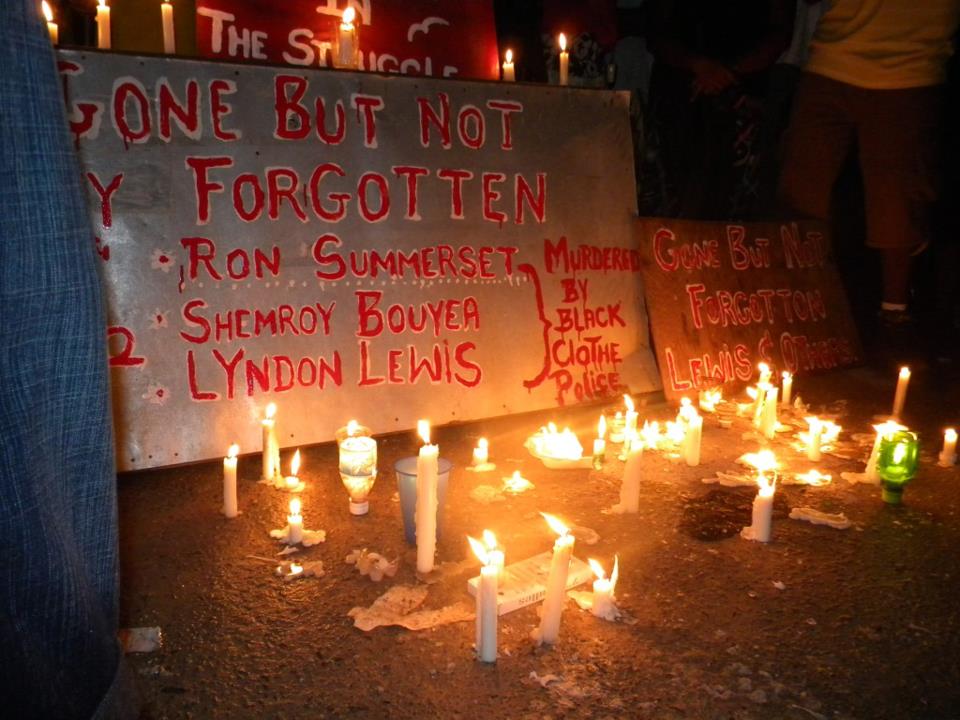
Selwyn A. Pieters, B.A. (Toronto), LL.B. (Osgoode), L.E.C. (U.W.I). Lawyer & Notary Public (Ontario). Attorney-at-Law (Republic of Guyana and Republic of Trinidad and Tobago). A significant portion of Selwyn's work involves representation of persons in human rights matters involving discrimination and harassment in the Federal and Provincial Courts and the Human Rights Tribunal of Ontario. Selwyn has appeared at all levels of courts, including the Ontario Court of Appeal in Freeman-Maloy v. Marsden 267 D.L.R. (4th) 37, 208 O.A.C. 307 (C.A.); Bangoura v. Washington Post(2005) 202 O.A.C. 76, (2005) 17 C.P.C. (6th) 30 (Ont.C.A.), the Federal Court of Appeal in The Honourable Sinclair Stevens v. The Conservative Party of Canada, [2005] F.C.J. No. 1890, 2005 FCA 383 and Supreme Court of Canada in Attorney General of Ontario v. Michael J. Fraser, et al., 2011 SCC 20. His current cases include the competing rights case of Taylor-Baptistev. Ontario Public Service Employees Union, 2012 HRTO 1393 that is at the reconsideration stage at the HRTO; Roachet al. v. Canada 2012 CarswellOnt 7799, 2012 ONSC 352 (ON S.C.) which is a constitutional challenge to the oath in the Citizenship Act. Selwyn is also acting as co-counsel for the families of three deceased persons killed during a civil demonstration in Linden, Guyana.

Wednesday, December 26, 2012

C55734 Pieters and Noble v. Peel Law Association

By Selwyn A. Pieters, B.A., LL.B., L.E.C.
Lawyer & Notary Public (Ontario, Canada)
Attorney-at-Law (Republic of Guyana, Island of Trinidad)
Posted on December 26, 2012

On December 18 and 19, 2012, a Court of Appeal panel in Ontario heard arguments in the appeal of C55734 Pieters and Noble v. Peel Law Association. Brian Noble and I was ably represented by experienced human rights lawyer Geri Sanson.

Thirteen lawyers put in appearance in the appeal on behalf of various parties. It appeared to me that most of the arguments and concerns centered on the legal concept of deference to the first level finder of facts as well as the test for discrimination.

The courtroom was packed with interested observers of the case.

It was also covered by the National Post "Dreadlock discrimination real: black lawyer’s human rights appeal told" November 19, 2012, Toronto Sun "Discrimination case tough to establish", Michele Mandel ,Toronto Sun, November 19, 2012 and Law Times, Lawyer’s racial profiling case argued at appeal court, by Yamri Taddese, December 31, 2012.

Peel Law Association v. Pieters, 2012 CarswellOnt 2026, [2012] O.J. No. 684, (2012), 288 O.A.C. 185, 2012 ONSC 1048, 213 A.C.W.S. (3d) 729 (Div. Ct.)

Noble v. Peel Law Association, 2010HRTO 2411, [2010] O.H.R.T.D. No. 2398 (HRTO)

_______________________________________________________________


Selwyn A. Pieters, B.A. (Toronto), LL.B. (Osgoode), L.E.C. (U.W.I). Lawyer & Notary Public (Ontario). Attorney-at-Law (Republic of Guyana and Republic of Trinidad and Tobago). A significant portion of Selwyn's work involves representation of persons in racial discrimination / harassment / profiling cases in the Federal and Provincial Courts  and the Human Rights Tribunal of Ontario. Selwyn has appeared at all levels of courts, including the Ontario Court of Appeal in Freeman-Maloy v. Marsden 267 D.L.R. (4th) 37, 208 O.A.C. 307 (C.A.); Bangoura v. Washington Post (2005) 202 O.A.C. 76, (2005) 17 C.P.C. (6th) 30 (Ont.C.A.), the Federal Court of Appeal in The Honourable Sinclair Stevens v. The Conservative Party of Canada, [2005] F.C.J. No. 1890, 2005 FCA 383 and Supreme Court of Canada in Attorney General of Ontario v. Michael J. Fraser, et al., 2011 SCC 20. His current cases include the competing rights case of Taylor-Baptistev. Ontario Public Service Employees Union, 2012 HRTO 1393 that is at the reconsideration stage at the HRTO; Roachet al. v. Canada 2012 CarswellOnt 7799, 2012 ONSC 352 (ON S.C.) which is a constitutional challenge to the oath in the Citizenship Act. Selwyn is also acting as co-counsel for the families of three deceased persons killed during a civil demonstration in Linden, Guyana.

Thursday, December 13, 2012

Lawyers Appeal of Racial Profiling Judicial Review Decision to be heard by the Ontario Court of Appeal: C55734 Pieters and Noble v. Peel Law Association

For Immediate Release

December 13, 2012

Lawyers Appeal of Racial Profiling Judicial Review Decision to be heard by the Ontario Court of Appeal: C55734 Pieters and Noble v. Peel Law Association

Date: Tuesday December 18, 2012

Time: 10:30 a.m.

Place: Courtroom One, Osgoode Hall, 130 Queen Street West, Toronto

On May 16, 2008, Lawyers Selwyn Pieters and Brian Noble attended with other lawyers representing the Ontario Human Rights Commission, Peel Regional Police and Dufferin Peel Catholic District School Board at the Ontario Court of Justice at the Brampton Courthouse to argue a production motion in F. (K.) v. Peel Regional Police Services Board (2008), 2008 CarswellOnt 5041, 2008 ONCJ 382, a racial profiling case involving Peel Police and the School Board. During the break in proceedings all of the parties entered the Peel Law Association Lounge to await recall by the Applications Judge.

Ms. Melissa Firth, who is a librarian/administrator with the Peel Law Association, approached Mr. Pieters, Mr. Noble and Mr. Paul Walrond (Pieters student) demanding that they identify themselves in the Brampton Courthouse’s Lawyer’s Lounge. Mr. Pieters and Mr. Walrond are Black men who have their hair in the dreadlocked hairstyle. All were dressed in business suits but not gowned as gowning is not required in the Ontario Court of Justice.


The policy of the lounge and library is only lawyers and law students are permitted to use the facilities, paralegals and members of the public are not. There were a number of other individuals in the lounge who had been unknown to the librarian at the time, including two white women (the lawyer and a Human Resources Manager from Peel Police), a racialized man who self-identified as South Asian (lawyer for the Human Rights Commission). These individuals were neither questioned nor asked to produce their identification. [1] The incident was unnecessary and humiliating. The Law Association and Ms. Firth were accused of racial profiling.

 The Human Rights Tribunal of Ontario found that Pieters and Noble rights to be free from racial discrimination were violated under the Human Rights Code in that their race and colour were factors which led to Ms. Firth’s decision to question them and affected the manner in which she questioned and interacted with them. It ordered the Peel Law Association to pay compensation of $2000.00 respectively. The Divisional Court overturned that decision ordering Pieters and Noble to pay $20,000.00 in legal costs to the Peel Law Association and Ms. Firth.

Whilst racial profiling against African Canadians, Aboriginals and other racial minorities in the provision of goods, services and facilities is widespread and pervasive, there is a dearth of racial profiling litigation in Canada.

This case is one of the first racial profiling cases that does not involved the police or other law enforcement agents or officials to be heard by the Court of Appeal.

This is a case where due to the Applicants’ status as human rights litigators they were able to identify, name, challenge and litigate racial profiling in the context of their positions as lawyers being treated differently based on race and colour.

The Court of Appeal decision in this case will be very important to the emerging jurisprudence on racial profiling from which lawyers and other Black professional are not immuned: “The legal profession has made no concerted effort to rid itself of the racism inherent in the practice.  As the evidence in this case illustrates, racialized lawyers continue to face barriers not experienced by their colleagues.” Benchers Clayton Ruby and Constance Backhouse writing in the recent Law Society of Upper Canada, Appeal Panel decision of Law Society of Upper Canada v. Selwyn Milan McSween, 2012 ONLSAP 3.
 
There are four intervenors arguing in this case:
 
Ontario Human Rights Commission,
Just Society
South Asian Law Association and
B'Nai Brith Canada

For more information, please contact:

Selwyn A. Pieters, B.A., LL.B., L.E.C.
Lawyer & Notary Public

 
- 30 -
 Resources:

Pieters v. Peel Law Association, 2010 HRTO 2411 (CanLII)2010-12-03
Human Rights Tribunal of Ontario — Ontario
lounge — personal — identification — library — racially profiled

Peel Law Association v. Pieters, 2012 ONSC 1048 (CanLII)2012-02-13
Divisional Court — Ontario
lounge — prima facie case of discrimination — library — complainants — differential treatment

Selwyn A. Pieters, B.A. (Toronto), LL.B. (Osgoode), L.E.C. (U.W.I). Lawyer & Notary Public (Ontario). Attorney-at-Law (Republic of Guyana and Republic of Trinidad and Tobago). A significant portion of Selwyn's work involves representation of persons in racial discrimination / harassment / profiling cases in the Federal and Provincial Courts and the Human Rights Tribunal of Ontario. Selwyn has appeared at all levels of courts, including the Ontario Court of Appeal in Freeman-Maloy v. Marsden 267 D.L.R. (4th) 37, 208 O.A.C. 307 (C.A.); Bangoura v. Washington Post(2005) 202 O.A.C. 76, (2005) 17 C.P.C. (6th) 30 (Ont.C.A.), the Federal Court of Appeal in The Honourable Sinclair Stevens v. The Conservative Party of Canada, [2005] F.C.J. No. 1890, 2005 FCA 383 and Supreme Court of Canada in Attorney General of Ontario v. Michael J. Fraser, et al., 2011 SCC 20. His current cases include the competing rights case of Taylor-Baptistev. Ontario Public Service Employees Union, 2012 HRTO 1393 that is at the reconsideration stage at the HRTO; Roachet al. v. Canada 2012 CarswellOnt 7799, 2012 ONSC 352 (ON S.C.) which is a constitutional challenge to the oath in the Citizenship Act. Selwyn is also acting as co-counsel for the families of three deceased persons killed during a civil demonstration in Linden, Guyana.

[1] Pieters had attended that lounge numerous times prior to 2008 including while acting as counsel in high profile cases such as the manslaughter and  criminal negligence causing death case of R. v. Cox and Klass 2005 CarswellOnt 6313 (Ont. CJ.) and the firearms case of R. v. Egonu 2007 CarswellOnt 5700 (SCJ).

Thursday, November 15, 2012

Toronto Police Services Board and The Chief of Police Denied Access to Black People at a Meeting to Discuss Racial Profiling and Carding of Black Men

By Selwyn A. Pieters, B.A., LL.B., L.E.C.
Lawyer & Notary Public (Ontario, Canada)
Attorney-at-Law (Republic of Guyana, Island of Trinidad)
Posted on November 14, 2012
 
As a litigator who is involved in issues of racial profiling in criminal matters, civil matters and human rights applications, naturally I have an interest in the Toronto Police Service and how its policies in this area that touches on the fundamental rights of citizens in this City are shaped.
 
I attended the Toronto Police Services Board meeting on November 14, 2012, to be met by a wall of police officers who denied total access to persons interested in attending that meeting, most of whom were Black people. The claim the the meeting room was full was proven to be false by Televisions reports that showed empty seats. As well, it is the normal practice to stream the meeting into an overflow room.
 
The Chair of the Police Services Board Alok Mukerjee and the Chief of Police William Blair are responsible for this disrespectful treatment.
 
Lets see who were outside: John Sewell, a former mayor could not get in. African Canadian Legal Clinic Lawyer Roger Love could not get.
 
I could not get into police headquarters to attend this public meeting. Here I am being blocked along with Tidy Francis and Steven Mayers. 
 
 
Three Black Deputants could not get in. To add injury to insult one was stopped, carded and denied access. The female Sargeant even recorded his personal information on her cellular telephone - a total violation of what a public meeting is supposedly about open access and possibly a violation of the man's privacy.
 
 
In fact even the media was prevented from entering the meeting, it took a lot of time and effort for the Canadian Broadcasting Corporation to gain entry to that public meeting. The Toronto Star also reported on the lock out of citizens who were there to make deputations.
 
The Toronto Police Services Board and the Toronto Police Service may do well to listen to the voices of the people in this city, once total public trust is lost it is hard to be regain and many countries are experiencing that phenomena with unfortunate results at all levels.
 
I wrote an email to the Chair and the Chief of Police that follows:
 
From: Selwyn Pieters
To: Alok.Mukherjee@tpsb.ca, William.Blair@torontopolice.on.ca
Cc: "Pieters, Selwyn"
Date: Wed, 14 Nov 2012 22:30:02 -0500
Subject: Racially insensitive conduct at Toronto Police Headquarters - November 14, 2012
Good evening,

It was interesting that as a public board with a meeting that was supposedly opened to the public and discussing an issue of importance to BLACK PEOPLE, i.e. racial profiling and carding of our young people, we were denied entry by armed police officers. Please advise whether as Chair of the Police Services Board together with the Chief of Police you directed your officers to deny entry to Black people at this meeting? Even speakers with deputations were denied admission at least until 2:30 p.m. when I left the premises at 40 College Street. A Picture is enclosed with the police officers blocking my entry and that of others the doors to police headquarters.

One of the Deputants a young Black male was forced to produce his id to a female Sargeant, picture enclosed. I as well, as an "Officer of the Court" vouched for his identity, as well as others to no avail. In order words, he was stopped, carded, and denied access. He was one of many who had deputations to make and were turned away.

The unwelcome conduct today at 40 College Street spoke volumes and no words needed to be spoken.

You need to take ownership for this an apologize.

Public meetings such be such and the impediment placed today on lawful access to a meeting that is ordinarily public is unacceptable.

Yours truly,

Selwyn A. Pieters
 
The Chief of Police explanation that could be found by viewing the Rogers Cable television network recording of that public meeting, unfortunately, did not accord with what took place outside the doors at police headquarters and some explanation is required for the discrepancy.
 
This is the state of affairs in the City of Toronto. Racial harassment and racial profiling is now the norm for our youth. In a speech to youth workers from the federal, municipal, provincial levels of government and private sector on November 08, 2012, I advised them of the important role they play in combatting racial profiling.
 
The widespread practice of racial profiling by the Toronto police was documented in a series of articles published in early February 2010 in the Toronto Star. Those articles may be found at http://www.thestar.com/racematters. Star reporters analyzed police data recorded from 1.5 million contact cards or field information reports on 1.1 million individuals stopped and carded by Toronto police between 2003 and 2008.  The data is from what police call `208 cards’ where police officers record the name, race, age, reason for the stop, time and date, and who the individual is with. Not everyone who is stopped is carded, but the cards record about 200,000 people stopped each year, or about one person every second shift by an officer. Analysis by the Toronto Star shows that black and brown youth are 2.5 times more likely to be stopped than white youth, three times more likely to be charged with a driving offence, and three times more likely to be held in jail rather than released.  Thus the Toronto police do not only engage in racial profiling in respect to those they stop; they also engage in racial profiling in regard to those they detain and those they charge. This is not the first time racial profiling by the Toronto police has been documented.
 
In October 2002, the Toronto Star published a series of articles alleging racial profiling within the Toronto Police Services based on extensive data they analyzed – over 500,000 incidents over a six year period.[1] In one of its analyses, the Star focused on arrests for simple drug possession (not trafficking) and how arrested individuals of different races were treated. The results? Whites were released on the scene 76.5% of the time, Blacks only 61.8% of the time. For those who were not released immediately, the difference was even more stark: Blacks were kept in jail 15.5% of the time pending a bail hearing, while Whites only 7.3% of the time. Julian Fantino, then Toronto Chief of Police, was quick to respond, "There's no racism...We do not do racial profiling."[2] Craig Bromell who was president of the Toronto Police Association echoed Fantino's beliefs and questioned how the Star had come to its conclusions.[3] Then Toronto Mayor Mel Lastman’s view was typically insightful: “Police only arrest bad guys…I don’t believe the Toronto police engage in racial profiling in any way.”[4]
 
Often times, the product of that profiling and harassment shows up in Court. In 2011, Mr. Justice Khawly found in one such recent large scale prosecution called “Project Corral” that the prosecution’s case was based on an “Elixir of suspicion, convincing rational human beings that what looks, acts and talks like suspicion magically transforms into evidence.” [5] Regardless of who commits crime there is no justification for law enforcement officers or organizations to use bias, stereotyping, or discrimination against individuals or large demographic groups of people. 
 
Racial profiling by any police service is unacceptable and all police officials have a responsibility to ensure that they treat people fairly and professionally. To target a particular race of young people for investigative purposes without reasonable and probable grounds places into question the competence of the police service on a policy level and the conduct of the officers on a personal level. "Competent policing, equals public trust."
 
This is not a Black versus White issue, whether we speak of youth who are Black, Aboriginal, Arabs, Muslim or mixed race, youth workers are at the frontline of persons involved in the receipt of information from young persons who are targeted and harassed by the police. It is therefore important that some measure of training and understanding of the regime of the Human Rights Tribunal be understood and the role youth workers can play as well.
 
It is a fundamental right of all humans and all Canadian citizens to be treated fairly, equitably and with respect by the very institutions mandated to uphold universal human rights instruments and the Canadian Charter of Rights and Freedoms
 
Postscript
 
By letter of November 23, 2012, Alok Mukherjee regretted the incident occurred. Chief Blair on the other hand shifted the reason for not letter Black people into Police Headquarters blaming it on protestors. Recall it was claimed that space capacity and fire code regulations was the issue at the material date.



[1] Rankin, Jim et al., “Singled out”. The Toronto Star. 19 October 2002.
<http://www.thestar.com/specialsections/raceandcrime/article/760539--singled-out>
[2] John Sewell, Police in Canada: The real story (Toronto: James Lorimer & Company Ltd.) at 76
[3] Ibid.
[4] Ibid.
[5] R. v. Agil, Chambers, Fullerton, Jimale and Brown (Ont. CJ. Unreported, July 14, 2011, Khawley J.), p. 8.


Friday, November 09, 2012

Moore v. British Columbia (Education), 2012 SCC 61 the locus classicus case in all jurisdictions in Canada under the various Human Rights legislation on the test for establishing a prima facie case of discrimination

By Selwyn A. Pieters, B.A., LL.B., L.E.C.
Lawyer & Notary Public (Ontario, Canada)
Attorney-at-Law (Republic of Guyana, Island of Trinidad)
Posted on November 09, 2012

On November 09, 2012, the Supreme Court of Canada in a 9-0 decision in Frederick Moore on behalf of Jeffrey P. Moore v. Her Majesty the Queen in Right of the Province of British Columbia as represented by the Ministry of Education, et al. 2012 SCC 61 that will serve as the locus classicus case in all jurisdictions in Canada under the various Human Rights legislation on the test for establishing a prima facie case of discrimination, the burden of justification on the respondent, and whether the respondent claim that I am just doing my job or acting in accordance with policy/practice insulates him/her from a finding of discrimination.
The principles are quite succinctly set out in this decision and will serve to erase all ambiguity that exist between amd amongst various lawyers, adjudicators and Court on the tests to be applied where a discrimination case is brought under the service provision sections of Human Rights Legislation. On the issue of prima facie discrimination: 

[33] As the Tribunal properly recognized, to demonstrate prima facie discrimination, complainants are required to show that they have a characteristic protected from discrimination under the Code; that they experienced an adverse impact with respect to the service; and that the protected characteristic was a factor in the adverse impact. Once a prima facie case has been established, the burden shifts to the respondent to justify the conduct or practice, within the framework of the exemptions available under human rights statutes. If it cannot be justified, discrimination will be found to occur.

 In terms of the the burden of justification on the respondent once discrimination is shown to have occurred, Madam Justice Abella wrote that: 
 
[49] The next question is whether the District’s conduct was justified. At this stage in the analysis, it must be shown that alternative approaches were investigated (British Columbia (Public Service Employee Relations Commission) v. BCGSEU, [1999] 3 S.C.R. 3 (“Meiorin”), at para. 65). The prima facie discriminatory conduct must also be “reasonably necessary” in order to accomplish a broader goal (Ontario Human Rights Commission v. Borough of Etobicoke, [1982] 1 S.C.R. 202, at p. 208; Central Okanagan School District No. 23 v. Renaud, [1992] 2 S.C.R. 970, at p. 984). In other words, an employer or service provider must show “that it could not have done anything else reasonable or practical to avoid the negative impact on the individual” (Meiorin, at para. 38; Central Alberta Dairy Pool v. Alberta (Human Rights Commission), [1990] 2 S.C.R. 489, at pp. 518-19; Council of Canadians with Disabilities v. VIA Rail Canada Inc., at para. 130).

  In terms of looking whether the respondent claim that I am just doing my job or acting in accordance with policy/practice insulates him/her from a finding of discrimination, the Court provided a helpful analysis: 
[58] …A practice is discriminatory whether it has an unjustifiably adverse impact on a single individual or systemically on several: Griggs v. Duke Power Co., 401 U.S. 424 (1971). The only difference is quantitative, that is, the number of people disadvantaged by the practice.
[59] In Canadian National Railway Co. v. Canada (Human Rights Commission), [1987] 1 S.C.R. 1114, this Court first identified ‘systemic discrimination’ by name. It defined it as “practices or attitudes that have, whether by design or impact, the effect of limiting an individual’s or a group’s right to the opportunities generally available because of attributed rather than actual characteristics” (p. 1138). Notably, however, the designation did not change the analysis. The considerations and evidence at play in a group complaint may undoubtedly differ from those in an individual complaint, but the focus is always on whether the complainant has suffered arbitrary adverse effects based on a prohibited ground.
[60] The inquiry is into whether there is discrimination, period. The question in every case is the same: does the practice result in the claimant suffering arbitrary — or unjustified — barriers on the basis of his or her membership in a protected group. Where it does, discrimination will be established.

This decision is welcome news coming from the highest court in the land given the great debate that arose in Ontario from the decision in the racial profiling in the provision of services case in Pieters et al v. Peel Law Assn. leave to appeal granted at: 2012 CarswellOnt 8616 from the decision of the Divisional Court at 2012 CarswellOnt 2026, [2012] O.J. No. 684, (2012), 288 O.A.C. 185, 2012 ONSC 1048, 213 A.C.W.S. (3d) 729 (Div. Ct.) that was in stark contrast to the decision of the Court of Appeal in Shaw v. Phipps, 2012 ONCA 155 (C.A.), also racial profiling case.  

In the Pieters case, the Divisional Court stated, at para 14:


…in order to prove a prima fascie case of discrimination, it is not sufficient for a complainant to identify himself or herself as possessing a characteristic that is protected under the Code and then to point to an incident with a negative impact on him or her.

The Divisional Court went on the say that to prove a prima fascie case of discrimination, there must be evidence to support the following findings:
a. A distinction or differential treatment;
b. Arbitrariness based on a prohibited ground;
c. A disadvantage; and
d. A causal nexus between the arbitrary distinction based on a prohibited ground and the disadvantage suffered.

In Phipps the Tribunal concluded after reviewing the evidence and hearing submissions from the parties, that "the applicant’s colour was a factor in Officer Shaw’s continued suspicion of the applicant and his decision to stop and question the applicant." This was upheld by the Court of Appeal which held that "the adjudicator did not assume discrimination, but drew an inference of discrimination from a number of different pieces of evidence".

The appeal hearing in Pieters takes place at the Ontario Court of Appeal, Courtroom One, on December 18, 2012 at 10:00 a.m.


COUNSEL FOR THE PARTIES

APPELLANT  Geri R. Sanson – S. Pieters and B. Noble
TRIBUNAL Margaret Leighton – Human Rights Tribunal
INT Anthony D. Griffin – Ontario Human Rights Commission
INT Ranjan K. Agarwal - SALCO
INT Joseph Osuji – Just Society Group
RES Mark J. Freiman - Peel Law Association
RES Lucas E. Lung - Peel Law Association


This information is provided courtesy of the Law Office of Selwyn Pieters, 181 University Ave., Suite 2200, Toronto, Ontario, M5H 3M7 Phone: 416-787-5928 Chambers: 416-601-6806 Fax: 416-787-6145 Email: selwyn @ selwynpieters  com Internet : http://www.selwynpieters.com


Thursday, October 25, 2012

The 37th anniversary and 2012 Annual Dinner Awards of The Urban Alliance on Race Relations

By Selwyn A. Pieters, B.A., LL.B., L.E.C.
Lawyer & Notary Public (Ontario, Canada)
Attorney-at-Law (Republic of Guyana, Island of Trinidad)
 
Posted below are a partial recording of the presentations of the President of the UARR and also the keynote speaker at the event:
 
Speech by Gary A. Pieters, B.A., B.Ed, M.Ed., President, Urban Alliance on Race Relations
 
Speech by Gerry McNeilly, Office of the Independent Police Review Director
 
The Late Charles C. Roach, Barrister and Solicitor was honoured with an award that was posthumously given to his surviving spouse, June Thorne-Roach.
 
 
The event was well attended by numerous members of the legal profession including Vice-Chairs and members of the Human Rights Tribunal of Ontario; Barbara Hall of the Ontario Human Rights Commission, Ian Scott of the Special Investigations Unit; Fiona Crean, Ombudsperson for the City of Toronto.
 
Professors from U of T, UOIT, Osgoode and Guelp University were also in the audience.

 
.


Monday, October 08, 2012

Images from the Commission of Inquiry into the July 18, 2012 shooting at the Wismar/McKenzie Bridge in Linden, Guyana

By Selwyn A. Pieters, B.A., LL.B., L.E.C.
Lawyer & Notary Public (Ontario, Canada)
Attorney-at-Law (Republic of Guyana, Island of Trinidad)
 
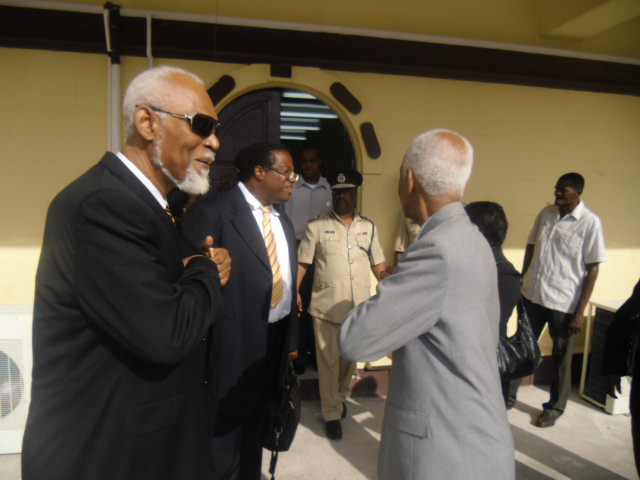
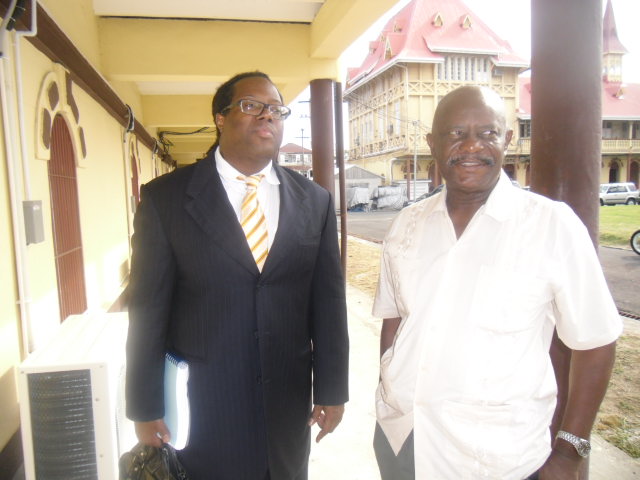
These are some of the images from the Commission of Inquiry Into Events in Linden on July 18, 2012
with Nigel Hughes

with Aubrey Norton, Winston Felix and Joseph Harmon

with K. D. Knight, Q.C. and Justice Lensley Wolfe

with Keith Desmond Knight, Q.C. and
Justice Lensley Wolfe

 with K. D. Knight, Q.C. and Justice Lensley Wolfe


With Winston Felix

Winston Felix

Shonette Adams
 
 
ASP Patrick Todd
 
Enrico Wolford


Meeting with Sharma Solomon


Senior Superintendent Clifton and Ronald Burch-Smith

Omeyana Hamilton, Nigel Hughes
Assistant Superintendent Patrick Todd being cross-examined
by Selwyn Pieters

Assistant Superintendent Patrick Todd being cross-examined
by Selwyn Pieters


Clifton Hicken on July 19, 2012