Showing posts with label special investigations unit. Show all posts

Thursday, December 26, 2019

Selwyn Pieters Litigation Year in Review 2019


By Selwyn A. Pieters B.A., LL.B., L.E.C.
Lawyer & Notary Public (Ontario, Canada)
Attorney-at-Law (Republic of Guyana, Island of Trinidad)
Pieters Law Office
Created December 25, 2019


Remembering 2019:  This was an interesting litigation year with highs, lows, speed bumps, pot holes (pun intended) and in-betweens. 

I litigated in at least 10 practice areas, delved into a new area of Securities Litigation and was an Expert in two international law matters originating from Guyana. The truth of the matter is that the cases litigated are mostly test case and fundamentally impacts society. Significantly, some of them were done pro-bono, particularly since Legal Aid or other funding were hard to come by, and some litigants cannot afford the costs of hiring a lawyer and the fees and disbursements associated with challenging the actions or omissions of public authorities particularly the police.

Overall it was a very busy year, with some significant victories. 2020 will mark my 15th year since I was called to the Ontario Bar.


Constitutional and Public law

Langenfeld v. Toronto Police Services Board et al., 2019 CarswellOnt 14511, 2019 ONCA 716, 309 A.C.W.S. (3d) 506, 437 D.L.R. (4th) 614, 55 Admin. L.R. (6th) 322, 58 C.C.L.T. (4th) 27 (ONCA). This application involves the right of individuals to attend public meetings of the Toronto Police Services Board (“TPSB”), held in the second floor auditorium of Police Headquarters in Toronto, without submitting to a search carried out with neither a warrant nor reasonable and probable grounds. The Ontario Superior Court of Justice declared that the practice of searching visitors to Police Headquarters prior to entry in the absence of a warrant or reasonable and probable grounds, as it applies to individuals wishing to attend public meetings of the TPSB, infringes s. 2(b) of the Charter and is not justified under s. 1 of the Charter because the infringement is not prescribed by law. The Court of Appeal agreed with the Superior Court that a search as a condition of entry to Police Headquarters infringed the s.2 (b) rights of individuals wishing to attend the TPSB meetings. On the s. 1 analysis, it held that the infringement was justified, as it was prescribed by law and was a reasonable limit on the s. 2(b) right. Therefore, it allowed the appeal of the Chief of Police, set aside the application judge’s order, and dismissed Mr. Langenfeld’s application. An application for leave to appeal was filed in the Supreme Court of Canada. As an aside, the reach of the Langenfeld decsions was recently explained in Canadian Broadcasting Corporation v. Ferrier 2019 ONCA 1025


I was co-counsel for Rocco Achampong in Toronto (City) v. Ontario (Attorney General) (C65861) where Justice Edward Belobaba of Ontario Superior Court of Justice overturned Bill 5, Better Local Government Act that dramatically changed the composition of City Counsel mid-way through the 2018 municipal elections. See, City of Toronto et al v. Ontario (Attorney General), 2018 ONSC 5151 stay granted Toronto (City) v. Ontario (Attorney General), 2018 ONCA 761. The appeal was heard on the merit by a five member panel of the Court of Appeal and the Court in a majority decision overturned the decision of the Superior Court and restored the status quo in favor of cutting City Council. See,Toronto (City) v. Ontario (Attorney General), 2019 ONCA 732. Mr. Achampong did not participate in the appeal. The City of Toronto has applied for leave to appeal to the Supreme Court. It is likely that we will intervene if leave is granted.

I provided an expert affidavit in Reid v. Speaker  Charrandass and AG which was cited by the Chief Justice of Guyana in her decision, that was upheld by the Caribbean Court of Justice in CharrandasPersaud v Compton Herbert Reid, Dr Barton Scotland, The Attorney General,Bharrat Jagdeo, Joseph Harmon & Guyana Elections Commission [2019] CCJ 10 (AJ). See also, High Court asked to quash no-confidence motion; says Charrandas Persaud was Canadian since 1998 - Demerara Waves Online News Guyana, January 04, 2019

Education Law/ Civil Litigation

Lam v. The University of Western Ontario Board of Governors et al., 2019 ONCA 82, 2019 CarswellOnt 1562 (ONCA) cost order Lam v. The University of Western Ontario Board of Governors et al., 2019 ONCA 185, 2019 CarswellOnt 3247 (ONCA) leave to appeal denied University of Western Ontario Board of Governors v. Simon Lam, 2019 CanLII 64826 (SCC). In this case the Court of Appeal determined that a University Student can sue for a breach of contract. The Court looked at what was signed when the student agreed to attend that university, which would contain the terms of the contract arguably and the graduate student handbook, and determined that there was an arguable case to litigate. This matter now proceeds to a trial. Another of my colleagues is handling the trial.

W.H. v. Toronto School of Theology The Student sought to appeal the termination of his registration in the Doctor of Theology Program (Program). Minutes of Settlement waived Student’s appeal rights. The Chair asked for written submissions from the parties as to whether the Academic Appeals Committee (AAC) had jurisdiction to hear the appeal. University of Toronto Academic Appeal Tribunal dismissed case holding that it has no jurisdiction.

Police Law (hybrid Human Rights)

Stanley v. Chief of Police of the Toronto Police Service, 2019 ONSC 180, 2019 CarswellOnt 65 (S.C.J.) stay of judgement pending appeal Stanley v. Office of the Independent Police Review Director 2019 CarswellOnt 13600 (ONCA). I have completed the appeal on the merits of Stanley v. OIPRD at the Ontario Court of Appeal. The decision is reserved. Essentially the Divisional Court rejected the proposition that OIPRD and a police service can have backroom conversations on substantive matters without the complainant being notified and held that “[28] As is emphasized by the name of the decision-maker, the Director of the Office of Independent Police Review was obliged to conduct an independent investigation and reach an independent decision. This independence is central to the OIPRD’s role in providing a public complaints system against police officers in Ontario: Nobody v. Ontario Civilian Police Commission, 2016 ONSC 5824 (CanLII) (Div. Ct.), at para. 49. Here, in circumstances which belie the independence of the OIPRD, the Director had undisclosed discussions with the TPS about changing his decision and, ultimately, he did change his decision.  These undisclosed communications give rise, at least, to an appearance of unfairness and compromise the independence of the Director.”

Aiken v. Ottawa Police Services Board 2019 CarswellOnt 9212, 2019 HRTO 934 (HRTO). In this case the parties sought a determination of the “data collection question” of the public interest remedy contained in the Consent and Agreement dated July 23, 2010.  The agreement was reached between the Parties and the Human Rights Commission (the “Commission”) by way of a settlement of the underlying complaint. The Commission is no longer a party to the proceedings.  The Applicant, Chad Aiken, sought an interpretation that reflects his right (and that of other persons in Ottawa) to equal treatment with respect to policing by the Ottawa Police Services (the “OPS”) without discrimination based on race.  In seeking this interpretation, the Applicant maintains its position that the data collection should be sufficiently encompassing to determine whether there is an overrepresentation of Afro-Canadians in police scrutiny. The Tribunal opined on the “critical secondary work” that is needed when data reveals a problem. It urged that “data collection is just a first step, albeit a significant one, in addressing racial disproportionalities arising from policing practices.” The HRTO strongly urged the police service to take the next steps in the process – “to identify to the best of its ability what is causing or contributing to these disparities through conducting further research, and then based on the research findings, to develop and implement specific strategies to reduce and hopefully eliminate these disparities.” paras 130, 132. The Tribunal felt that Ottawa Police went way beyond what was called for in the 2012 Memorandum of Settlement and agreement.

I currently sit on four technical tables convened by the Ministry of the Solicitor General to create standards for the implementation of the Comprehensive Ontario Police Services Act, 2019, S.O. 2019, c. 1.

I also attended community meetings in Regent Park on collecting statistics and the roll out of the new neighborhood policing model. 


Securities Law / Quasi Criminal

R. v. W. W. 2019 CarswellOnt 18822 (O.C.J.) - On January 21, 2019, Mr. W. pleaded guilty to one count of trading in securities while prohibited contrary to s. 122(1)(c) of the Ontario Securities Act. The OSC Prosecutors were seeking 12 months as a joint position, 15 to 16 months as an open position, 2 years less a day on conviction after trial, and two years probation, in any event, on terms that would prohibit Mr. W. from working in securities or any related businesses. Justice Malcolm McLeod of the Ontario Court of Justice was not convinced that a higher sentence was required as there was no fraud involved, it was not a boiler room scam and neither was there any investor losses. Reviewing existing caselaw, Justice McLeod found that harsher sentences were usually reserved for offenders facing similar charges in cases involving boiler room scams and significant investor losses. The court made it clear that no such factors were present in Mr. Weber’s case and such absence of ordinarily aggravating factors cannot be used to drive up the sentence. Taking guidance from existing precedents, Justice McLeod refused to accept the OSC’s arguments for a higher sentence in the range of 15-18 months. Mr. W. was sentenced to a 90-days intermittent sentence to be served on weekends and two years probation. OSC has appealed the sentence and a hearing of the appeal has been set for May 25, 2020.

R. v. W.W. 2019 CarswellOnt 14097 (O.C.J.) Mr. W. brought an application to strike his guilty plea on the basis that it was not voluntary, informed and unequivocal. The motion to strike the guilty plea was dismissed. The matter thereafter proceeded to the sentencing phase.

Criminal Law

R. v. M.B. 2019 CarswellOnt 10207 (O.C.J.). M.B. was a residential support worker employed at children’s residence that housed individuals with developmental, emotional, psychiatric and behavioural challenges. She was alleged to have assaulted 11-year old complainant on six occasions.  A third-party record application was filed. Records were produced for review by judge, who concluded that some of records were likely relevant. Copies of were produced. Record was not to be used in any other proceeding except with authorization of court order. M.B. matter proceeded to trial and she was acquitted of all charges.

R. v. B.L. (O.C.J.). Mr. L. was charged with six counts of assault, one count of assault with a weapon and one count of utter threat to cause death. He pled guilty to two counts of assault and was given a conditional discharge with probation. The Crown sought a DNA Order for this secondary designated offence. Submissions were made that the state’s interest in obtaining the offender’s DNA profile is premised on the serious nature of both primary and secondary designated offences making the order one that will advance the state’s objectives of:[1]
a)     deterring potential repeat offenders (i.e. specific deterrence);
b)     promoting the safety of the community;
c)     detecting/identifying/prosecuting the offence upon re-offending;
d)     assisting in the solving of "cold" crimes;
e)     streamline investigations; and
f)      protecting the innocent by eliminating suspects and exonerating the wrongfully convicted.

Mr. Justice Stephen Brown accepted and adopted my written submissions: "I have read Mr. Pieters' very thorough written submissions on this matter and they are set out in paragraph 28 to 39 on his written submissions which I am going to file…. And I adopt them in their entirety.". The Crown’s request for an Order to collect Mr. B.L. DNA was denied.

Human Rights Law

Khan v. Ontario (Community Safety and Correctional Services) 2019 HRTO 357, 2019 CarswellOnt 2769 (HRTO). In this case, the applicant filed an Application alleging discrimination because of race, colour, ancestry, ethnic origin, disability and reprisal contrary to the Human Rights Code, R.S.O. 1990, c. H.19, as amended (the “Code”). Specifically, among other things the applicant alleges that the respondents have discriminated and reprised against her in how hours at the workplace have been scheduled.   In addition to filing this Application, the applicant filed a grievance with her union regarding the way in which hours are scheduled. The grievance alleges that there is favouritism in the awarding of overtime hours. She seeks “full redress”. The Tribunal deferred the matter. The applicant subsequently withdrew her grievances and the matter is proceeding through the HRTO processes.

2015-20752-I; 2015-20753-I; 2015-20754-I Stanley v. Toronto Police Services Board.  The applicant filed three Applications, one on behalf of each of her three sons (the “claimants”). In the Applications, she alleged that the respondents discriminated against the claimants because of race, colour, ancestry, place of origin, ethnic origin and age contrary to the Human Rights Code, R.S.O. c. H. 19, as amended (the “Code”). The Application arose out of a raid of the applicant’s home carried out by Toronto Police officers in April 2014. The Applicant alleged that the officers’ conduct was fuelled by stereotypical assumptions about young black males and their propensity to commit criminal offences and to act violently. In addition to filing the Applications, the applicant filed a complaint to the OIPRD alleging misconduct on the part of the police officers involved in the raid. See, above section on Police law. This Human Rights matter came before the Tribunal in 2019 and has now been completed.

HRTO File 2019-37512-I - S.A. by litigation guardian A. A. v TPSB, et al. This case revolves around the encounter between a group of racialized youths in Regent Park and Toronto Police Officers who followed them over several blocks and then pretextually ticketed them at a traffic light (crossing on a red light) to collect intelligence in 51 Division. A human Rights complaint was filed in June 2019 This case will be a test on how far the Human Rights Tribunal is willing to go to make orders dealing with Walking Whilst Black situations. A youtube video of part of the encounter is available.

HRTO File 2018-33829-I JC v The Regional Municipality of Peel Police Services Board et al involves a complaint filed by a Black youth concerning his experience with Peel Police. On August 25, 2017, in Brampton, Ontario, J.C. was arrested by Peel Police and criminally charged for assaulting a police officer.  Those criminal charges were later withdrawn.  At the time of his arrest, J.C. was a young person under the Youth Criminal Justice Act, S.C. 2002, C.1 (“YCJA”).  He subsequently commenced an application (“Human Rights Application”) before the Human Rights Tribunal of Ontario (“HRTO”) alleging that the Peel Regional Police Services Board, Jennifer Evans, David Oxley, Jarrett Curtis, Alexander Scott-Krawczyk and Gary Mackin (collectively, “Peel Police”) discriminated against J.C. on numerous grounds including race.  A Judge of the Ontario Court of Justice recently granted an Order with respect to the use the parties can make of the file in the criminal proceedings. The matter is likely to be heavily litigated in 2020.

Harrower v. Ontario 2019 CarswellOnt 14680 (HRTO) – The applicant suffers from Arthrogryposis Multiplex Congenita (AMC), a congenital joint contracture condition, as well as several other conditions including Chronic Obstructive Pulmonary Disorder (COPD) and Celiac Disease. In addition to his disabilities and illnesses, of which he needs immediate and urgent relief of his symptoms, Ken has limited funds making the OCS system unreasonable and flawed. As a result of his COPD condition, Ken is unable to smoke cannabis and must either eat cannabis in edible form or eat raw cannabis itself. Given his disabilities, he is unable to work full-time, making him reliant on the Ontario Disability Support Program where he receives very limited funds that do not adequately cover his day-to-day expenses. Ken has a prescription for medical cannabis under Access to Cannabis for Medical Purposes Regulation. Ken filed a Human Rights challenge against The Attorney General of Ontario, The Office of the Premier of Ontario and The Toronto Police Service citing that the current cannabis retail system launched by the Government of Ontario –  the Ontario Cannabis Store (OCS) – is flawed and discriminatory against people with disabilities and limited financial means.  Tribunal directed combined summary/preliminary hearing.  Tribunal would determine whether complaint had reasonable prospect of succeeding. Parties could make submissions regarding whether complaint should be dismissed on basis medical cannabis was unconnected to jurisdiction of Ontario.

2017-28096-I Walkes v. Reids Heritage Homes the Tribunal heard evidence on whether an expert affidavit from J David Hulchanski, PhD will be accepted into evidence and the expert qualified to provide evidence in this housing discrimination case. Dr. Hulchanski posited that “Given that the Black population of the region Fergus is part of is 526,000 (5.8% of the GGH, Table 1) researchers are correct to wonder what are the odds of an exceptionally small Black population of Fergus occurring and maintaining itself ‘naturally,’ and for so long (as of 2016), given the extensive ethnocultural diversity of the Toronto region, and much of Ontario and Canada? How is it that Fergus with 20,400 people, 8,150 households, in a county that has 3,300 Black residents, has a Black population of 100? These facts, given that they are from 2016, would alert most researchers to consider residential discrimination, in the form of racial steering and racial exclusion, as part of the explanation.” The decision in respect to this discrete issue is reserved.

In the international law arena, I was engaged as a local expert for the World Bank Group’s Women, Business and the Law project in their Violence against Women survey for Guyana. My contribution was reported in the Law Times, Canadian lawyer helps with World Bank project on women and the law, October 21, 2019. 


Licencing / Professional Regulation

11724 v. Director, Child, Youth and Family Services Act 2019 CarswellOnt 2389, 2019 CanLII 29112 (ON LAT). The appellant operated a children’s residence in Ottawa, Ontario. It appealed the respondent’s Proposal to Revoke a Licence (the Proposal) pursuant to s. 236(1) and s. 264(2) of the Child, Youth and Family Services Act, 2017. This decision dealt with a request to seal part of the hearing and its records. The Tribunal considered the openness principle as set out in Toronto Star v. AG Ontario, 2018 ONSC 2586 (ONSC). The appellants voluntarily surrendered their licence. Two days of evidence was heard in Ottawa.

Inquests

Ekamba, Re 2019 CarswellOnt 9640. Mr. Ekamba was fatally shot by Peel Regional Police officers who were responding to a complaint. During the incident, a stray police bullet struck Ms. Susan Zreik, who had not been involved and was in her apartment. Ms. Zreik was transported to hospital, underwent surgery for the bullet wound, and survived the injury. Mr. Ekamba’s death was investigated by the Special Investigations Unit. At the conclusion of its investigation, the SIU did not lay criminal charges against the involved officers. One of the main issues in the inquest is the intersection of race and mental health and what role it had in this case. The Inquest has been scheduled for three weeks commencing May 11, 2020. I will be counsel for Black Action Defence Committee.

Cannabis Law

This was a busy year litigating cannabis cases on many fronts. The advocacy was in the Courts and on the streets. Toronto Police Services conducted major operations resulting in the arrest and prosecution of hundreds of young bud tenders.

Toronto Police Service Drug Squad launched Project Buffet in which charges were laid of conspire to commit an indictable offence: to wit, distribution of cannabis, contrary to subsection 10(1) of the Cannabis Act, thereby committing an offence contrary to subsection 465(1)(c) of the Criminal Code and Possession of property obtained by crime: to wit, currency derived from drug trafficking, contrary to section 354(1) of the Criminal Code against numerous persons. On some days I was running bail hearing for 15 persons held for show cause hearings. These matters are making their way through the Courts.

Sale or distribution by non-authorized cannabis retailer or permitted by landlord (ss.6, 7, 13 and 23 of the CCA). For charges od sale of cannabis under s. 6 of the CCA, Ontario Attorney General disposed of over 100 cases with the use of fines of $500.00 and stays of some of the charges. The City of Toronto prosecution asked for $1000.00 and one-year probation, for the budtenders.
Concrete blocks were used to shutter dispensaries. In one instance which prompted a hasty change in the law, I forced the City of Toronto By-law enforcement to re-open a location in which a tenant was locked out of his unit.

The law was amended to remove the provision where a building remained open if residential tenants resided on the property. We litigated the change of the legislation in Brodie v. Attorney General of Ontario, 2019 ONSC 5735. Unfortunately, the application judge did not allow interim access to the premises pending the determination of the constitutional issues.

Law enforcement inclusive of the police engaged in aggressive enforcement in relation to cannabis under the governing federal and provincial statutes, namely, the Criminal Code, Cannabis Act and the Cannabis Control Act, 2017 (CCA) which came into force on October 17, 2018 in Ontario.
The unlicensed cannabis market has and continue to meet a demand unmet by the current regulatory regime. In this regard, there because intense enforcement action by the City of Toronto and Toronto Police to shut down the unlicensed.

The Cannabis Retail Store Allocation Lottery became a farce and has been the subject of litigation. 104 Harbord Street, the location of a series of raids, actually won one of the spots in the lottery.
The Province recently announced that the laws will be amended to open the markets. In the meantime, hundreds of criminal matters and CCA matters are clogging up the Court’s dockets and wasting precious judicial, public and private resources because of a series of costly missteps on the part of the government and regulators.

I have won two different awards in 2019 for my work on law reform and advocacy in this area.
Cases will be litigated in 2020 on the Constitutional, human rights, criminal/quasi criminal and administrative law front on the cannabis files. It will be interesting to see how the judiciary wrestle with these matters.


[1] R. v. F.(P.R.), 2001 CarswellOnt 4566 (C.A.),  at paras 17-18.

Tuesday, January 26, 2016

R v. Constable James Forcillo - Is the judgement a licence to kill?


By Selwyn A. Pieters, B.A., LL.B., L.E.C.
Lawyer & Notary Public (Ontario, Canada)
Attorney-at-Law (Republic of Guyana, Island of Trinidad)
 
Pieters at the site
where Yatim was gunned down
On July 27, 2013, Constable James Forcillo a member of the Toronto Police Service, together with several police officers converged on a streetcar that was stopped at Dundas Street and Bellwoods Avenue, in response to an emergency alarm from the Toronto Transit Operator who was driving the 505 streetcar. Yatim was alone in the streetcar having allegedly threatened passengers who were sitting in close proximity to him.

Forcillo issued expletive laden commands to Yatim. Yatim responded with his own expletive laden words. Forcillo fired three shots at Yatim as he allegedly made a step forward on the streetcar in disobedience to Forcello's command.  That pathology report stated that the shots fired in this volley killed Yatim. That is not the end of the story. Whilst Yatim fell on the floor of the streetcar and was dying, Constable Forcillo fired six more shots at Yatim. The six shots were not lethal.

Constable Forcillo was arraigned before the Jury and tried for the following offences:
1) Second degree murder;
2) Manslaughter;
3)Attempted murder
4) Aggravated assault.

The first two charges relates to the first volley of three rounds fired at Sammy Yatim on the streetcar whilst he was close to the streetcar door with a knife in his hands. The third and fourth charges relate to the six shots fired after a pause and during the time that Yatim lay helpless on the floor of the streetcar dying.

On January 25, 2015, Constable James Forcillo was found guilty by a eleven (11) member mixed jury in a Superior Court Trial presided over by  The Honourable Edward F. Then.

The defence in this case raised the justification for the use of force under section 25 of the Criminal Code and self-defence  under section 34 of the Criminal Code. From all appearance the jury accepted the defence contention that there was some doubt that Forcillo's conduct amounted to second degree murder and/or manslaughter.

The jury however accepted the Crown's contention that Forcillo's conduct beyond a reasonable doubt established the specific intent offence of attempted murder. Constable Forcillo therefore was found to have intended to kill Yatim when he fired the six second volley of shots that were not lethal.

In R. v. McArthur, 2004 CanLII 8759, 182 CCC (3d) 230; 19 CR (6th) 38; [2004] OJ No 721 (QL); 184 OAC 108 (ON CA), <http://canlii.ca/t/1gk4v>, Doherty J.A. explains that:
47. Under our law, a person can only be convicted of attempted murder if he or she intended to kill. The moral culpability of the attempted murderer is at least equal to that of a murderer. He or she avoids a murder conviction and the automatic sentence of life imprisonment not because of any mitigating factor, but because through good fortune, the victim was not killed.

48. A conviction for attempted murder will almost inevitably result in a lengthy penitentiary term...

In Ontario, it is rare that police officers who has shot citizens whilst in the line of duty are convicted. In this case, the Crown's strategy to charge on second degree murder was criticized as an overcharge for which conviction by a jury would be a "herculean task". On the other hand, the Crown's splitting the conduct of Constable Forcillo into two distinct component resulted in accountability and the resulting criminal liability with the finding of guilt.

It is reported that Constable Forcillo will be seeking a stay of the proceedings prior to sentencing the principal basis is that he cannot be convicted of a crime when the very basis of the crime is the training he received as a police officer. A state actor raising argument that he is not deserving of a convicting whilst acting on behalf of the state and in the course of his duties as the premise of a stay application is quite novel. However, a stay is an exceptional remedy that is rarely granted. So there is little to no reason to believe this argument will prevail.

Sage advise
In this criminal prosecution the objective video and audio evidence, the testimony of numerous eye witnesses and the pathology report made a different. The finding of guilt, in my view, makes it clear that a badge, gun and state power is not a licence to kill. Police officers are required to exercise sound judgment, mental discipline and respect the right to life, even when dealing with encounters that could potentially be violent.

The reaction to the verdict on television and on social media, particularly twitter, was stark and contrasting:

Toronto Police Association President Mr. Mike McCormack expressed his disappointment, stated that the verdict created a chill and that a stay will be sought on the basis that Constable Forcillo acted consistent with his training.
Toronto Police Service Chief Mark Saunders, was combative and surly in his presser. He contradictory to Mike McCormack, praised the superior system of training that Toronto Police has for its officers. He refused to answer some of the questions posed to him by journalists. He announced that Forcillo would be suspended with pay pending the outcome of the criminal justice process.
Julian Falconer, counsel to the mother of Sammy Yatim, triumphantly thundered that the era of police impunity has come to an end. No longer is the police word against a hapless citizen’s but the police evidence not has to be squared against objective video and photographic evidence and its credibility is assessed on that basis.
Jeff Hershberg ‏@LawyerToronto  Criminal Defence Lawyer “The police often tout video surveillance as amazing and proves guilt. When posted online in #Forcillo case, it's trial by YouTube.”
Chris Marriott ‏@chrismarriott  “The absurdity of Canadian "Justice": Convicted of attempted murder when you're on video actually committing murder.”
Wendy Gillis, Journalist “No matter which way #Forcillo decision goes, verdict is hugely significant for police accountability, police use of force & video evidence.”
Desmond Cole ‏@DesmondCole  “Every day, people who work with the public de-escalate dangerous situations without guns, without killing.”
Andray ‏@AndrayDomise  “If anything is "chilling" about any of this, it's what the mouthpiece of TO officers just told us about their mindset.”

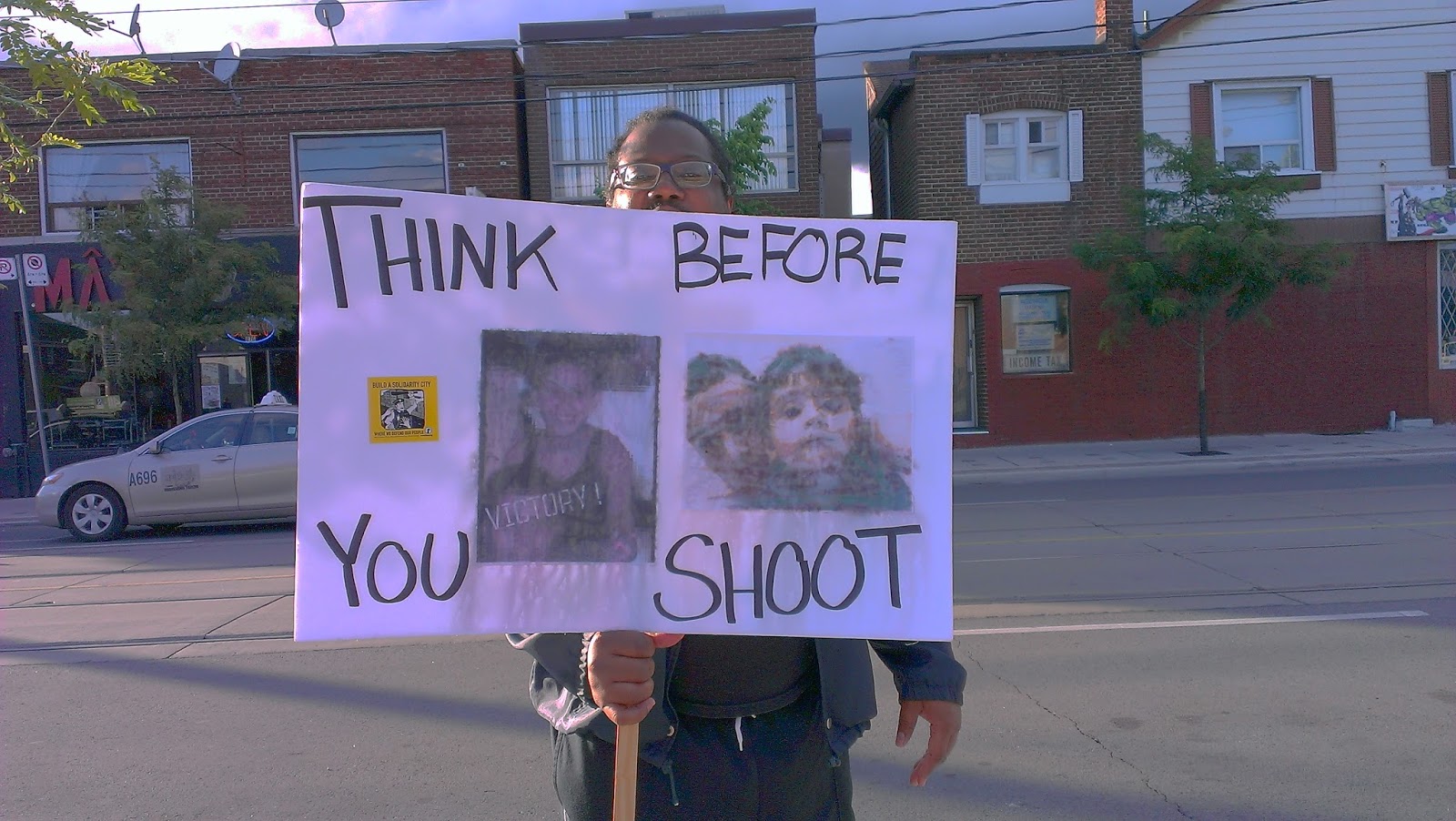
Police officers do need to think before they shoot. Police officers do need to resort to less lethal options in the use of force continuum and escalate only as necessary. Police officers need to de-escalate rather than escalate situations. Those are the implications of a guilty finding in this case on criminal liability.

It can be expected however that the the funders of Constable Forcillo's legal team will exhaust all appeal routes to keep him from being convicted and sentence to a lengthy term of penitentiary. A conviction and sentence to jail time will inevitably result in the loss of his employment as a police officer.

****

In August 2013, I provided legal commentary on the Sammy Yatim homicide on a Streetcar by Police Constable James Forcillio, on CP24, CTV, CBC Television, CBC Radio, Toronto Star, Global National: 

CBC, The National" Police officer gets bail in Sammy Yatim shooting" August 21, 2013; 

L'heure du monde - Relations difficiles entre les citoyens et la police de Toronto avec K. Djinko August 21, 2013; 


Toronto Star "James Forcillo: An explanation of the bail processAugust 20, 2013; 


Related Research...
Andre Marin's Investigation
MICHAEL ELIGON

Coroners Inquest


Public Statement from the Father of Michael Eligon Jr.

SIU REPORT

Video SHOOTING OF MICHAEL ELIGONhttp://www.thestar.com/news/crime/article/1140015--police-shooting-of-michael-eligon-a-timeline

Doug Pritchard Eye-witness Account Interview regarding the Police Killing Of Michael Eligon
(Very good verbal re-inactment)
http://vimeo.com/40549621

Media Report on SIU Director's decision regarding Eligon... Mentions TASERS...
http://www.zuza.com/news-story/75948-siu-clears-police-officer-in-shooting-of-michael-eligon/

Greiving Father hopes Truth will come out...
Andre Marin Slams SIU

Rogers TV Coverage of Police Service Board meeting
http://www.rogerstv.com/page.aspx?lid=237&rid=16&gid=95147 
Reuben Abib - BADC Deputation by Reuben Abib begins around the 1hr:33min mark...


Saturday, December 27, 2014

Review of my more important, challenging and interesting cases in 2014

By Selwyn A. Pieters, B.A., LL.B., L.E.C.
Lawyer & Notary Public (Ontario, Canada)
Attorney-at-Law (Republic of Guyana, Island of Trinidad)
Posted on December 27, 2014
Updated on December 29, 2014

This is a review of my year of litigation. In 2014 my journey through litigation took my through several practice areas including education law, human rights, police law, criminal law, civil litigation, administrative, constitutional and public law. I won some, I lost some, I resolved some and other cases were litigated on principles so that whether lost or won, the important issue was the principle and standing up for justice.

Constitutional and Public law

I was involved as co-counsel at the Ontario Court of Appeal in McAteer v. Canada (Attorney General), 2014 CarswellOnt 10955, 2014 ONCA 578, 121 O.R. (3d) 1, 242 A.C.W.S. (3d) 772, 27 Imm. L.R. (4th) 216, 376 D.L.R. (4th) 258 affirming McAteer, Topey, Dror-Natan v. Canada (Attorney General)  2013 CarswellOnt 13165, 290 C.R.R. (2d) 332, 20 Imm. L.R. (4th) 121, 117 O.R. (3d) 353, 2013 ONSC 5895, E.M. Morgan J. (Ont. S.C.J.). See also Roach et al. v. Canada 2012 CarswellOnt 7799, 2012 ONSC 3521 (ON S.C.). 
Leave to Appeal has been sought at the Supreme Court of Canada. The applicants' position are the Oath to the Queen in the Citizenship Act violates sections 2(a) and (b) Charter of Rights and Freedoms and cannot be saved by section 1. 

Leave to Appeal was granted by the Ontario Court of Appeal in the case of  Taylor-Baptiste v. Ontario Public Service Employees Union, 2014 ONSC 2169 (Div. Ct.) and Taylor-Baptiste v. Ontario Public Service Employees Union et al, 2014 ONSC 5218 (costs). Counsel at the Court of Appeal and Divisional Court are Ranjan Agarwal and Amanda McLaughlin of Bennet Jones. At the Human Rights Tribunal I represented Correctional Manager Mariann Taylor-Baptiste in the ground-breaking competing rights case of Taylor-Baptiste v. Ontario Public Service Employees Union, 2012 CarswellOnt 8965, 2012 HRTO 1393, 2012 C.L.L.C. 230-022 reconsideration denied in 2013 CarswellOnt 1033, 2013 HRTO 180, 2013 C.L.L.C. 230-019 at the HRTO.

Human Rights Law


On October 16, 2014, Mr. Justice Wagner of the Supreme Court of Canada granted the Center for Research-Action on Race Relations leave to intervene in Commission des droits de la personne et des droits de la jeunesse, et al. v. Bombardier Inc. (Bombardier Aerospace Training Center), et al. (Quebec) (Civil) (By Leave). This case has interesting parallels to Peel Law Association v. Pieters, 2013 CarswellOnt 7881, 2013 ONCA 396, 228 A.C.W.S. (3d) 204, 116 O.R. (3d) 81, 306 O.A.C. 314, 9 C.C.E.L. (4th) 233, [2013] O.J. No. 2695. I am co-counsel with a Quebec Lawyer Aymar Missikala. In our written arguments we take the position that: 
18 . Since the Ontario Court of Appeal in Pieters expressly repudiates the unacceptable notion of a "causal nexus" in proving discrimination and profiling, CRARR submits that the Supreme Court has a historic opportunity, with this appeal, to end the more formalistic and restrictive civilist "causal link" test as retained by the Court of Appeal of Quebec that directly reverts to the rejected and rigid intent-based conception of discrimination.
19. The objective is not to set in motion a collision between the Quebec Civil Code and Quebec's civilist tradition with the constantly evolving dimensions of the Canadian Charter of Rights and Freedoms and the common-Iaw tradition on equality in particular, but rather to create a more perfect harmony between the two dominant legal cultures in Canada in order to provide more effective and equal protection to victims of race and other discrimination, be they in Quebec or in the rest of Canada, and be they French-speaking or English-speaking.  
Oral arguments are being heard on January 23, 2015.

Another significant case litigated in 2014 was an employment discrimination case Patterson v. Toronto District School Board. This was an application that alleged discrimination in employment on the basis of age, race, ancestry, colour and association with a person identified by a Code ground. The applicant has also alleged that he experienced reprisal or the threat of reprisal. The case generated several reported decisions including:
  • Patterson v. Toronto District School Board, 2014 HRTO 635 (Series of events)
  • Patterson v. Toronto District School Board, 2014 CarswellOnt 713 (Recording hearing)
  • Patterson v. Toronto District School Board, 2014 CarswellOnt 454, 2014 HRTO 66 (Productions - Disclosure of documents)
  • Patterson v. Toronto District School Board, 2014 CarswellOnt 446 (further - disclosure)
  • Patterson v. Toronto District School Board, 2014 CarswellOnt 238 (the Request sought statistical data: with respect to the racial makeup of the senior management levels of the respondent Board; the number of Black Principals in the Qualified Applicant Pool and the racial makeup of the “Senior Team”. In addition the applicant seeks particulars of some element of the respondents’ response.)
  • Patterson v. Toronto District School Board, 2014 CarswellOnt 83 - (witnesses - will-say)
I have completed hearings on the merits in Lewis v. Toronto Transit Commission. Mr. Lewis, an African-Canadian male, filed an Application under section 34 of Part IV of the Human Rights Code, R.S.O. 1990, c. H.19, as amended, alleging discrimination with respect to employment because of race, colour, place of origin and reprisal. The decision is reserved.

Police Law (hybrid Human Rights)


In Afzal v. Regional Municipality of Peel Police Services Board 2014 CarswellOnt 10803, 2014 HRTO 1200, [2014] O.H.R.T.D. No. 1210.  The applicant who was self-represented filed an Application under s. 34 of the Human Rights Code, alleging discrimination with respect to employment because of race, colour, place or origin, ethnic origin. He leter retained counsel to assist him with the process. At that point better pleading were drafted and amendments were opposed by the organizational and personal respondents. The Tribunal Ruled that "
[15] Having considered these factors, I grant the applicant’s request to amend the Application but only in part. At the outset, I note that the applicant’s request to amend his Application was made at an early stage of proceedings. Although the respondents have each filed Responses, no hearing has been scheduled and no disclosure has yet been made. This factor would generally weigh in favour of granting the applicant’s amendment request." I was able to provide better pleadings for a police officer who alleged that he has been subjected to discrimination and/or retaliation by Supervisors. See also, Afzal and Peel (Regional Municipality) Police Services Board, Re 2014 CarswellOnt 9011. 

Emms v. Waterloo Police Services Board - Tribunal File: 2013-14928-I - This was an application where a police officer alleged discrimination against her in employment on the basis of sex and disability contrary to sections 5(1), 7(2), 7(3)(a), (b), and 9 of the Human Rights Code. The application also alleged that the employer took retaliatory action against her in contravention of section 8 of the Code.

I also had the opportunity to litigate Clarke, Clarke and McDonald v HMQ (CSCS) - Tribunal File Nos. 2013-15247-I, 2013-15248-I, 2013-15496-I. This was an application alleging racial profiling in the provision of services by the Ontario Provincial Police.

I appeared before the Toronto Police Services Board in two cases: The first involved a recommendation by the Chief of Police to revoke the Special Constable Status of a Toronto Community Housing Corporation Officer. I was successful in having the Board reject the recommendation of the Chief of Police. The second involved representing a probationary constable who the Chief of Police recommended that his appointment be terminated. The Board accepted the recommendation of the Chief of Police.

Criminal Law

I am involved in drugs, guns and gang case "Project Rx". In that case over 70 persons were arrested by police officers in a joint forces operation. It is still in the early stages of its movement through the Courts.

I represented a young person in a reported matter: R. v. C.(K.) 2014 CarswellOnt 11887, 2014 ONCJ 445, [2014] O.J. No. 4183, 115 W.C.B. (2d) 418 this is a case where a Youth Court justice crafted a unique remedy to a case in which a young person plea guilty to robbery. The headnote from westlaw reads: "Accused young person was currently 19 years old and had no criminal record — Accused young person and two males entered washroom at party where some people had gathered, then brandished gun and demanded that everyone turn over their belongings, including watches, purses, and i-Phones — Accused approached complainant, searched his pockets, took his wallet and keys, then shoved and taunted him, and repeatedly punched him in face — Accused young person pleaded guilty plea to armed robbery — Trial judge sentenced accused young person to five months’ probation, then four months open custody, and two months community supervision — Trial judge also ordered ten-year weapons prohibition and made DNA order — Presumption of diminished moral blameworthiness was not rebutted — Although accused did not possess or brandish weapon, he was not only party to its use, he was active participant in robbery — Accused’s actions resulted in physical and psychological harm to victim, and his use of physical violence was gratuitous — Accused had significant and long-standing issues that had been identified, but not addressed — While accused was open to change in his behaviour, any conclusion as to his ability and willingness to pursue his own rehabilitation remained speculative — Accused was at moderate risk of re-offending and was willing to attend counselling — Accused was required to serve probation order first, then appear before court for review at beginning of custodial portion of sentencing — If circumstances were appropriate to do so, period of custody and supervision would be converted to period of six months probation."

Civil Litigation

Bogiatzis v. Davis 2014 CarswellOnt 16643 has been restored to the normal process of litigation. This is a civil proceedings that followed a criminal matter where proceedings were stayed based on the misconduct of an officer R. v. Bogiatzis 2003 CarswellOnt 3272, [2003] O.J. No. 3335, [2003] O.T.C. 785, 108 C.R.R. (2d) 294, 59 W.C.B. (2d) 545. The Westlaw headnote sets out part of the conduct at issue: [Criminal law --- Charter of Rights and Freedoms — Charter remedies — Exclusion of evidence Applicants were charged with membership in criminal organization and multiple conspiracies related to narcotics and weapons following lengthy investigation into their alleged activities as supplier of drugs to well-known motorcycle gang — Intercepted communications were crucial to Crown’s case against each accused — Investigation conducted by wiretap rested on cumulative affidavit of senior police officer — Officer prepared affidavit based on five bankers boxes of documents provided by various investigative police services involved in investigation — Officer returned documents he considered non-relevant, made use of relevant documents for purposes of affidavit, then destroyed documents by shredding them — Officer did not keep list of shredded documents — Authorizations based on affidavit were granted in sequence over 11-month period with last five authorizations relying on first affidavit — Upon commencement of trial in response to application to compel disclosure of bankers boxes, Crown attempted to reassemble documents by copying originals — Application was brought for stay of all charges on basis that officer’s intentional destruction of documents and consequent non-disclosure seriously prejudiced right to make full answer and defence — At hearing on applications officer testified that in first affidavit he knowingly swore to falsehood regarding informant which was repeated by incorporation in each of five subsequent affidavits — Officer further testified to additional falsehoods in particular later affidavits to support interception of communications of accused as he considered them key targets of investigation — Accused took position that officer’s evidence was so misleading that no reliable evidence existed upon which wiretap authorizations could have been granted — All wiretap evidence was ruled inadmissible — Applications for stay dismissed — Despite non-conscriptive nature of evidence seriousness of breach in obtaining evidence was such that admission of evidence would diminish justice — Officer’s misconduct was flagrant in that he generated wiretap evidence to introduce at trial against targeted persons by deceiving judge authorizing wiretap with false and misleading sworn statements in affidavit — Exclusion of evidence was required to protect integrity of wiretap authorization process.]


Education Law

I am representing former Toronto District School Board (TDSB) Director Christopher "Chris" Spence before the University of Toronto Tribunal in respect to plagiarism allegation in respect to his PhD Thesis. Dr. Spence has filed an abuse of process motion that is to be argued on a date and time to be determined by the University of Toronto Tribunal Chaired by lawyer Paul Morrisson. Various preliminary issues are being dealt with: See, University of Toronto and Spence, Re 2014 CarswellOnt 12490.

In April 2014, I successfully resolved a suspension appeal and an all-schools exclusion appeal pursuant to section 265(1)(m) of the Education Act at Dufferin-Peel Catholic District School Board involving allegations of bullying.


In March 2014, I successfully resolved suspension appeal at Halton District School Board involving allegations of bullying and sexual assault.

Commission of Inquiry

In 2014, I was retained to represent its interest of the Guyana Trades Union Congress (GTUC) at the Walter Rodney Commission of Inquiry. I am currently co-counsel with Brian M. Clarke representing the Guyana Trades Union Congress in the Walter Anthony Rodney Commission of Inquiry in Georgetown, Guyana.

The Commissioners are Sir. Richard L. Cheltenham, K.A., Q.C., Ph.D – Chairman (Barbados); Mrs. Jacqueline Samuels-Brown, Q.C. (Jamaica) and Mr. Seenath Jairam, S.C. (Trinidad). The Commission’s mandate established by its terms of reference are:-
(i) To examine the facts and circumstances immediately prior, at the time of, and subsequent to, the death of Dr. Walter Rodney in order to determine, as far as possible, who or what was responsible for the explosion resulting in the death of Dr. Walter Rodney;
(ii) To inquire into the cause of the explosion in which Dr. Walter Rodney died, whether it was an act of terrorism, and if so, who were the perpetrators;
(iii) To specifically examine the role, if any, which the late Gregory Smith, Sergeant of the Guyana Defence Force, played in the death of Dr. Walter Rodney and if so, to inquire into who may have counselled, procured, aided and or abetted him to do so, including facilitating his departure from Guyana after Dr. Walter Rodney’s death;
(iv) To examine and report on the actions and activities of the State, such as, the Guyana Police Force, the Guyana Defence Force, the Guyana National Service, the Guyana People’s Militia and those who were in command and superintendence of these agencies, to determine whether they were tasked with the surveillance of and the carrying out of actions, and whether they did execute those tasks and carried out those actions against the Political Opposition, for the period 1st January, 1978 to 31st December, 1980;
(v) To examine, review and report on earlier investigations and enquiries done on and into the death of Dr. Walter Rodney.

The hearings have been adjourned sine die. The main witness Donald Rodney has not provided evidence to date. Dr. Roopnarine has not given his oral evidence. Norman McLean has not yet testified. Cecil Skip Roberts have not yet testified. My client Lincoln Lewis has not provided his evidence as yet.

The life of the Commission expires again at the end of January 2015. Parliament in Guyana has been prorogued and the President announced that elections are to be called on a date to be fixed in early 2015. 


Thursday, December 19, 2013

Wood v. Schaeffer: Watchdogs Special Investigations Unit and Ombudsman Ontario Vindicated in the Fight for Accountability of Police in Death Investigations


By Selwyn A. Pieters, B.A., LL.B., L.E.C.
Lawyer & Notary Public (Ontario, Canada)
Attorney-at-Law (Republic of Guyana, Island of Trinidad)
Posted on December 19, 2013

December 19, 2013 marks a significant day in the era of police accountability in the area of note - taking and responsibility of police officers to cooperate with the Special Investigations Unit (SIU) in investigations into serious injuries and death.

In Wood v. Schaeffer 2013 SCC 71 Police Officers facing SIU Ontario probes can no longer have lawyers help them write their notes.

Historical Overview on the Civilian Oversight Body
(1)   The Creation of the Special Investigations Unit
[35]                          Before the SIU was formed, incidents of serious injuries or deaths involving police officers were investigated internally by the police (A. Marin, Oversight Unseen:  Investigation into the Special Investigations Unit’s operational effectiveness and credibility (2008), at para. 23).  This changed in 1990 with the enactment of the Act, which created the SIU. 
[36]                          The creation of the SIU followed on the heels of a report released in 1989 by the Task Force on Race Relations and Policing (Report of the Race Relations and Policing Task Force (1989)).  The Task Force was commissioned by the provincial government after two black Ontarians were fatally shot by the police in 1988.  Its report contained a host of recommendations, one of which called for the creation of an “investigative team” comprised partially of civilians “to investigate police shootings” in the province (p. 150).  The Task Force recommended civilian participation in investigations of the police because, in its view, the practice of “police investigating the police” could not “satisfy the public demand for impartiality” and fostered “a serious deterioration in the public confidence” (p. 147).
[37]                          The Solicitor General, during legislative debate on the Act, confirmed that the creation of the SIU was a direct response to the recommendation of the Task Force.  He stated that the government had listened to the concerns raised by the Task Force and that the Act “addresses the concern, heard by the general public, of police investigating police” (Legislative Assembly of Ontario, Official Report of Debates (Hansard), 2nd Sess., 34th Parl., May 17, 1990, at p. 1318).
The importance of Police Officers notes

Paras. 62 - 68 deals with the duty to make notes in a very authoritative sense:


(a)   The Duty to Make Notes Generally
[62]                          Section 9(1) and (3) of the regulation require witness and subject officers to “complete in full the notes on the incident in accordance with [their] duty”.  The regulation does not define the duty to make notes.  Nor does the Act, which provides a non-exhaustive list of the “duties of a police officer” in s. 42, including, for example, preserving the peace, laying charges and participating in prosecutions, and performing the lawful duties that the chief of police assigns.
[63]                          Although it is common ground among the parties that the duties of a police officer include a duty to make notes on the events that transpire during the officer’s tour of duty, I recognize that neither side points to a definitive statement of this Court holding as much.[3] 
[64]                          However, reports by experienced jurists have concluded that such a duty exists.  For example, in their 1993 report to the Attorney General of Ontario on charge screening, disclosure, and resolution discussions, a committee made up of experienced counsel and police officers and led by the Honourable G. A. Martin, observed that:
[T]he duty to make careful notes pertaining to an investigation is an important part of the investigator’s broader duty to ensure that those who commit crimes are held accountable for them.

. . .

[I]nadequate note-taking, while it can hamper the conduct of the defence, also risks hampering an investigation and/or a prosecution.  In short, inadequate note-taking does a disservice to both an accused and the community, [which] is entitled to expect that innocent people will be acquitted and guilty people properly convicted.  [Emphasis added.]
(Report of the Attorney General’s Advisory Committee on Charge Screening, Disclosure, and Resolution Discussions (1993) (“Martin Committee”), at pp. 151 and 153)
[65]                          In another instance, the Honourable R. E. Salhany considered the significance of police notes in the course of a public inquiry into a death caused by an off-duty officer.  He explained the importance of notes in this way:
[Note-making] is not a burdensome task that police officers must reluctantly undertake because they were taught to do so at their police college. It is an integral part of a successful investigation and prosecution of an accused. It is as important as obtaining an incriminating statement, discovering incriminating exhibits or locating helpful witnesses. The preparation of accurate, detailed and comprehensive notes as soon as possible after an event has been investigated is the duty and responsibility of a competent investigator.  [Emphasis added.]
(Report of the Taman Inquiry (2008), at p. 133)
[66]                          These conclusions, in my view, stand on firm ground.  The importance of police notes to the criminal justice system is obvious.  As Mr. Martin observed of properly-made notes:
The notes of an investigator are often the most immediate source of the evidence relevant to the commission of a crime. The notes may be closest to what the witness actually saw or experienced. As the earliest record created, they may be the most accurate.  [p. 152]
[67]                          Against that background, I have little difficulty concluding that police officers do have a duty to prepare accurate, detailed, and comprehensive notes as soon as practicable after an investigation.  Drawing on the remarks of Mr. Martin, such a duty to prepare notes is, at a minimum, implicit in an officer’s duty to assist in the laying of charges and in prosecutions — a duty that is explicitly recognized in s. 42(1)(e) of the Act.
[68]                          None of this, of course, comes as news to police officers.  In this case, for example, OPP policy confirms the duty to make notes by requiring constables to record “concise, comprehensive particulars of each occurrence” during their tour of duty and to “make all original investigative notes . . . during an investigation or as soon as thereafter practicable” (OPP Order 2.50, Member Note Taking, SIU Record, at pp. 48-52).  More generally, police manuals have long emphasized the importance of accurate, detailed, and comprehensive notes; see, e.g., R. E. Salhany, The Police Manual of Arrest, Seizure & Interrogation (7th ed. 1997), at pp. 270-78. 

Even prior to the Supreme Court of Canada decision, caselaw exist to show that the importance of contemporaneous notes is no small matter. As observed in R. v. Tang, 2011 ONCJ 525 citing R. v. Odgers, [2009], O.J. No. 2592


[52] In my view, the lack of proper note-taking by Constable Monahar makes his
testimony before me of no value or reliability.

[53] I agree with my colleague Justice Robert N. Fournier, in his view of the importance of note-taking, at paragraph 16 of his recent judgement in R. v. Odgers [2009] O.J. No. 2592:
[16] Generally speaking in the matter of police officers' notes - the law has indeed evolved over time. No longer are the notes of an officer a simple aide-mémoire generated for the sole purpose of that officer to assist in refreshing his/her memory. While the notebook continues to be an important investigative tool, it has also evolved into a fairly significant evidentiary document of sorts. Their use as a source of reference in the course of a trial can play a significant role in a court's assessment of the evidence. The quality of such record keeping can indeed impart far reaching consequences on occasion. It cannot be said that the adequacy of an officer's notes is of little consequence. Accordingly the courts have recognized that there is an inherent duty placed on officers, to prepare complete and accurate notes. In the normal course of disclosure, officers' notes invariably find their way into the hands of defence counsel, who will of course rely on them. This has become an even more significant reality, since the advent of Stinchcombe. It can be of particular concern in instances, when events or observations of obvious relevance and importance, are omitted or not adequately documented in the notebooks of officers. In such instances, the courts have demonstrated a heightened awareness of the evidentiary dangers, such deficient notes present to a trier of fact. When serious inadequacies are demonstrated, the credibility of police officers can in fact be discounted. It goes without saying that the absence of notes on an important factor is relevant to an officer's credibility.(9) As a result the courts have on occasion, been reluctant to attribute much weight to evidence adduced viva voce by an officer, in the absence of corroborating written references in that officer's notebook. I am aware of a large body of case law(10) on the subject. Ultimately however, this is often a matter of common sense and as usual each case, must be determined on its merits.

[54] In this proceeding, I have concluded that Constable Monahar’s testimony was evasive and contrived. It is not supported by his own notes, and his testimony lacks both credibility and reliability on this key question of his use of force in arresting Mr. Tang.

[55] I therefore, in this proceeding have concluded that Mr. Tang’s evidence, and that of the other witnesses called by the defence, is more reliable than that of the arresting officer, Constable Monahar, as to the sequence of events during the “take down” and arrest.


Justice Nordheimer observed in R. v. Schertzer, (2007) 161 C.R.R. (2d) 367 at paras. 14, 16, 21 (Ont. S.C.J.); rev’d on other grounds (2009) 248 C.C.C. (3d) 270 (C.A.), that:

…the obligation to make notes arises from the individual's employment as a police officer. At the risk of stating the obvious, no one is compelled to become a police officer. Persons make a free decision to become police officers and they do so with full knowledge of what that decision entails. Persons deciding to become police officers surely know that their actions as police officers will be subject to scrutiny in a variety of ways including by their superiors, by their fellow officers, by the public, by the media and by the courts. The training that individuals go through in order to become police officers fully informs those persons regarding their duties and obligations as such.

The notes … assist in the proper prosecution of criminal and other offences because they are intended to provide a reliable and timely record of the events underlying those offences.

It remains the fact that the principal purpose of requiring notes to be made is not for the purpose of investigating the actions of police officers. It is an incidental effect of the requirement to make notes that possible misconduct by an officer may be revealed.


All levels of Court have now spoken on this issue including the highest court in the land.
Why exclude lawyers from the note-taking process


In overturning the Court of Appeal decision pursuant to a Cross-Appeal from the Director of the SIU on the point of whether or not police officers can consult legal counsel the Court made it clear that in the performance of their professional responsibilites as peace officers, allowing counsel to provide even basic legal advise whould be inconsistent with the duties as set out in section 42 of the Police Services Act.

[67]                          Against that background, I have little difficulty concluding that police officers do have a duty to prepare accurate, detailed, and comprehensive notes as soon as practicable after an investigation.  Drawing on the remarks of Mr. Martin, such a duty to prepare notes is, at a minimum, implicit in an officer’s duty to assist in the laying of charges and in prosecutions — a duty that is explicitly recognized in s. 42(1)(e) of the Act.
[82]                          The Court of Appeal concluded that, while s. 7(1) of the regulation does not entitle officers to the assistance of counsel in the preparation of their notes, it does entitle them to “basic legal advice” about the nature of their rights and obligations under the Act and the regulation before they complete their notes.  That basic advice could include informing officers that they are required to complete their notes prior to the end of their tour of duty unless excused by the police chief, and that their notes will be submitted to the Chief of Police (para. 81).
[83]                          With respect, I disagree with this aspect of the Court of Appeal’s reasons.  In my view, the legislative history shows that s. 7(1) was not meant to create an entitlement to counsel before an officer has completed his or her notes.  Without in any way impugning the integrity of counsel or police officers, even the perfunctory consultation contemplated by the Court of Appeal is liable to cause an “appearances problem” similar to the one I have already identified.  Because the initial consultation is privileged, the public will have no way of knowing what was discussed.  As a result, the same threat to public confidence exists, even if on a somewhat diminished scale.
[84]                          A loss of public trust would seem a high price to pay for an initial consultation that, in my view, achieves no tangible benefit.  Counsel cannot discuss the facts surrounding the incident in any meaningful sense, if at all; nor can there be any discussion about the legal issues that flow from the facts.  Under the Court of Appeal’s model, counsel is limited to providing officers with basic information about their rights and obligations under the legislative scheme.  This information can easily be conveyed in ways that do not generate any appearance problem.  It can and should be included as part of every officer’s training.  If there is some need to refresh officers as to their responsibilities after an event triggering an SIU investigation, this refresher can be provided by a ranking officer or a generic card kept in an officer’s notebook.
[85]                          In the end, the basic legal advice contemplated by the Court of Appeal is essentially meaningless — and anything that might be meaningful sends counsel into a minefield.  In this regard, I agree with the Officers that the court’s proposal is unhelpful:
The officer is unable to ascertain what questions can properly be addressed to counsel and counsel is required to navigate through an obstacle course and provide little, if any, practical assistance to his client.  The permissible advice is, in effect, no advice at all.  The Court of Appeal for Ontario has relegated the role of counsel to a recitation of the most basic legislative requirements rather than providing meaningful legal assistance.  [Emphasis added; A.F., at para. 72.]
[86]                          In reaching the conclusion that officers are not permitted to consult with counsel before they have completed their notes, I acknowledge the fact that officers who have been involved in a traumatic incident may well feel the need to speak to someone before they complete their notes.  While the regulation prevents such officers from consulting with counsel, it does not prevent them from speaking to doctors, mental health professionals, or uninvolved senior police officers before they write their notes.  Moreover, the regulation empowers the chief of police to allow such officers more time to complete their notes (see s. 9(5)).
[87]                          I should also be clear about the scope of my conclusion.  Once officers have completed their notes and filed them with the chief of police, they are free to consult with counsel.  This would include consultation both before and after the interview with the SIU.  Consulting with counsel at that stage is consistent with the plain wording of s. 7(1) of the regulation and does not derogate from an officer’s duty or from the purpose of the legislative scheme.
The Significance of this decision
Its a super big win for civilian oversight of policing and lawful law enforcement.
********

Selwyn A. Pieters, B.A. (Toronto), LL.B. (Osgoode), L.E.C. (U.W.I). Lawyer & Notary Public (Ontario). Attorney-at-Law (Republic of Guyana and Republic of Trinidad and Tobago). A significant portion of Selwyn's work involves representation of persons in human rights, civil and criminal litigation matters in the Federal and Provincial Courts and the Human Rights Tribunal of Ontario.

Selwyn is the successful litigant in the recent racial profiling case involving carding of three Black men: Peel Law Association v. Pieters2013 CarswellOnt 7881, 2013 ONCA 396, 228 A.C.W.S. (3d) 204, 116 O.R. (3d) 81, 306 O.A.C. 314, 9 C.C.E.L. (4th) 233, [2013] O.J. No. 2695.

Selwyn has appeared at all levels of courts, including the Ontario Court of Appeal in Freeman-Maloy v. Marsden 267 D.L.R. (4th) 37, 208 O.A.C. 307 (C.A.); Bangoura v. Washington Post (2005) 202 O.A.C. 76, (2005) 17 C.P.C. (6th) 30 (Ont.C.A.), the Federal Court of Appeal in The Honourable Sinclair Stevens v. The Conservative Party of Canada, [2005] F.C.J. No. 1890, 2005 FCA 383 and Supreme Court of Canada in Attorney General of Ontario v. Michael J. Fraser, et al., 2011 SCC 20. He represented Correctional Manager Mariann Taylor-Baptiste in the ground-breaking competing rights case of Taylor-Baptiste v. Ontario Public Service Employees Union, 2012 CarswellOnt 8965, 2012 HRTO 1393, 2012 C.L.L.C. 230-022 reconsideration denied in 2013 CarswellOnt 1033, 2013 HRTO 180, 2013 C.L.L.C. 230-019 at the HRTO; Civil Rights lawyer Charles Roach in the Oath cases of McAteer, Topey, Dror-Natan v. Canada (Attorney General) 2013 CarswellOnt 131652013 ONSC 5895 (ON S.C.) and Roach et al. v. Canada 2012 CarswellOnt 7799, 2012 ONSC 352 (ON S.C.) which is a constitutional challenge to the oath in the Citizenship Act.

Selwyn most recently litigated the racial profiling case of:
M. (R.) v. Toronto Police Services Board, 2013 CarswellOnt 12134, 2013 HRTO 1472
M. (R.) v. Toronto Police Services Board, 2013 CarswellOnt 11941
M. (R.) v. Toronto Police Services Board, 2013 HRTO 1102
M. (R.) v. Toronto Police Services Board, 2013 HRTO 73
M. (R.) v. Toronto Police Services Board, 2012 CarswellOnt 11158
M. (R.) v. Toronto Police Services Board, [2011] O.H.R.T.D. No. 618, 2011 HRTO 410
M. (R.) v. Toronto Police Services Board, 2011 ONCJ 143, 2011 CarswellOnt 1980, 2011 ONCJ 143, 274 C.C.C. (3d) 272 (Ont. CJ.)
M. (R.) v. Toronto Police Services Board, 2010 CarswellOnt 9121, 2010 HRTO 2349
M. (R.)v. Toronto Police Services Board was recently settled to the satisfaction of all parties and the terms of settlement reached remain confidential.

Selwyn also acted as co-counsel with C. Nigel Hughes for the families of three deceased persons killed during a civil demonstration in Linden, Guyana, at the Linden Commission of Inquiry.