Showing posts with label violence. Show all posts

Thursday, August 04, 2016

Walter Rodney Debates - Guyana Parliament - August 04, 2016

Walter Rodney Report is the focus of Debates in the Guyana Parliament on August 04, 2016. This should be an interesting debate).

RECOMMENDATIONS OF THE REPORT OF THE COMMISSION OF INQUIRY ON THE DEATH IN AN EXPLOSION OF THE LATE DR. WALTER RODNEY <http://www.parliament.gov.gy/…/5851-report_of_the_commissio…
Background Information <http://selwynpieters.blogspot.ca/…/walter-rodney-commission…>
Ms Gail Teixeira, M.P. to move the following motion:WHEREAS the Report on “The Commission of Inquiry Appointed To Enquire and Report On the Circumstances Surrounding The Death in An Explosion Of the Late Dr. Walter Rodney On Thirteenth Day Of June, One Thousand, Nine Hundred and Eighty at Georgetown” was handed over to the Government of Guyana on February 10, 2016;
AND WHEREAS the Government laid Volume 1 of the Report of the Commission of Inquiry in the National Assembly on May 12, 2016;
AND WHEREAS the Commission in its Report presented its findings including “Critical Findings and Summary on Gregory Smith” and 11 significant recommendations,
BE IT RESOLVED:
That this National Assembly adopts the Report and its findings;
BE IT FURTHER RESOLVED:
That the National Assembly calls on the Government to take measures to implement the recommendations therein in order to ensure that the democratic architecture of the state is preserved and strengthened.
(Notice Paper No. 52 (M41 Opp. 8) published on 2016-05-31)

Tuesday, January 26, 2016

R v. Constable James Forcillo - Is the judgement a licence to kill?


By Selwyn A. Pieters, B.A., LL.B., L.E.C.
Lawyer & Notary Public (Ontario, Canada)
Attorney-at-Law (Republic of Guyana, Island of Trinidad)
 
Pieters at the site
where Yatim was gunned down
On July 27, 2013, Constable James Forcillo a member of the Toronto Police Service, together with several police officers converged on a streetcar that was stopped at Dundas Street and Bellwoods Avenue, in response to an emergency alarm from the Toronto Transit Operator who was driving the 505 streetcar. Yatim was alone in the streetcar having allegedly threatened passengers who were sitting in close proximity to him.

Forcillo issued expletive laden commands to Yatim. Yatim responded with his own expletive laden words. Forcillo fired three shots at Yatim as he allegedly made a step forward on the streetcar in disobedience to Forcello's command.  That pathology report stated that the shots fired in this volley killed Yatim. That is not the end of the story. Whilst Yatim fell on the floor of the streetcar and was dying, Constable Forcillo fired six more shots at Yatim. The six shots were not lethal.

Constable Forcillo was arraigned before the Jury and tried for the following offences:
1) Second degree murder;
2) Manslaughter;
3)Attempted murder
4) Aggravated assault.

The first two charges relates to the first volley of three rounds fired at Sammy Yatim on the streetcar whilst he was close to the streetcar door with a knife in his hands. The third and fourth charges relate to the six shots fired after a pause and during the time that Yatim lay helpless on the floor of the streetcar dying.

On January 25, 2015, Constable James Forcillo was found guilty by a eleven (11) member mixed jury in a Superior Court Trial presided over by  The Honourable Edward F. Then.

The defence in this case raised the justification for the use of force under section 25 of the Criminal Code and self-defence  under section 34 of the Criminal Code. From all appearance the jury accepted the defence contention that there was some doubt that Forcillo's conduct amounted to second degree murder and/or manslaughter.

The jury however accepted the Crown's contention that Forcillo's conduct beyond a reasonable doubt established the specific intent offence of attempted murder. Constable Forcillo therefore was found to have intended to kill Yatim when he fired the six second volley of shots that were not lethal.

In R. v. McArthur, 2004 CanLII 8759, 182 CCC (3d) 230; 19 CR (6th) 38; [2004] OJ No 721 (QL); 184 OAC 108 (ON CA), <http://canlii.ca/t/1gk4v>, Doherty J.A. explains that:
47. Under our law, a person can only be convicted of attempted murder if he or she intended to kill. The moral culpability of the attempted murderer is at least equal to that of a murderer. He or she avoids a murder conviction and the automatic sentence of life imprisonment not because of any mitigating factor, but because through good fortune, the victim was not killed.

48. A conviction for attempted murder will almost inevitably result in a lengthy penitentiary term...

In Ontario, it is rare that police officers who has shot citizens whilst in the line of duty are convicted. In this case, the Crown's strategy to charge on second degree murder was criticized as an overcharge for which conviction by a jury would be a "herculean task". On the other hand, the Crown's splitting the conduct of Constable Forcillo into two distinct component resulted in accountability and the resulting criminal liability with the finding of guilt.

It is reported that Constable Forcillo will be seeking a stay of the proceedings prior to sentencing the principal basis is that he cannot be convicted of a crime when the very basis of the crime is the training he received as a police officer. A state actor raising argument that he is not deserving of a convicting whilst acting on behalf of the state and in the course of his duties as the premise of a stay application is quite novel. However, a stay is an exceptional remedy that is rarely granted. So there is little to no reason to believe this argument will prevail.

Sage advise
In this criminal prosecution the objective video and audio evidence, the testimony of numerous eye witnesses and the pathology report made a different. The finding of guilt, in my view, makes it clear that a badge, gun and state power is not a licence to kill. Police officers are required to exercise sound judgment, mental discipline and respect the right to life, even when dealing with encounters that could potentially be violent.

The reaction to the verdict on television and on social media, particularly twitter, was stark and contrasting:

Toronto Police Association President Mr. Mike McCormack expressed his disappointment, stated that the verdict created a chill and that a stay will be sought on the basis that Constable Forcillo acted consistent with his training.
Toronto Police Service Chief Mark Saunders, was combative and surly in his presser. He contradictory to Mike McCormack, praised the superior system of training that Toronto Police has for its officers. He refused to answer some of the questions posed to him by journalists. He announced that Forcillo would be suspended with pay pending the outcome of the criminal justice process.
Julian Falconer, counsel to the mother of Sammy Yatim, triumphantly thundered that the era of police impunity has come to an end. No longer is the police word against a hapless citizen’s but the police evidence not has to be squared against objective video and photographic evidence and its credibility is assessed on that basis.
Jeff Hershberg ‏@LawyerToronto  Criminal Defence Lawyer “The police often tout video surveillance as amazing and proves guilt. When posted online in #Forcillo case, it's trial by YouTube.”
Chris Marriott ‏@chrismarriott  “The absurdity of Canadian "Justice": Convicted of attempted murder when you're on video actually committing murder.”
Wendy Gillis, Journalist “No matter which way #Forcillo decision goes, verdict is hugely significant for police accountability, police use of force & video evidence.”
Desmond Cole ‏@DesmondCole  “Every day, people who work with the public de-escalate dangerous situations without guns, without killing.”
Andray ‏@AndrayDomise  “If anything is "chilling" about any of this, it's what the mouthpiece of TO officers just told us about their mindset.”

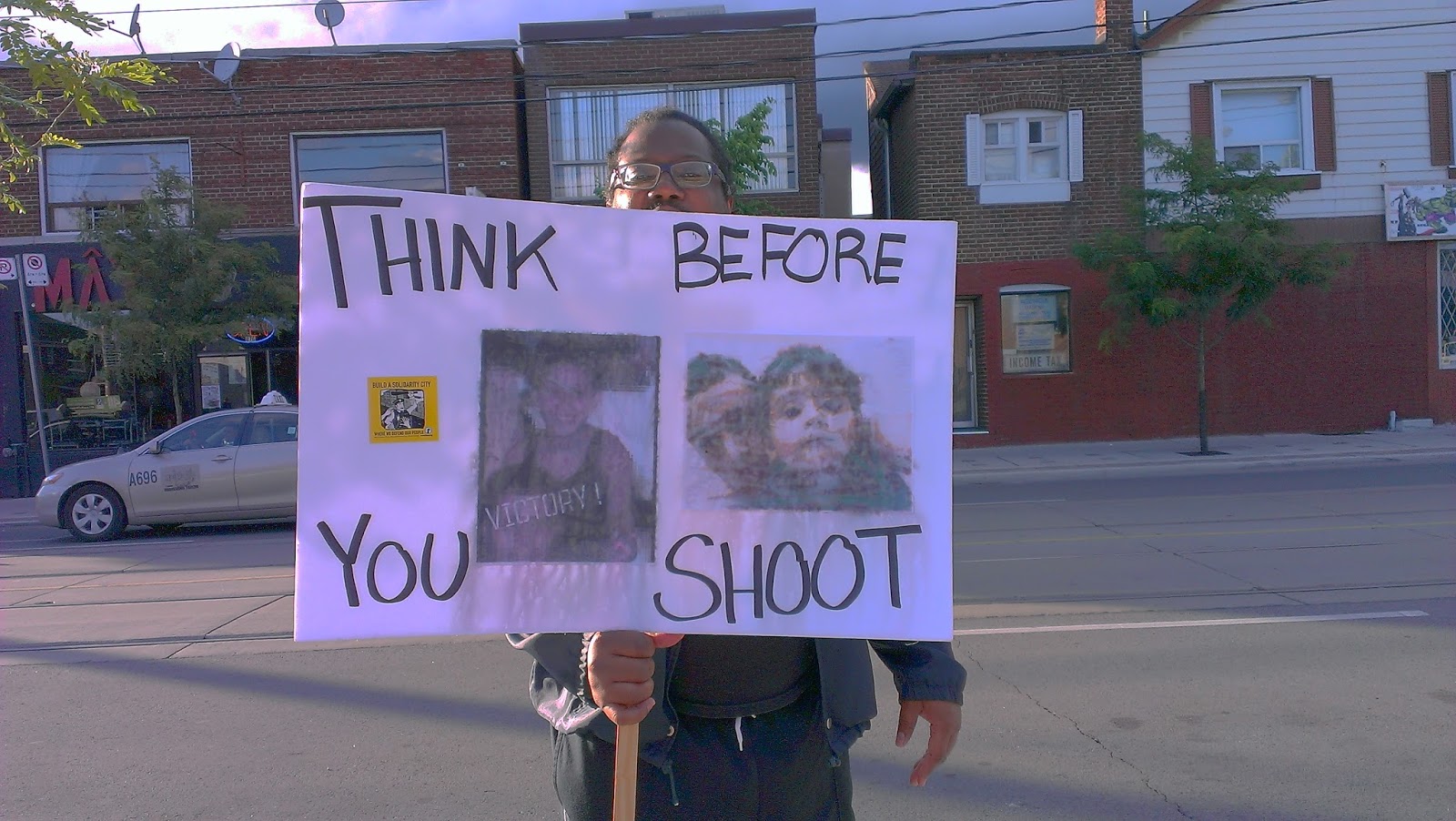
Police officers do need to think before they shoot. Police officers do need to resort to less lethal options in the use of force continuum and escalate only as necessary. Police officers need to de-escalate rather than escalate situations. Those are the implications of a guilty finding in this case on criminal liability.

It can be expected however that the the funders of Constable Forcillo's legal team will exhaust all appeal routes to keep him from being convicted and sentence to a lengthy term of penitentiary. A conviction and sentence to jail time will inevitably result in the loss of his employment as a police officer.

****

In August 2013, I provided legal commentary on the Sammy Yatim homicide on a Streetcar by Police Constable James Forcillio, on CP24, CTV, CBC Television, CBC Radio, Toronto Star, Global National: 

CBC, The National" Police officer gets bail in Sammy Yatim shooting" August 21, 2013; 

L'heure du monde - Relations difficiles entre les citoyens et la police de Toronto avec K. Djinko August 21, 2013; 


Toronto Star "James Forcillo: An explanation of the bail processAugust 20, 2013; 


Related Research...
Andre Marin's Investigation
MICHAEL ELIGON

Coroners Inquest


Public Statement from the Father of Michael Eligon Jr.

SIU REPORT

Video SHOOTING OF MICHAEL ELIGONhttp://www.thestar.com/news/crime/article/1140015--police-shooting-of-michael-eligon-a-timeline

Doug Pritchard Eye-witness Account Interview regarding the Police Killing Of Michael Eligon
(Very good verbal re-inactment)
http://vimeo.com/40549621

Media Report on SIU Director's decision regarding Eligon... Mentions TASERS...
http://www.zuza.com/news-story/75948-siu-clears-police-officer-in-shooting-of-michael-eligon/

Greiving Father hopes Truth will come out...
Andre Marin Slams SIU

Rogers TV Coverage of Police Service Board meeting
http://www.rogerstv.com/page.aspx?lid=237&rid=16&gid=95147 
Reuben Abib - BADC Deputation by Reuben Abib begins around the 1hr:33min mark...


Friday, May 01, 2015

Public trust in Toronto Police Service means that the law must be respected

By Selwyn A. Pieters, B.A., LL.B., L.E.C.
Lawyer & Notary Public (Ontario, Canada)
Attorney-at-Law May 01, 2015

Below is an extract from part of a lengthy May 01, 2015 letter that I wrote to the recently appointed Chief of the Toronto Police Service, Mark Saunders, concerning racial profiling, racialized violence and inappropriate use of the Canadian criminal justice system machinery. The quote from R. v. Schertzer, 2015 ONCA 259 is an add on to the letter.
.....
Mr. [X] reported to me the following in respect to his interactions with officers at 31 Division:
i. That he has been stopped and searched in public many times without any reason;
ii. That he was assaulted in the past as well by Toronto Police Officers;
iii. That he does not feel comfortable to walk in his community alone as a result;
iv. That he wants the police harassment of him in his community to stop.
Just for your reminder on May, 30th, 2013, the Black Community Police Consultative Committee (BCPCC) held a town hall meeting at the Christian Centre Church with Toronto Police 31 Division and residents of the Jane-Finch area.  The purpose of this discussion was to identify problems and solutions to improve community safety and the relationship with local police.[1] You were in attendance and said this:

“First and foremost, our primary function within a community is public safety, making sure folks are getting to and from their places safely.  In different areas of the City there are different values, I can go to a different pocket of the city and their primary issue is, my car getting broken into, then I can go to other parts of the City and the big issue is, is my son and daughter ok to walk to school and back?  Two completely different dynamic issues, and so as a police service the way that we try to be successful and addressing the needs is by identifying what is the strongest value for that community? The way that we learn that is by having those conversations with the members of the community, with the consultative communities because they speak to us and let us know what’s going on and they let us know where the relationships are weak and where we can do better.”   

....
In Toronto in 31 Division of Toronto Police it is no different than Baltimore. Essentially, the troubled police - community interaction in 31 Division is systemic and endemic. A Black police Chief and Black Commander makes no difference when the culture supports racial profiling and racialized violence. I cannot stress enough how deleterious it is to the Toronto Police Service and society as a whole when police officers abuse and misuse their powers. We watched how things unfolded in Baltimore over the past few weeks with the Freddie Gray matter. That is not an unlikely occurrence where the culture of the police service is such that lawless behavior on the part of police officers are shielded and covered up.

Little affects me more than the abuse of power by police officers and when such organizations are tone deaf to the concerns of its citizens. Our Canadian judicial system is inappropriately used with trumped up charges of assault police when your officers abuse citizens rights.....

The Court of Appeal recently reiterated the following in R. v. Schertzer, 2015 ONCA 259:

[132]     Public confidence in the honesty of the police is fundamental to the integrity of the criminal justice system.  As Moldaver J.A. wrote in Schaeffer v. Wood2013 SCC 71 (CanLII) at para. 52, citing Sir Robert Peel:
“‘the police are the public and…the public are the police…  The wisdom of this statement lies in its recognition that public trust in the police is, and always must be, of paramount concern.” 
[133]   Police officers are sworn to uphold the law. In R. v. Feeney2008 ONCA 756 (CanLII)238 C.C.C. (3d) 49, at para. 8, this court endorsed the following passage from R. v. Cusack (1978), 41 C.C.C. (2d) 289 (N.S. S.C.(A.D.))::
[T]he paramount consideration in this case is the protection of the public from offences of this sort being committed by persons who are given special authority by our law to deal with individual members of society, and to deter such persons from acting in breach of their trust....
The commission of offences by police officers has been considered on numerous occasions by the Courts, and the unanimous finding has been that their sentence should be more severe than that of an ordinary person who commits the same crime, because of the position of public trust which they held at the time of the offence and their knowledge of the consequences of its perpetration..
It is not a crime for a Black man in Jane and Finch to be in and around his neighbourhood. I live in Regent Park and I walk in my neighbourhood any hour of the day and night as that is my prerogative. I trust that you will, in your new role, reinforce to your officers that citizens have rights under  The Constitution Act, 1982, Schedule B to the Canada Act 1982 (UK), 1982, c 11 (the "Charter"); Human Rights Code, R.S.O. 1990, c. H.19, as amended (the “Code”); Police Services Act, R.S.O. 1990, c. P.15 as amended. This is not North Korea.


Copyright © 2015 Selwyn Pieters. All rights reserved. Please use citation if using or relying on my analysis.

********
Selwyn A. Pieters, B.A. (Toronto), LL.B. (Osgoode), L.E.C. (U.W.I). Lawyer & Notary Public (Ontario). Attorney-at-Law (Republic of Guyana and Republic of Trinidad and Tobago).

Selwyn has appeared at all levels of courts, including the Supreme Court of Canada in Attorney General of Ontario v. Michael J. Fraser, et al., 2011 SCC 20  and Commission des droits de la personne et des droits de la jeunesse, et al. v. Bombardier Inc. (Bombardier Aerospace Training Center), et al. (2015 - decision reserved); Ontario Court of Appeal in Freeman-Maloy v. Marsden 267 D.L.R. (4th) 37, 208 O.A.C. 307 (C.A.); Bangoura v. Washington Post (2005) 202 O.A.C. 76, (2005) 17 C.P.C. (6th) 30 (Ont.C.A.), McAteer v. Canada (Attorney General) 2014 CarswellOnt 10955, 2014 ONCA 578, 121 O.R. (3d) 1, 376 D.L.R. (4th) 258 (CA) and most recently R. v. Steele (2015) ONCA 169 (Ont. C.A.);  the Federal Court of Appeal in The Honourable Sinclair Stevens v. The Conservative Party of Canada, [2005] F.C.J. No. 1890, 2005 FCA 383. He represented Correctional Manager Mariann Taylor-Baptiste in the ground-breaking competing rights case of Taylor-Baptiste v. Ontario Public Service Employees Union, 2012 CarswellOnt 8965, 2012 HRTO 1393, 2012 C.L.L.C. 230-022 reconsideration denied in 2013 CarswellOnt 1033, 2013 HRTO 180, 2013 C.L.L.C. 230-019 at the HRTO; Civil Rights lawyer Charles Roach in the Oath cases of McAteer, Topey, Dror-Natan v. Canada (Attorney General) 2013 CarswellOnt 13165, 2013 ONSC 5895 (ON S.C.) and Roach et al. v. Canada 2012 CarswellOnt 7799, 2012 ONSC 352 (ON S.C.) which is a constitutional challenge to the oath in the Citizenship Act.

Selwyn has provided representation to persons charged with various criminal offenses including Drugs: Selling and Possessing, Shoplifting, Serious Offences of Violence: Aggravated Assault, Assault with a Weapon and Robbery, Gun Offences, sexual assault, robbery, theft, extortion, HIV/AIDS litigation; fraud, break & enter, attempted murder, murder, regulatory offences under the Occupational Health and Safety Act, professional disciplinary offences, and conspiracy offences.

Selwyn has also been involved in drugs, guns and gang trials including "Project Green Apple", "Project XXX" and "Project Kryptic", "Project Corral" which are some of Canada's largest Criminal Organization prosecutions. Selwyn is currently counsel for an accused in "Project Feline" and Project Revival" drug sting operations. In Project Corral, Selwyn's advocacy resulted in the "gang expert" evidence being discredited and the Criminal Organization charges against his client and others being tossed out by the Court: R. v. Agil, Chambers, Fullerton, Jimale and Brown 2011 CarswellOnt 18099 (Ont. CJ. July 14, 2011, Khawley J.)

Selwyn recently obtained an extraordinary remedy of costs agains the Crown for failure to provide disclosure of police officer memo book notes in R. v. W.(J.), [2013] O.J. No. 2284, 2013 CarswellOnt 6322, 2013 ONCJ 270 (Ont. CJ.).

Selwyn is the successful litigant in the recent racial profiling case involving carding of three Black men: Peel Law Association v. Pieters, 2013 CarswellOnt 7881, 2013 ONCA 396, 228 A.C.W.S. (3d) 204, 116 O.R. (3d) 81, 306 O.A.C. 314, 9 C.C.E.L. (4th) 233, [2013] O.J. No. 2695(Ont. C.A.).

Selwyn has provided crucial legal advise to clients duringhigh risk situations such as gun calls, hostage taking, barricaded persons, mentally disturbed persons, high risk arrests and public order control in situations where there is significant public disorder, lawlessness, personal injury and property damage. Charges of cause disturbance and assault police can be pretextual racial profiling charges: R. v. Roach, 2005 O.J. No. 5278 (Ont. C.J.) (Criminal Law - Causing a Disturbance); R. v. Ramsaroop, 2009 CarswellOnt 5281, 2009 ONCJ 406 (Ont. CJ.); R. v. Taylor, 2010 CarswellOnt 6584, 2010 ONCJ 396, [2010] O.J. No. 3794 (Ont. CJ.)

Selwyn was co-counsel in the world's first-ever sexual HIV transmission murder trial of Johnson Aziga in Hamilton, Ontario. See, for example, R. v. Aziga, 2008 CanLII 39222 (ON S.C.); R. v. Aziga; 2008 CarswellOnt 4300 (ON S.C.) and R. v. Aziga, 2008 CanLII 29780 (ON S.C.)

Selwyn argued on racial profiling includes: R. v. Steele, 2010 ONSC 233 (ON S.C.) and R. v. Egonu, 2007 CanLII 30475 (ON SC) - Driving while black and R. v. Bramwell-Cole [2010] O.J. No. 5838 (ON S.C.) - walking while black.

Selwyn has acted in exclusion cases at the Immigration and Refugee Board of Canada: See, Song Dae Ri (Re) 2003 CarswellNat 4527; (2004) 36 Imm. L.R. (3d) 203; Liang (Re) 2002 CarswellNat 4719; 33 Imm. L.R. (3d) 251.

Selwyn has appeared in  Coroners' Inquest including: Coroner's Inquest into the Death of Negus Topey (May 02, 2005, Coroners' Court, Dr. K.A. Acheson) Ruling on Application for Standing; Coroner's Inquest into the Death of Dwight Haughton (Coroners' Court, Dr. Evans) Ruling on Application for Standing; Coroner's Inquest into the Death of Jeffrey Reodica(May 04, 2006, Coroners' Court, Dr. B. Porter) Ruling on Application for Standing

Selwyn also acted as co-counsel with C. Nigel Hughes for the families of three deceased persons killed during a civil demonstration in Linden, Guyana, at the Linden Commission of Inquiry. Selwyn is currently co-counsel with Brian M. Clarke representing the Guyana Trades Union Congress in the Walter Anthony Rodney Commission of Inquiry in Georgetown, Guyana.


[1] - The Black Community Police Consultative Committee (BCPCC) Town Hall Meeting, May 30th, 2013; a video of the Town Hall Meeting is available at this web link - http://jane-finch.com/videos/policetownhall.htm   

Monday, March 16, 2015

Walter Rodney Commission of Inquiry - Propaganda Press of Guyana Chronicle


By Selwyn A. Pieters, B.A., LL.B., L.E.C.
Lawyer & Notary Public (Ontario, Canada)
Attorney-at-Law (Republic of Guyana, Island of Trinidad)
Posted on March 17, 2015

On January 07, 2015, I wrote to the Secretariat of the Walter Rodney Commission stating as follows:
Thank you for your correspondence in respect to the proposed resumption of the Commission which you advised may resume sitting on January 26, 2015. On November 07, 2014, that was the final day of the last round of hearings, Chairman Sir. Richard L. Cheltenham closed the hearing with this pronouncement “We will issue a notice well in advance as to when next we will be meeting, but the days and months ahead might be uncertain. Even though we have agreed on a date, we will let you know closer to the time because we may have to change depending on what is happening on the ground.” An uncertainty or more has arisen. Fundamentally, Parliament has been prorogued under Article 70 (1) of the Constitution of the Cooperative Republic of Guyana, Chapter 1:01. The President in his New Years message has announced that he will be calling elections within the first quarter of 2015. It appears premature to propose any schedule until the issues of state as mentioned above are settled. That is my respectful view having regard to the circumstances and Mr. Basil Williams email below that speaks to the election campaigning that is occurring in Guyana with the political parties.
No formal response was received from the Commission as is the usual pattern of behavior when counsel send correspondence to the Commission Secretariat.

The Commission resumes its public hearings from March 23, 2015 to March 27, 2015. In the leadup to the resumption of the Commission the propaganda continues. On March 16, 2015, I wrote the following in response to an article in Guyana Chronicle:

On another note, I applaud freedom of the press and "responsible journalism". However, the propaganda in the Guyana Chronicle leaves much to be desired and does politicized the Commission in an unacceptable way. Today's online publication in its headline section alone illustrates the point: 
"Our nation stands perplexed and puzzled that Opposition Leader, Brigadier David Granger, adamantly refuses to participate in this process. One would expect, not only as a former top leader of the Guyana Defense Force (GDF), but also given his current leadership role in our nation, that Brigadier Granger would want to solve the Dr Rodney cold case and see the ghost of the past put to rest." RODNEY’S DEATH: AN ENIGMA BEING ANSWERED Special Report on the Rodney Commission of Inquiry by Shaun Michael Samaroo : Rohee testifies to Commission of X13  <http://guyanachronicle.com/rodneys-death-an-enigma-being-answered-special-report-on-the-rodney-commission-of-inquiry-by-shaun-michael-samaroo-rohee-testifies-to-commission-of-x13/> retrieved on 2015-03-16 
The Commission has yet to reach witnesses Lincoln Lewis, Cecil Skip Roberts, Norman McLean, Rupert Roopnarine. This process, unless Salmon Letters, were issued, is voluntary. So it is unclear why the taxpayer funded papers is carrying the line that Granger "adamantly refuses to participate in this process." In a meaningful way Granger is present in through his counsel Basil Williams. 
"But the Opposition Leader refuses to acknowledge the Commission’s integrity, and even said that if his coalition wins the May 11 national elections, he would terminate the Commission’s work." It was repeated to the Commission more than once that a Presidential Commission survives irrespective of who is the President of the Republic of Guyana. How then does the Guyana Chronicle get away with the irresponsibility of stating that the Commission folds if a new government assumes power? 
"The Commission vindicates the role of the Working People’s Alliance (WPA), and is writing the admirable history of this political party in the making of modern Guyana." The Commission has made no findings and has written nothing in respect to the WPA or any other political party. 
"The Opposition uses the excuse that the Government is using the Commission as political currency, to opt out of facing the evidence the Commission unearths." As a Canadian based lawyer of Guyanese origin reading this said view that the Commission is being used as "political currency", the process of examination, cross-examination, re-examination and other built in mechanism such as impartiality, integrity and other tennets of the quasi-judicial system makes that difficult, in the hearing process. [For a discussion on challenges in the hearing process and the conduct of the Commission of Inquiry, please see, previous blog postings: A Revisiting of the Issue of Partiality or Impartiality of the Walter Rodney Commission of Inquiry, Oct 22, 2014; Walter Rodney Commission of Inquiry - Gerald "Gerry" Gouveia evidence - Does a Reasonable apprehension of bias exist?, June 26, 2014; and Walter Rodney Commission of Inquiry - The Battle for Contemporaneous Documents June 13, 2014]
[......]. 
The witnesses up to the final moment of the Commission's hearing remains to be seen. However, purported blackmail of potential and/or prospective witnesses through unfounded and untested allegations splashed across the national newspapers are unhelpful. 
In Canada, Leon Mugesera faced the music for his propaganda and speeches in the lead up to a genocide. Mugesera v. Canada (Minister of Citizenship and Immigration), [2005] 2 SCR 100, 2005 SCC 40 (CanLII), <http://canlii.ca/t/1l249> retrieved on 2015-03-16
I pull no punches in say[ing] that given the current situational context in Guyana such publications in the face of an election campaign is not only unhelpful but disgraceful.

See also, PPP calls for Granger, Harmon to appear before Rodney CoI –to account for missing army weapons <http://guyanachronicle.com/ppp-calls-for-granger-harmon-to-appear-before-rodney-coi-to-account-for-missing-army-weapons/>  retrieved on 2015-03-16

Guyana Times, Last Chance <http://www.guyanatimesgy.com/2015/03/05/last-chance/>  retrieved on 2015-03-16

Youtube <https://www.youtube.com/watch?v=-TrTAt1u_dY> Post Cabinet press briefing by HPS Dr Roger Luncheon 4th March, 2015 starts at 20:39 retrieved on 2015-03-16

GINA <http://www.gina.gov.gy/home/index.php/home/all-news/item/1968-rodney-s-death-hps-queries-why-surviving-pnc-personalities-of-that-era-have-not-yet-volunteered-to-testify-before-coi> Rodney’s death… HPS queries why surviving PNC personalities of that era have not yet volunteered to testify before COI  retrieved on 2015-03-16

********
Selwyn A. Pieters, B.A. (Toronto), LL.B. (Osgoode), L.E.C. (U.W.I). Lawyer & Notary Public (Ontario). Attorney-at-Law (Republic of Guyana and Republic of Trinidad and Tobago).

Selwyn has appeared at all levels of courts, including the Supreme Court of Canada in Attorney General of Ontario v. Michael J. Fraser, et al., 2011 SCC 20  and Commission des droits de la personne et des droits de la jeunesse, et al. v. Bombardier Inc. (Bombardier Aerospace Training Center), et al. (2015 - decision reserved); Ontario Court of Appeal in Freeman-Maloy v. Marsden 267 D.L.R. (4th) 37, 208 O.A.C. 307 (C.A.); Bangoura v. Washington Post (2005) 202 O.A.C. 76, (2005) 17 C.P.C. (6th) 30 (Ont.C.A.), McAteer v. Canada (Attorney General) 2014 CarswellOnt 10955, 2014 ONCA 578, 121 O.R. (3d) 1, 376 D.L.R. (4th) 258 (CA) and most recently R. v. Steele (2015) ONCA 169 (Ont. C.A.);  the Federal Court of Appeal in The Honourable Sinclair Stevens v. The Conservative Party of Canada, [2005] F.C.J. No. 1890, 2005 FCA 383. He represented Correctional Manager Mariann Taylor-Baptiste in the ground-breaking competing rights case of Taylor-Baptiste v. Ontario Public Service Employees Union, 2012 CarswellOnt 8965, 2012 HRTO 1393, 2012 C.L.L.C. 230-022 reconsideration denied in 2013 CarswellOnt 1033, 2013 HRTO 180, 2013 C.L.L.C. 230-019 at the HRTO; Civil Rights lawyer Charles Roach in the Oath cases of McAteer, Topey, Dror-Natan v. Canada (Attorney General) 2013 CarswellOnt 13165, 2013 ONSC 5895 (ON S.C.) and Roach et al. v. Canada 2012 CarswellOnt 7799, 2012 ONSC 352 (ON S.C.) which is a constitutional challenge to the oath in the Citizenship Act.

Selwyn has provided representation to persons charged with various criminal offenses including Drugs: Selling and Possessing, Shoplifting, Serious Offences of Violence: Aggravated Assault, Assault with a Weapon and Robbery, Gun Offences, sexual assault, robbery, theft, extortion, HIV/AIDS litigation; fraud, break & enter, attempted murder, murder, regulatory offences under the Occupational Health and Safety Act, professional disciplinary offences, and conspiracy offences.

Selwyn has also been involved in drugs, guns and gang trials including "Project Green Apple", "Project XXX" and "Project Kryptic", "Project Corral" which are some of Canada's largest Criminal Organization prosecutions. Selwyn is currently counsel for an accused in "Project Feline" and Project Revival" drug sting operations. In Project Corral, Selwyn's advocacy resulted in the "gang expert" evidence being discredited and the Criminal Organization charges against his client and others being tossed out by the Court: R. v. Agil, Chambers, Fullerton, Jimale and Brown 2011 CarswellOnt 18099 (Ont. CJ. July 14, 2011, Khawley J.)

Selwyn recently obtained an extraordinary remedy of costs agains the Crown for failure to provide disclosure of police officer memo book notes in R. v. W.(J.), [2013] O.J. No. 2284, 2013 CarswellOnt 6322, 2013 ONCJ 270 (Ont. CJ.).

Selwyn is the successful litigant in the recent racial profiling case involving carding of three Black men: Peel Law Association v. Pieters, 2013 CarswellOnt 7881, 2013 ONCA 396, 228 A.C.W.S. (3d) 204, 116 O.R. (3d) 81, 306 O.A.C. 314, 9 C.C.E.L. (4th) 233, [2013] O.J. No. 2695(Ont. C.A.).

Selwyn has provided crucial legal advise to clients duringhigh risk situations such as gun calls, hostage taking, barricaded persons, mentally disturbed persons, high risk arrests and public order control in situations where there is significant public disorder, lawlessness, personal injury and property damage. Charges of cause disturbance and assault police can be pretextual racial profiling charges: R. v. Roach, 2005 O.J. No. 5278 (Ont. C.J.) (Criminal Law - Causing a Disturbance); R. v. Ramsaroop, 2009 CarswellOnt 5281, 2009 ONCJ 406 (Ont. CJ.); R. v. Taylor, 2010 CarswellOnt 6584, 2010 ONCJ 396, [2010] O.J. No. 3794 (Ont. CJ.)

Selwyn was co-counsel in the world's first-ever sexual HIV transmission murder trial of Johnson Aziga in Hamilton, Ontario. See, for example, R. v. Aziga, 2008 CanLII 39222 (ON S.C.); R. v. Aziga; 2008 CarswellOnt 4300 (ON S.C.) and R. v. Aziga, 2008 CanLII 29780 (ON S.C.)

Selwyn argued on racial profiling includes: R. v. Steele, 2010 ONSC 233 (ON S.C.) and R. v. Egonu, 2007 CanLII 30475 (ON SC) - Driving while black and R. v. Bramwell-Cole [2010] O.J. No. 5838 (ON S.C.) - walking while black.

Selwyn has acted in exclusion cases at the Immigration and Refugee Board of Canada: See, Song Dae Ri (Re) 2003 CarswellNat 4527; (2004) 36 Imm. L.R. (3d) 203; Liang (Re) 2002 CarswellNat 4719; 33 Imm. L.R. (3d) 251.

Selwyn has appeared in  Coroners' Inquest including: Coroner's Inquest into the Death of Negus Topey (May 02, 2005, Coroners' Court, Dr. K.A. Acheson) Ruling on Application for Standing; Coroner's Inquest into the Death of Dwight Haughton (Coroners' Court, Dr. Evans) Ruling on Application for Standing; Coroner's Inquest into the Death of Jeffrey Reodica(May 04, 2006, Coroners' Court, Dr. B. Porter) Ruling on Application for Standing

Selwyn also acted as co-counsel with C. Nigel Hughes for the families of three deceased persons killed during a civil demonstration in Linden, Guyana, at the Linden Commission of Inquiry. Selwyn is currently co-counsel with Brian M. Clarke representing the Guyana Trades Union Congress in the Walter Anthony Rodney Commission of Inquiry in Georgetown, Guyana.


Wednesday, November 05, 2014

Walter Rodney Commission of Inquiry - Charles Rishiram Ramson on Guyana Police Force

A retired Judge enlightened view on the Guyana Police Force
A 1986 picture of Tactical Services Unit members
some of whom served in 1979.
The member circled in red is very special
"Mr. Pieters: You see that is the problem with stereotyping...
Justice Ramson: That is not stereotyping. You do not know that in this country in order to relieve
the country of the crime rate in those days Mr. Burnham took all the people who were known criminals and made them Policemen.
Mr. Pieters: You see again that is the problem …
Justice Ramson: You do not know that, I am telling you.
Mr. Pieters: You see that is the problem. You are now denigrating the character of people who served this country...."


By Selwyn A. Pieters, B.A., LL.B., L.E.C.
Lawyer & Notary Public (Ontario, Canada)
Attorney-at-Law (Republic of Guyana, Island of Trinidad)
Posted on November 05, 2014
Updated on November 07, 2014

As a lawyer with significant experience in human rights, civil rights and non-adversarial matters, I was retained to represent its interest of the Guyana Trades Union Congress (GTUC) at the Walter Rodney Commission of Inquiry. I am currently co-counsel representing the Guyana Trades Union Congress in the Walter Anthony Rodney Commission of Inquiry in Georgetown, Guyana.

Whether as Judicial Officers or Information Commissioner, lawyer or ordinary Joe Public. stereotyping is simply wrong. That was the point to which I took on Charles Ramson on November 03, 2014. Part of Charles Ramson examination in Chief before the Walter Rodney Commission of Inquiry comes to mind when providing evidence on the predominantly Black, Afro-Guyanese, Tactical Services Unit of the Guyana Police Force:

Justice Ramson: Correct. He did not had a car at the time so wanted a lift home from the Director of Public Prosecution (DPP)’s place and I offered to drop him home, but we wanted to go and see this… have a look and see what is going on at this meeting because the political temperature was rising, the thermostat was bursting at the seams. So we wanted to see what was going on, not to be participants that is why we stood so far away about 500 yards away from the meeting and if you know Mr. Chang, Justice Chang is not a man who likes to be involved at a political level. So while we were there, we noticed a squad of Policemen or people who were dressed in Pplice clothing. In those days we used to call it the riot squad. I do not know it is the same as the TSU now, but the Riot Squad had a particular set of clothes that you know when they are coming and they were big hunky, five foot, six foot and six foot four people, the mere presence use to frighten them.
Mr. Hanoman: They used to make you as well afraid Justice Ramson?
Justice Ramson: Of course, what happen to me, I do not look like six foot, four. I may have a very strong mind and personality, I do not ever believe I can be described as a coward, but I can tell you I was no match physically for those… some of them said they were not Policemen, that is evidence in the case. The defense in the case was these people were thugs from the House of Israel and the Court of Appeal gave them short shrift it is all part of the evidence. When you read the case you will see it.
Mr. Hanoman: So this group of Police who you identified as Riot Police were approaching yourself and Justice Ian Chang…
Justice Ramson: And as they were coming, they were clearing the streets people who were standing on the road, hanging around, going into the people’s yard and pulled them out. So Justice Chang and I were standing and watching and seeing what they were doing not knowing we were going to be the last victims. Well when I say “we” not him. So when they approached, I knew the man who was the Officer in charge because I interacted, I did a lot of criminal works in those days and I had to interact with most of the Policemen they even used to call me “Al Pacino” and “Serpico”. They had a big film called “Justice for All” or something and “Serpico”. So the Policemen who got to know me they gave me that moniker.

Cross-examination by Pieters - part of my aim here was to expose the absurdity  of the testimony, particularly in so far as members of the Tactical Services Services Unit are concerned. He you will see when challenged on his height desgription, it changed from 6'4", to 6'2" or 6'3":

Mr. Pieters: Let me quote the passage to you Justice Ramson. It says, “It is quite evident that the Police following their directive from the Divisional Headquarters went to the venue of the proposed meeting prepared for and ready to deal with such preaches as might occur. Even the Riot Squad was there, but they did not go into action nor did in support of his viva voce evidence speak to any incidence whatsoever involved in the preach of the peace”. Do you recall that passage from your case?
Justice Ramson: I am accepting you reading verbatim, I do not recall it, but they obviously are referring to where the actual venue was, not where I was. I was 500 yards away from there.
Mr. Pieters: I appreciate that you were …
Justice Ramson: I accept Counsel’s word, I do not …
Mr. Pieters: So the Riot Squad, you say that it was member of the Riot Squad that attacked you.
Justice Ramson: That is how I know them; I see it marked on their helmet and I am telling you again I know about the different in physical attributes of different departments of the Police Force. They got certain people who are traffic people and they would be of a certain kind of stature. When it comes to the resisting any encroachments on the right of the State, they have these very large fellas and they belong to Special Squads. The Special Branch of this country, you do not even know that they are Special Branch; some of them look like market people.
Mr. Pieters: Let us deal with the size of Police Officers because you seem to be sort of misrepresenting or seem to be portraying that protest, misrepresentation of what Police Officers were at that material time. Any Police Officers that were hired by the Guyana Police Force came through the Felix Austin Police College before they were just dispersed to any specific unit.
Justice Ramson: That College came long after the time I am talking about.
Mr. Pieters: So you are saying that Eve Leary did not exist in 19 …
Justice Ramson: But it was not called Felix Austin …
Mr. Pieters: … well, but it was there.
Justice Ramson: … they must have gone to some kind preliminary training school. I do not know where, but I can tell you Felix Austin was a distinguished Police and he, the name …
Mr. Pieters: I am not concerned who Felix Austin was, I am concerned about where Police Officers were hired and where they were trained so you just answer the questions I asked you and nothing else.
Justice Ramson: Yes well, I can try that.
Mr. Pieters: Let me ask you this, you would know that the Guyana Police Force has any other Police organisation at least until, let us say the 1980’s, they had a height requirement for example, for people who want to be members of their organisations.
Justice Ramson: That was a requirement and it was always the case that you need to be of a certain height before you were able to qualify to be admitted to the Police Force.
Mr. Pieters: So it would be that any member of the Guyana Police Force would have been over 5’ 11”?
Justice Ramson: I do not think 5’ 11’; I think about 5’ 6”.
Mr. Pieters: I am telling you what their height requirement was, 5’ 11” and over.
Justice Ramson: If that is what the record is, I would accept that.
Mr. Pieters: So when you saw people and they were around 6 feet tall or over, that would have been consistent with the hiring practice at the time across the board?
Justice Ramson: I am speaking about 6’ 4”.
Mr. Pieters: And how many people that you say would have been about 6’ 4” that would have been in the Tactical Service Unit on 22nd August, 1979?
Justice Ramson: The people who I saw on that day, none of them were less than 6’ 2”; 6’ 3”.

Mrs. Samuels-Brown: I am sorry to interrupt your flow Counsel; could you tell me the source of the height per commendation that you just put forward, the height requirement, Counsel? You said it is 5’ 11” …
Mr. Pieters: 5’ 11”.
Mrs. Samuels-Brown: … where is this source of that?
Mr. Pieters: It is in the Guyana Police Force recruitment material. I will have it laid over to the Commission …
Mrs. Samuels-Brown: It is in the Guyana Police Force, what?
Mr. Pieters: … recruitment material. I would have it laid over to the Commission.
Mrs. Samuels-Brown: Thank you.
Mr. Chairman: Counsel, I am concerned about relevance. How is that likely to be helpful?
Mr. Pieters: Sorry, I just missed what you just said, Mr. Chairman.
Mr. Chairman: I was saying I was beginning to get concerned about relevance. How is it likely to be helpful to us?
Mr. Pieters: How is what, relevant or helpful to you?
Mr. Chairman: The questions that you are opposing and the evidence that you are trying to extract.
Mr. Pieters: The Witness is being cross-examined on the evidence he gave this morning. He gave that evidence and he is being cross-examined. Let me ask you this, going to the meat of …
Mrs. Samuels-Brown: I think you are saying that you are not as menacing he made them out to be or they were not a Special Squad of menaces?
Mr. Pieters: Well, yes, he tried sort to have us to a stereotypical image what Tactical Services Unit Officers would look like.
Mr. Chairman: I thought he was referring to conduct rather than appearance.
Mr. Pieters: No, he was referring to appearance. You look at the transcripts. I was here and I heard it. He is trying to stereotype Officers in a way that is inappropriate.
......
Mr. Pieters: You would admit or agree that you are pretty litigious. You already had the experience with in respect to the Persaud Case so you had already access the Courts successfully and you know how to access the Court?
Justice Ramson: Yes, but I do not like the word “pretty litigious”; if a man beat me up tomorrow I will take the State to Court.
Mr. Pieters: And that is acceptable. You would also agree that under the Police Act, they were disciplined and employment consequences for Officers who misused their authority as Police Officers?
Justice Ramson: There is a Police Disciplinary Act, I think is Chapter 16:02 and it creates the framework for disciplining the Policemen, but before you discipline the Policeman you have to know who the Policeman is. You cannot go and say Mr. Doe, like you can do in America, I think, Mr. Doe. You got to know the man name and all of them look alike. They do not look like Mr. Williams different from Mr. Hanoman.
Mr. Pieters: You see that is the problem with stereotyping Mr. …
Justice Ramson: That is not stereotyping. You do not know that in this country in order to relieve the country of the crime rate in those days Mr. Burnham took all the people who were known criminals and made them Policemen.
Mr. Pieters: You see again that is the problem …
Justice Ramson: You do not know that, I am telling you.
Mr. Pieters: You see that is the problem. You are now denigrating the character of people who served this country, but that is not …
Justice Ramson: That is not nothing denigrating.

Mr. Pieters: … excuse me, just let me finish, but I am not here to debate that point. I am just here to ask you questions and have you answered them.
Justice Ramson: But when you tell me I am stereotyping them, you do not know what the context is. I live through the time.
Mr. Pieters: And you say that, well I am not going to repeat your defamatory remarks about Officers.

12:57hrs
Justice Ramson: Defamatory? I never defamed anybody. I am telling you the truth; I am like Mohandas Karamchand Gandhi.
Mr. Pieters: So you, well … anyway. You did not…
Mrs. Samuels-Brown: Sorry, I am going to dwell on this a little. Justice Ramson, as a private practitioner and as a Judge, you did find that there were honourable persons in the Police Force?
Justice Ramson: Oh yes, on to now.
Mrs. Samuels-Brown: From 1979 up to now?
Justice Ramson: On to now.
Mrs. Samuels-Brown: Thank you.
Justice Ramson: Not every person in the barrel was rotten.
Mrs. Samuels-Brown: I thought that is what you meant.
Justice Ramson: No.

Mrs. Samuels-Brown: That it was everybody.
Justice Ramson: No, no.
Mrs. Samuels-Brown: I just wanted to give you the opportunity to clarify.

 Mr. Pieters: Very well and you testified earlier this morning that there were members of the Death Squad or the Tactical Services Unit (TSU) present?
Justice Ramson: I did not know them as the Tactical Services Unit (TSU) at the time. Maybe that name was given afterwards. I know them as the Riot Squad from Eve Leary.
Mr. Pieters: Well let me suggest this to you about the Tactical Services Unit. Riot control is just one aspect of the functions that the Tactical Services Unit would be performing?
Justice Ramson: Well, if they were so named at that time. I knew them as the Riot Squad.
Mr. Pieters: Right because when you saw them outside of Police Headquarters, you would see them on riot control duties?
Justice Ramson: I did not see them outside Police Headquarters.
Mr. Pieters: I thought you testified that you did on 22nd August, 1979.
Justice Ramson: No, they were running down the road on Sheriff Street. That is not Police Headquarters.
Mr. Pieters: Right that is outside of Police Headquarters?
Justice Ramson: No that is not outside of. Outside of means that there is a proximity issue. You mean when they are not at their home base and they are doing duties outside. But not outside of the office itself or the department.
Mr. Pieters: Outside part of their duties, you would have seen them guarding the police compounds, for example Police Headquarters you would see them protecting that compound?
Justice Ramson: I have no recollection ever going there to see whether they are protecting the compound.
Mr. Pieters: Very well. But what you do know and that is in your decision at page 224 is that the Riot Squad, as you call it, they were not put into action on 22nd August, 1979?
Justice Ramson: They were not?
Mr. Pieters: That is right. That is what your decisions say.
Justice Ramson: Well I do not know. The people I know who were coming down Sheriff Street, I recognised them from their uniform and the helmets they were wearing and it was marked Riot Squad.
Mr. Pieters: There is not a debate that the Riot Squad or the Tactical Services Unit was or was not present. They were present, but they did not go into action in terms of the dispersal of people who were assembled?

The extracts of the November 07, 2014 hearing at the Walter Rodney Commission of Inquiry on the above noted subject matter is below. Please note the Commission's statement and Pieters statement on behalf of the GTUC:

Mr. Chairman [Sir. Richard L. Cheltenham, K.A., Q.C., Ph.D.]: We are back in session, and I wish to begin by indicating to those present as well as to those public that we apologise for the delay in resuming; but we took the opportunity of the break with all present: Commission Counsel, and the Secretariat, to set dates for the New Year, to the extent that this is our last sitting for this year. We had to make sure we were all armed with our 2015 diaries. I did promise before the break that I would make a statement in relation to a complaint made by our Retired Justice Ramson, in relation to two articles that appeared in the Stabroek News, as well as the Kaieteur News. The statement reads as follows, “Retired Justice, Mr. Charles Ramson testified before the Commission on Monday, and Tuesday last. In a report of his testimony in the Stabroek News of Tuesday, November 04th, he is reported as having testified that he observed a team of policemen...” and the exact word here is, “...who he described as...” and I quote, “...as the red squad breaking up the WPA meeting that afternoon. He described the Policemen as “Big Monkey” 6.7” people, adding that their mere presence was intimidating.” In the Kaieteur News, dated Thursday, 06th of November, 2014; there is, at page 17, a headline “GTUC condemns Ramson’s “Monkey” reference to Policemen.” The Kaieteur News added in one paragraph, “While the statement was not met with any objections from those participating in the Commission of Inquiry (COI), it did not escape the attention of GTUC.”
13:13hrs
Mr. Chairman: The testimony given before the Commission is recorded and verbatim reports are provided every evening. The tape has been checked as well as the verbatim reports and the word “monkey” does not appear on the tape or in the verbatim reports. Put differently, there is no evidence before us that the word “monkey” was ever used in the course of his testimony by Justice of Appeal Ramson. In these circumstances, the Commission had nothing to object to and Mr. Ramson had been inaccurately reported. In the event described the Stabroek News may wish to take note of this statement which are making and to withdraw the statement and the make the appropriate amends to Mr. Ramson. We have the audio and will play it for the benefit of the public.
[Audio of the 03rd November, 2014 played for the benefit of the public]
“Justice Ramson: 1970 was the… the Act was passed in 1970 and no further appeals could be had but all appeals that were pending or in the system had to be finished by 1972. That Declaration of the Republic in 1970 had some significance as well because we no longer could access honours from the Queen and the last person to get on the last day of 1969 who received a Knight Wood, was and still and is extraordinary and distinguished Jurist, I am not going to call his name, you blow whistle and I will tell you if it is true.
Counsel to the Commission Mr. Hanoman: Could I now bring you to the case of Charles Rishi Ram Ramson against Lloyd Barker, Commissioner of Police and Attorney General.
Mr. Hanoman: That name is a reference to you, Justice Ramson?
Justice Ramson: Yes, that was inspired by a beating…” “…August in 1975…” “…but the Riot Squad had a particular set of clothes that you know when they are coming and they were big hunky, five foot, six foot and six foot four people, the mere presence use to frighten them.
Mr. Hanoman: They used to make you as well afraid Justice Ramson?
Mr. Ramson: Correct. “…but the riot squad had a particular set of clothes that you know when they are coming and they were big hunky, five foot, six foot and six foot four people, the mere presence use to frighten them.”
Mr. Chairman: In the transcript of the day’s proceeding Monday, the 03rd November, 2014 at page 18 this is the Verbatim Report. “While we were there we noticed a squad of Policemen or people who were dressed in police clothing. In those days we used to call it the riot squad. I do not know if it is the same as the TSU now, but the Riot Squad had a particular set of clothes so that you, but the Riot Squad had a particular set of clothes that you know when they are coming and they were big hunky, five foot, six foot and six foot four people, the mere presence used to frighten them.”
Mr. Williams: “Hunky”
Mr. Chairman: “Hunky” “…big hunky, five foot, six foot and six foot four people…” so that the word “monkey” was not appeared on the tape. We have no memory of it being used here. So in the circumstances the newspaper may wish to take note and I leave it to the party’s concern. Thanks.
Attorney for the Guyana Trades Union Congress (GTUC) [Mr. Selwyn Pieters]: Mr. Chairman, I just want to say, Selwyn Pieters for the GTUC that my client, Mr. Lincoln Lewis, is in the  room as well. When I heard Justice Ramson spoke at the Commission on Tuesday, I believe it was, I was anxious to see the Stabroek News to see what was reported and later listened to the rebroadcast of this hearing on NCN so I knew at that point that it was “hunky” as opposed to “monkey”. I was concerned at that point where the term “monkey” was used as to what the impact would have been on the reading public. And so, the GTUC did read the newspapers and took cognizance of what the newspaper reported as opposed to what the transcript would have been and I did not have the opportunity to review the press statement before it went, otherwise, I would have caught it and corrected it. So on behalf of GTUC, I am apologising that they took the word or the reporting of the Stabroek News as something that actually was the records of these proceedings when they were not. But I would say this as well we were concerned and the record illustrates it that we were concerned about how Justice Ramson described the Policemen of that era. He spoke of the Policemen being recruited by the Prime Minister of the day as criminals and thieves I felt that those were inappropriate stereotyping of police officers and the way he described as…
Mr. Chairman: One minute…
Mr. Pieters: Excuse me, let me finish.
Mr. Chairman: I thought I was giving you the opportunity to apologise now you want to go beyond the issue that we are dealing with?
Mr. Pieters: The issue that we are dealing with and I think the crux of what the Stabroek News Article meant to portray is the inappropriate stereotyping of people. We have apologise that the term “monkey” was used in the Stabroek News and in the Kaieteur News, but the issue of stereotyping is an issue that was alive and well during Justice Ramson's testimony here and that is an issue as a Human Rights Lawyer that I was alive to at the time.
Mr. Chairman: That is not an issue for us.
Mr. Pieters: I am simply using this opportunity to speak on it as well because it must be noted that there were stereotypes used in his evidence that was challenged.
Mr. Chairman: With respect, Mr. Pieters, there is no issue before us of stereotyping so why are you using the opportunity to speak on the issue of stereotyping there is no stereotyping before the Commission. Mr. Ramson made his comments, he testified. When the time comes for submission, you may say all of that, but that has no issue before us whether he used stereotyping or not.
Mr. Pieters: Thank you very much, Mr. Chairman.
Mr. Chairman: Thank you too.
Attorney for the People’s National Congress (PNC) [Mr. Basil Williams]: Just to say Mr. Chairman, Commissioners, that if Mr. Ramson had used the term “monkey” in that box there, I surely would have invade against that term.
Mr. Chairman: I think all of us would have.
Mr. Williams: Yes.
Mr. Chairman: But there is no evidence at all that Justice used the expression.
Mr. Williams: I must, well I must say I did not hear any “monkey”.
Mr. Chairman: So I think from my view point we have put the matter to rest. What happens now between Justice Ramson and the newspaper is a different matter, no concerns of ours and I would like to indicate that indeed but I did not thank Mr. Pieters for the concession which he made on behalf of his client.
[Cheltenham's attempt to silence me on the nub of the issue has me concerned on the issue of stereotyping and adding a stamp of legitimacy to it - anyone can read the transcripts of the evidence of November 04, 2014 and form their own conclusion. I rely on the transcript, my life experience and the contextual analysis of racism and stereotyping rather than this abrogation of responsibility to deal with such issues where and when they arise.]

Walter Rodney Commission of Inquiry Round 6, Day 10 Highlights,New Guyana Media,  November 03, 2014

GTUC apologises to Ramson over inaccurate statement, Stabroek News, November 08, 2014

Justice Ramson: I said “hunky” not “monkey” — Guyana Times, November 08, 2014

Apology by Stabroek News - Stabroek News, November 08, 2014

********
Selwyn A. Pieters, B.A. (Toronto), LL.B. (Osgoode), L.E.C. (U.W.I). Lawyer & Notary Public (Ontario). Attorney-at-Law (Republic of Guyana and Republic of Trinidad and Tobago).

Selwyn has appeared at all levels of courts, including the Supreme Court of Canada in Attorney General of Ontario v. Michael J. Fraser, et al., 2011 SCC 20, Ontario Court of Appeal in Freeman-Maloy v. Marsden 267 D.L.R. (4th) 37, 208 O.A.C. 307 (C.A.); Bangoura v. Washington Post (2005) 202 O.A.C. 76, (2005) 17 C.P.C. (6th) 30 (Ont.C.A.), the Federal Court of Appeal in The Honourable Sinclair Stevens v. The Conservative Party of Canada, [2005] F.C.J. No. 1890, 2005 FCA 383. He represented Correctional Manager Mariann Taylor-Baptiste in the ground-breaking competing rights case of Taylor-Baptiste v. Ontario Public Service Employees Union, 2012 CarswellOnt 8965, 2012 HRTO 1393, 2012 C.L.L.C. 230-022 reconsideration denied in 2013 CarswellOnt 1033, 2013 HRTO 180, 2013 C.L.L.C. 230-019 at the HRTO; Civil Rights lawyer Charles Roach in the Oath cases of McAteer, Topey, Dror-Natan v. Canada (Attorney General) 2013 CarswellOnt 13165, 2013 ONSC 5895 (ON S.C.) and Roach et al. v. Canada 2012 CarswellOnt 7799, 2012 ONSC 352 (ON S.C.) which is a constitutional challenge to the oath in the Citizenship Act.

Selwyn has provided representation to persons charged with various criminal offenses including Drugs: Selling and Possessing, Shoplifting, Serious Offences of Violence: Aggravated Assault, Assault with a Weapon and Robbery, Gun Offences, sexual assault, robbery, theft, extortion, HIV/AIDS litigation; fraud, break & enter, attempted murder, murder, regulatory offences under the Occupational Health and Safety Act, professional disciplinary offences, and conspiracy offences.

Selwyn has also been involved in drugs, guns and gang trials including "Project Green Apple", "Project XXX" and "Project Kryptic", "Project Corral" which are some of Canada's largest Criminal Organization prosecutions. Selwyn is currently counsel for an accused in "Project Feline" and Project Revival" drug sting operations. In Project Corral, Selwyn's advocacy resulted in the "gang expert" evidence being discredited and the Criminal Organization charges against his client and others being tossed out by the Court: R. v. Agil, Chambers, Fullerton, Jimale and Brown 2011 CarswellOnt 18099 (Ont. CJ. July 14, 2011, Khawley J.)

Selwyn recently obtained an extraordinary remedy of costs agains the Crown for failure to provide disclosure of police officer memo book notes in R. v. W.(J.), [2013] O.J. No. 2284, 2013 CarswellOnt 6322, 2013 ONCJ 270 (Ont. CJ.).

Selwyn is the successful litigant in the recent racial profiling case involving carding of three Black men: Peel Law Association v. Pieters, 2013 CarswellOnt 7881, 2013 ONCA 396, 228 A.C.W.S. (3d) 204, 116 O.R. (3d) 81, 306 O.A.C. 314, 9 C.C.E.L. (4th) 233, [2013] O.J. No. 2695.

Selwyn has provided crucial legal advise to clients duringhigh risk situations such as gun calls, hostage taking, barricaded persons, mentally disturbed persons, high risk arrests and public order control in situations where there is significant public disorder, lawlessness, personal injury and property damage. Charges of cause disturbance and assault police can be pretextual racial profiling charges: R. v. Roach, 2005 O.J. No. 5278 (Ont. C.J.) (Criminal Law - Causing a Disturbance); R. v. Ramsaroop, 2009 CarswellOnt 5281, 2009 ONCJ 406 (Ont. CJ.); R. v. Taylor, 2010 CarswellOnt 6584, 2010 ONCJ 396, [2010] O.J. No. 3794 (Ont. CJ.)

Selwyn was co-counsel in the world's first-ever sexual HIV transmission murder trial of Johnson Aziga in Hamilton, Ontario. See, for example, R. v. Aziga, 2008 CanLII 39222 (ON S.C.); R. v. Aziga; 2008 CarswellOnt 4300 (ON S.C.) and R. v. Aziga, 2008 CanLII 29780 (ON S.C.)

Selwyn argued on racial profiling includes: R. v. Steele, 2010 ONSC 233 (ON S.C.) and R. v. Egonu, 2007 CanLII 30475 (ON SC) - Driving while black and R. v. Bramwell-Cole [2010] O.J. No. 5838 (ON S.C.) - walking while black.

Selwyn has acted in exclusion cases at the Immigration and Refugee Board of Canada: See, Song Dae Ri (Re) 2003 CarswellNat 4527; (2004) 36 Imm. L.R. (3d) 203; Liang (Re) 2002 CarswellNat 4719; 33 Imm. L.R. (3d) 251.

Selwyn has appeared in  Coroners' Inquest including: Coroner's Inquest into the Death of Negus Topey (May 02, 2005, Coroners' Court, Dr. K.A. Acheson) Ruling on Application for Standing; Coroner's Inquest into the Death of Dwight Haughton (Coroners' Court, Dr. Evans) Ruling on Application for Standing; Coroner's Inquest into the Death of Jeffrey Reodica(May 04, 2006, Coroners' Court, Dr. B. Porter) Ruling on Application for Standing

Selwyn also acted as co-counsel with C. Nigel Hughes for the families of three deceased persons killed during a civil demonstration in Linden, Guyana, at the Linden Commission of Inquiry. Selwyn is currently co-counsel with Brian M. Clarke representing the Guyana Trades Union Congress in the Walter Anthony Rodney Commission of Inquiry in Georgetown, Guyana.




Tuesday, August 05, 2014

Walter Rodney Commission of Inquiry - Activists Karen DeSousa evidence


"We are trying to get to the truth of this matter and every single document that exists and should exist, should be here that is what my point is." Selwyn A. Pieters

By Selwyn A. Pieters, B.A., LL.B., L.E.C.
Lawyer & Notary Public (Ontario, Canada)
Attorney-at-Law (Republic of Guyana, Island of Trinidad)
Posted on August 4, 2014

As a lawyer with significant experience in human rights, civil rights and non-adversarial matters, I was retained to represent its interest of the Guyana Trades Union Congress (GTUC) at the Walter Rodney Commission of Inquiry. I am currently co-counsel with Brian M. Clarke representing the Guyana Trades Union Congress in the Walter Anthony Rodney Commission of Inquiry in Georgetown, Guyana.

The Commissioners are Sir. Richard L. Cheltenham, K.A., Q.C., Ph.D – Chairman (Barbados); Mrs. Jacqueline Samuels-Brown, Q.C. (Jamaica) and Mr. Seenath Jairam, S.C. (Trinidad). The Commission’s mandate established by its terms of reference is:-
(i) To examine the facts and circumstances immediately prior, at the time of, and subsequent to, the death of Dr. Walter Rodney in order to determine, as far as possible, who or what was responsible for the explosion resulting in the death of Dr. Walter Rodney;
(ii) To inquire into the cause of the explosion in which Dr. Walter Rodney died, whether it was an act of terrorism, and if so, who were the perpetrators;
(iii) To specifically examine the role, if any, which the late Gregory Smith, Sergeant of the Guyana Defence Force, played in the death of Dr. Walter Rodney and if so, to inquire into who may have counselled, procured, aided and or abetted him to do so, including facilitating his departure from Guyana after Dr. Walter Rodney’s death;
(iv) To examine and report on the actions and activities of the State, such as, the Guyana Police Force, the Guyana Defence Force, the Guyana National Service, the Guyana People’s Militia and those who were in command and superintendence of these agencies, to determine whether they were tasked with the surveillance of and the carrying out of actions, and whether they did execute those tasks and carried out those actions against the Political Opposition, for the period 1st January, 1978 to 31st December, 1980;
(v) To examine, review and report on earlier investigations and enquiries done on and into the death of Dr. Walter Rodney.

Karen DeSousa was an activist in the WPA. She is an important witness as the surviving occupant of the vehicle in which Dr. Walter Rodney died, his baby brother, Donald Rodney went to Karen's home seeking assistant for his injuries and Dr. Walter Rodney.

The cross-examination that I conduct on Karen DeSousa went to the modus operandi of Dr Walter Rodney as a political leader: charismatic, courageous, risk-taker, and in the final instance "fool-hardy" (either a dupe or willing participant in testing the exp-losive device). A question also dealt with whether Dr. Rodney was seen as a threat to the political hierarchy of both PNC and PPP? 

Mr. Pieters: Let me read, Ms. De Souza, what Mr. Burnham said... This is the Comrade Leader on page 29. He said, “Alright. Ease it. Now, Comrades, we allow them for the time being, as I said, to hold meetings, and we would always allow them to hold meetings, but they must understand that when you hold meetings you must be sure you do not offend the audience. No, no, cannot offend your audience. You must not mistake other people‟s audience for your own. An audience is a wife that belongs exclusively to one, so Comrades, the youngsters apply to hold the meeting one block away from the PNC Congress, well then, we had to say this [and in quotation marks] “eye-pass must stop”.”
Ms. De Souza: Sorry, I have lost the question.
Mr. Pieters: The question was phrased differently. The question that I was going to suggest to you was Prime Minister Forbes Burnham had no issues with peaceful assembly so long as they were lawful and not conducted in a way that can cause physical antagonism between the Parties. I believed you answered that one. Then I went onto the next question and I said in the speech of the Third Biennial Congress, page 29, you would agree that Burnham considered it eye-pass that WPA came it Sophia in the vicinity of the PNC Headquarters to hold their public meetings.
Ms. De Souza: And I am saying that the premise of the question is wrong. The WPA was not in Sophia.
Mr. Pieters: Right, but that is what his speech is; that the WPA applied to hold their meeting one block away from Congress Place; that is what his speech reflects.
10:40hrs
Ms. De Souza: Yes, so what are you asking me to respond to?
Mr. Pieters: I was asking you to respond because the Chairman asked a question about the issue of eye pass. You would agree that in the Guyana context, eye-pass means a gross insult.

Ms. De Souza: I actually do not like the term eye-pass. It speaks to disrespect between people. It speaks to differing power relation and most of the time, it speaks about children eyes pass adults and it is in that context, I would understand that statement.
Mr. Pieters: So you are saying that Prime Minister Burnham attempted to infantilise the WPA when he made that statement?
Ms. De Souza: I think he was speaking to his own superiority and paramouncy.
Mr. Pieters: Now, would you agree that when Dr. Rodney addressed Forbes Mr. Burnham as King Kong, King Kong can be accepted as a derogatory stereotype?
Ms. De Souza: It might, it depends on who was saying it.
Mr. Pieters: And in the context in which Dr. Rodney used those terms, I am going to suggest to you that it was a derogatory racist stereotype directed at Forbes Burnham.

Ms. De Souza: I would disagree.

****

Mr. Pieters: The Commission has evidence that the Ministry of National Development seems to have been a place where a lot of things were funneled through and so I am going to suggest to you that the Ministry of National Development was a powerful arm of the People‟s National Congress or Government of the day.
Ms. De Souza: I imagine that it was, but as I said, I have no direct experience with it.
Mr. Pieters: And I am going to suggest to you that the burning down of that building shook the Prime Minister of the day, Forbes Burnham.

Ms. De Souza: It may have done so.

***

Mr. Pieters: And you testify in response to pounding on your door. You opened it to be met by Donald Rodney, the brother of Walter. He rang the bell and shouted, “Open, open there has been a terrible accident”.

Ms. De Souza: Much have been made of the word „accident‟ and I have said on every occasion that he may have said „accident‟; he may have said, “something terrible has happened”. I cannot say. I have continued to use those words.
Mr. Pieters: Very well, Madame Commissioner. Let me ask you this: You would agree that your memory would have been fresh and as fresh as it could be soon after the incident occurred?
Ms. De Souza: And I would also agree that I was in serious shock.
Mr. Pieters: Very well. Donald Rodney told you to go and check on the welfare of Dr. Walter Rodney. He told you to go to him, is that not correct?
Ms. De Souza: It is.
Mr. Pieters: And you left your home and you went to the scene?
Ms. De Souza: I did.
Mr. Pieters: And you said that you got to the scene seven minutes after you heard the explosion from Croal Street, correct?

Ms. De Souza: I did.
Mr. Pieters: When you left your home you left on the premise accepting what the Commissioner just read. You left on the premise that Dr. Rodney was involved in a terrible accident or something terrible had happened to him and he was in his brother‟s vehicle.
Ms. De Souza: Yes.
Mr. Pieters: And when you left your home, you had no concern that you would have been at risk or a secondary explosion or any form of harm?
Ms. De Souza: I do not remember thinking in that way.

Mr. Pieters: I am going to suggest to you that you had no concern that you were at risk when you left your home to attend to the scene based on what Donald Rodney had told you.
Mr. Pieters: Why would you have taken the risk of rushing to the scene where Dr. Walter Rodney was?

Ms. De Souza: I believe I responded subsequently in the same way. I was told that a friend of mine is likely to be hurt and in that context, you are talking about possible political hurt. The issue is not “why would I take the risk?”, the issue is, “is there something I could do to help?”

***

Mr. Pieters: Let me move back to Dr. Walter Rodney. You would agree that Dr. Walter Rodney was a courageous person?
Ms. De Souza: Yes.
Mr. Pieters: You would agree that he was a brave man?
Ms. De Souza: Yes.
Mr. Pieters: You would also agree that he was a risk taker?
Ms. De Souza: Yes. I believe anybody in the WPA in those days was a risk taker.

***

Mr. Pieters: Now my understanding is that there were two Police Officers that were directed to work at the prison that evening, Constable Isaiah Williams and Constable Easton, and they were from Brickdam Police Station. Now if it is true that the Guyana Police Force had sentries that were on duty, then would it be plausible as well that given the risk-taking nature of Dr. Rodney that his presence or his going to the prison, whether it was at the direction of Gregory Smith or whomever, was consistent with him as a risk taker?
Mr. Pieters: Well if the premise is accepted, my understanding is he was going to the prison wall to test the device that he had on him which was a placebo of a walkie-talkie.
Mr. Chairman: That the incident took place near the prisons is the same thing as saying he was going to the prison? I think we have to be very precise with our language here. As I understand the evidence, the incident in which Dr. Walter Rodney was blown up and met his death took place near the prison, but there was no evidence that he was going to the prison. I think there is a subtle difference, but you proceed.
Mr. Pieters: I appreciate that, Mr. Chairman.
Mrs. Samuels-Brown: And in fact the Police Officers‟ evidence that you are referring relate to them being on beat and foot patrol carrying out traffic vigilance and duties. Am I correct, Sir?
Mr. Pieters: They were on duty, Madame Commissioner.
Mrs. Samuels-Brown: Thank you.
Mr. Pieters: So my question to you is if there were Police Officers on duty, given the courageous nature of Dr. Walter Rodney, given the risk-taking nature that he adopted that such actions in the face of armed guards would have been quite plausible if he was heading to that prison, outside the walls to test a device?
Ms. De Souza: Counsel, that sounds like the kind of question I might ask, “Do you still beat your wife?” I did not find the wrecked car with Walter‟s body near to the prison. I do not know that Walter was going to the prison. I said that he took risks and that he was courageous. I did not say that he was foolhardy.
Mr. Chairman: That is the answer you got, Counsel.
Mr. Pieters: Do you know what? Seeing that you have raised that, I am going to attack that answer.
Mr. Chairman: I just wondered whether there was another question.
Mr. Pieters: You know when Counsel Scotland cross-examined Eusi Kwayana, Counsel Scotland put to him the situation of Dr. Walter Rodney bending down and looking for a red light and actually had Eusi Kwayana do a demonstration. Were you present when that evidence was given?
Ms. De Souza: No, I was not.
Mr. Pieters: Well let me ask you this: If it is true that the instructions were that Dr. Walter Rodney was to bend over and look for a red light in that vehicle, would that not be something fool hardy?
Mr. Jairam: Mr. Pieters, you know I did not want to stop you before but I think this is the second occasion on which you are inviting her to speculate. This kind of evidence… I do not think, speaking for myself, that this witness could give us a helpful answer.
Mr. Pieters: Very well, Mr. Commissioner. Let me ask you this: Were you aware of the relationship between Dr. Walter Rodney and Gregory Smith?
Ms. De Souza: I was not.

Mr. Pieters: Those are all my questions.

Resources

Transcript of Evidence of Ms. Karen DeSousa and Tacuma Ogunseye, August 4, 2014

Walter Rodney COI, August 4, 2014 - Part 1, Stabroek News, August 4, 2014

Walter Rodney COI, August 4, 2014 - Part 2, Stabroek News, August 4, 2014

Walter Rodney COI, August 4, 2014 - Part 3, Stabroek News, August 4, 2014

Walter Rodney COI, August 4, 2014 - Part 4, Stabroek News, August 4, 2014

Walter Rodney COI, August 4, 2014 - Part 5, Stabroek News, August 4, 2014

Walter Rodney COI, August 4, 2014 - Part 6, Stabroek News, August 4, 2014

Walter Rodney COI, August 4, 2014 - Part 7, Stabroek News, August 4, 2014

********
Selwyn A. Pieters, B.A. (Toronto), LL.B. (Osgoode), L.E.C. (U.W.I). Lawyer & Notary Public (Ontario). Attorney-at-Law (Republic of Guyana and Republic of Trinidad and Tobago).

Selwyn has appeared at all levels of courts, including the Supreme Court of Canada in Attorney General of Ontario v. Michael J. Fraser, et al., 2011 SCC 20, Ontario Court of Appeal in Freeman-Maloy v. Marsden 267 D.L.R. (4th) 37, 208 O.A.C. 307 (C.A.); Bangoura v. Washington Post (2005) 202 O.A.C. 76, (2005) 17 C.P.C. (6th) 30 (Ont.C.A.), the Federal Court of Appeal in The Honourable Sinclair Stevens v. The Conservative Party of Canada, [2005] F.C.J. No. 1890, 2005 FCA 383. He represented Correctional Manager Mariann Taylor-Baptiste in the ground-breaking competing rights case of Taylor-Baptiste v. Ontario Public Service Employees Union, 2012 CarswellOnt 8965, 2012 HRTO 1393, 2012 C.L.L.C. 230-022 reconsideration denied in 2013 CarswellOnt 1033, 2013 HRTO 180, 2013 C.L.L.C. 230-019 at the HRTO; Civil Rights lawyer Charles Roach in the Oath cases of McAteer, Topey, Dror-Natan v. Canada (Attorney General) 2013 CarswellOnt 13165, 2013 ONSC 5895 (ON S.C.) and Roach et al. v. Canada 2012 CarswellOnt 7799, 2012 ONSC 352 (ON S.C.) which is a constitutional challenge to the oath in the Citizenship Act.

Selwyn has provided representation to persons charged with various criminal offenses including Drugs: Selling and Possessing, Shoplifting, Serious Offences of Violence: Aggravated Assault, Assault with a Weapon and Robbery, Gun Offences, sexual assault, robbery, theft, extortion, HIV/AIDS litigation; fraud, break & enter, attempted murder, murder, regulatory offences under the Occupational Health and Safety Act, professional disciplinary offences, and conspiracy offences.

Selwyn has also been involved in drugs, guns and gang trials including "Project Green Apple", "Project XXX" and "Project Kryptic", "Project Corral" which are some of Canada's largest Criminal Organization prosecutions. Selwyn is currently counsel for an accused in "Project Feline" and Project Revival" drug sting operations. In Project Corral, Selwyn's advocacy resulted in the "gang expert" evidence being discredited and the Criminal Organization charges against his client and others being tossed out by the Court: R. v. Agil, Chambers, Fullerton, Jimale and Brown 2011 CarswellOnt 18099 (Ont. CJ. July 14, 2011, Khawley J.)

Selwyn recently obtained an extraordinary remedy of costs agains the Crown for failure to provide disclosure of police officer memo book notes in R. v. W.(J.), [2013] O.J. No. 2284, 2013 CarswellOnt 6322, 2013 ONCJ 270 (Ont. CJ.).

Selwyn is the successful litigant in the recent racial profiling case involving carding of three Black men: Peel Law Association v. Pieters, 2013 CarswellOnt 7881, 2013 ONCA 396, 228 A.C.W.S. (3d) 204, 116 O.R. (3d) 81, 306 O.A.C. 314, 9 C.C.E.L. (4th) 233, [2013] O.J. No. 2695.

Selwyn has provided crucial legal advise to clients duringhigh risk situations such as gun calls, hostage taking, barricaded persons, mentally disturbed persons, high risk arrests and public order control in situations where there is significant public disorder, lawlessness, personal injury and property damage. Charges of cause disturbance and assault police can be pretextual racial profiling charges: R. v. Roach, 2005 O.J. No. 5278 (Ont. C.J.) (Criminal Law - Causing a Disturbance); R. v. Ramsaroop, 2009 CarswellOnt 5281, 2009 ONCJ 406 (Ont. CJ.); R. v. Taylor, 2010 CarswellOnt 6584, 2010 ONCJ 396, [2010] O.J. No. 3794 (Ont. CJ.)

Selwyn was co-counsel in the world's first-ever sexual HIV transmission murder trial of Johnson Aziga in Hamilton, Ontario. See, for example, R. v. Aziga, 2008 CanLII 39222 (ON S.C.); R. v. Aziga; 2008 CarswellOnt 4300 (ON S.C.) and R. v. Aziga, 2008 CanLII 29780 (ON S.C.)

Selwyn argued on racial profiling includes: R. v. Steele, 2010 ONSC 233 (ON S.C.) and R. v. Egonu, 2007 CanLII 30475 (ON SC) - Driving while black and R. v. Bramwell-Cole [2010] O.J. No. 5838 (ON S.C.) - walking while black.

Selwyn has acted in exclusion cases at the Immigration and Refugee Board of Canada: See, Song Dae Ri (Re) 2003 CarswellNat 4527; (2004) 36 Imm. L.R. (3d) 203; Liang (Re) 2002 CarswellNat 4719; 33 Imm. L.R. (3d) 251.

Selwyn has appeared in  Coroners' Inquest including: Coroner's Inquest into the Death of Negus Topey (May 02, 2005, Coroners' Court, Dr. K.A. Acheson) Ruling on Application for Standing; Coroner's Inquest into the Death of Dwight Haughton (Coroners' Court, Dr. Evans) Ruling on Application for Standing; Coroner's Inquest into the Death of Jeffrey Reodica(May 04, 2006, Coroners' Court, Dr. B. Porter) Ruling on Application for Standing

Selwyn also acted as co-counsel with C. Nigel Hughes for the families of three deceased persons killed during a civil demonstration in Linden, Guyana, at the Linden Commission of Inquiry. Selwyn is currently co-counsel with Brian M. Clarke representing the Guyana Trades Union Congress in the Walter Anthony Rodney Commission of Inquiry in Georgetown, Guyana.