Monday, October 08, 2012

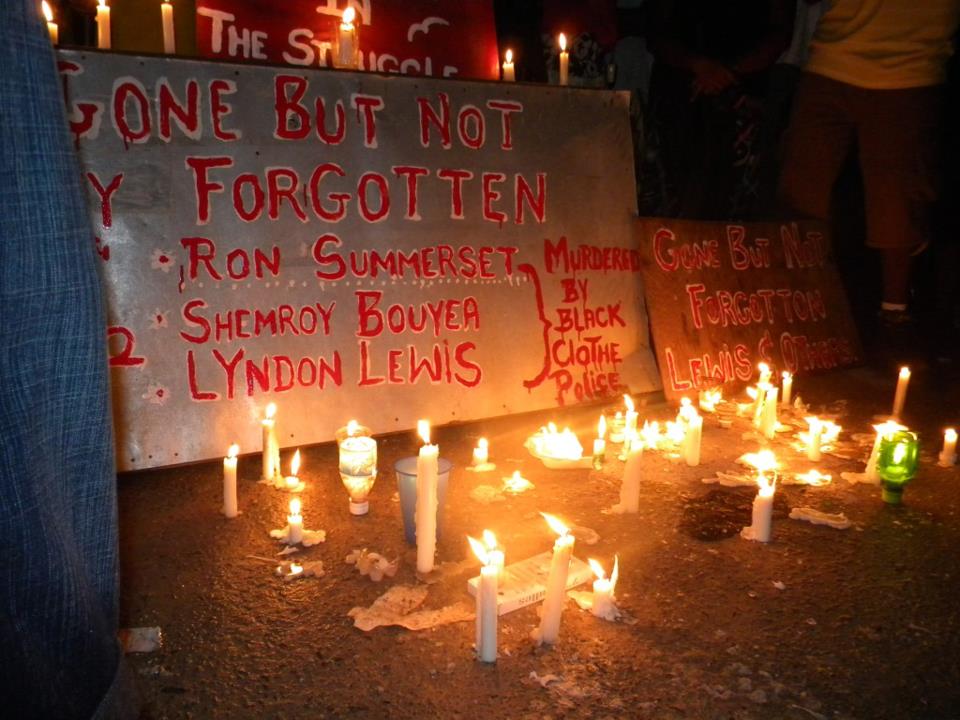
Images from the Commission of Inquiry into the July 18, 2012 shooting at the Wismar/McKenzie Bridge in Linden, Guyana

By Selwyn A. Pieters, B.A., LL.B., L.E.C.
Lawyer & Notary Public (Ontario, Canada)
Attorney-at-Law (Republic of Guyana, Island of Trinidad)
 
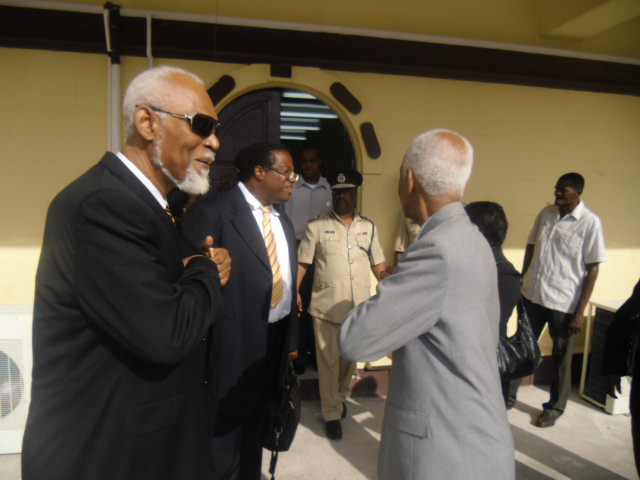
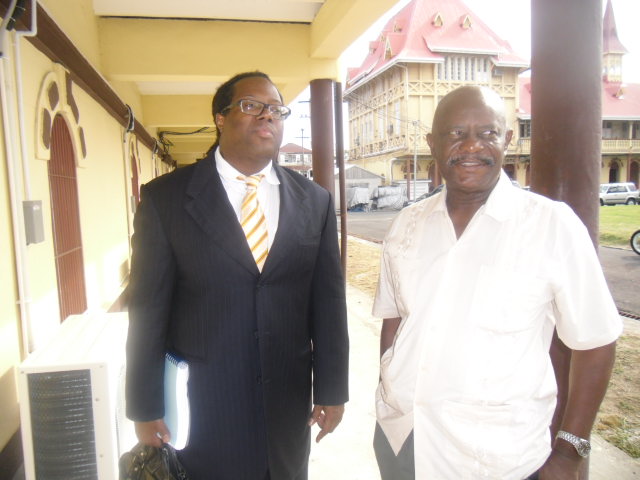
These are some of the images from the Commission of Inquiry Into Events in Linden on July 18, 2012
with Nigel Hughes

with Aubrey Norton, Winston Felix and Joseph Harmon

with K. D. Knight, Q.C. and Justice Lensley Wolfe

with Keith Desmond Knight, Q.C. and
Justice Lensley Wolfe

 with K. D. Knight, Q.C. and Justice Lensley Wolfe


With Winston Felix

Winston Felix

Shonette Adams
 
 
ASP Patrick Todd
 
Enrico Wolford


Meeting with Sharma Solomon


Senior Superintendent Clifton and Ronald Burch-Smith

Omeyana Hamilton, Nigel Hughes
Assistant Superintendent Patrick Todd being cross-examined
by Selwyn Pieters

Assistant Superintendent Patrick Todd being cross-examined
by Selwyn Pieters


Clifton Hicken on July 19, 2012


Sunday, July 22, 2012

Case Analysis on social media, the modern workplace and Human Rights related harassment: Taylor–Baptiste v. OPSEU

By Selwyn A. Pieters, B.A., LL.B., L.E.C.
Lawyer and Notary Public of the Bars of Ontario, Guyana and Trinidad

Facts

The facts of Taylor-Baptiste v. Ontario Public Service Employees Union, 2012 HRTO 1393 have not been repeated in this analysis. The facts as accepted by the Tribunal could be found in paragraphs 4 – 19 of the decision.

The Issue

The question of law decided by the Tribunal is whether the content of the blog posts violated the protections in section 5(1) and 5(2) of the Human Rights Code, R.S.O. 1990, c.H.19 (“the Code”) against discrimination with respect to employment and harassment in the workplace on the grounds of marital status and/or sex:

 While the facts are straightforward, they raise difficult and challenging issues and conflicting interpretive values. In what circumstances are statements outside work hours, on line, “with respect to employment” or “in the workplace.”? In what circumstances, if any, can a manager make a Code claim against the Union or its leaders for statements directed at union members about the workplace relationship?[1]

Legal Reasoning

The decision turned principally on undisputed facts and law.[2]  It was argued on behalf of the Applicant that a "blog is an extension of the workplace, and that social media, including blogs, Facebook and Twitter are integrally woven into the fabric of the modern workplace."

[25] I agree with the applicant that employers can discipline employees for actions they take in cyberspace, and that the Code may apply to workplace-related postings on the internet. It is not open to serious doubt, in my view, that in 2012 postings on blogs and other electronic media may be part of or an extension of the workplace and that the Code may apply to them.

The Applicant also argued that:

The Code does not have a hierarchy of those deserving of protection and those that do not based on whether they are frontline employees, supervisors, managers, union presidents or directors.“Every person” in an employment relationship therefore captures the relationship and interaction between a local president of a union and a manager who seeks to bring a human rights application before the Tribunal.

The Tribunal applied a purposive and contextual interpretation of section 5 of the Code.[3]The Tribunal found that the blog comments were not harassment ‘in the workplace’ under section 5(2), even given its broadest interpretation. This was because the posts ‘were made on a blog identified with the union that, although open to the public, was directed at communication between union members and their leadership.”[4] In other words, the Tribunal is saying that for section 5(2) to apply to postings in cyberspace, there must be a sufficient nexus or connection. The Tribunal was less clear about what exactly would constitute a sufficient connection.

The Applicant in her submission submitted that "to establish that a blog, a facebook group or any other form of social media form part of the workspace a nexus has to be established between the employer and the errant employee in cyberspace and this could be done by quantification of the number of explicit references, quantification of the number of named individuals, direct/indirect references and a corollary assessment of the employer’s policy practice in this area and response to the particular incident are key starting points."

While it is not mentioned anywhere in the Tribunal's judgment, on October 27, 2011, the Tribunal dismissed a Request for Order during proceedings in which “the Applicant request the following Orders in advance of the proceedings to be dealt with in writing:

                                                               i.      That the Respondents disclosed to the Applicant, through her counsel: 
a) The IP addresses and email addresses for the anonymous posters;
b) Raw data logs that showed the visitors to the Blog at the material time the material were posted;
c) All deletions and updates to the Blog for the material time.”

The Tribunal said at the time this evidence was tangential to the main issues - yet the absence of this very evidence was significant to whether or not the postings originated "in the workplace."

In considering whether the respondent’s actions constituted discrimination under section 5(1) of the Code, the Tribunal deemed it necessary to consider all relevant circumstances, including:

  1. the seriousness of the conduct;
  2. their significance;
  3. their effect on the workplace;
  4. the role of the person making them;
  5. the effect on the applicant; and
  6. the reaction of the respondent to any concerns raised

The Tribunal held that Mr. Dvorak’s comments were protected by the right to freedom of expression in section 2(b) of the Canadian Charter Rights and Freedoms and also the right to freedom of association in section 2(d) of the Charter.[5]  “This case involves an issue of competing rights” Ms. Taylor – Baptiste’s Code rights to freedom from discrimination with respect to employment and harassment in the workplace and the union’s core Charter rights to express themselves on matters of concern in the union-management relationship.”[6]

Balancing the competing rights of the applicant and the respondent, the Tribunal assessed Mr. Dvorak’s rights against the appellants right to freedom from discrimination with respect to employment and harassment in the workplace: “The Tribunal has emphasized that ambiguity in the scope of Code rights should be resolved in favour of protecting matters at the core of Charter rights and freedoms.”[7] The Tribunal disagreed that merely mentioning the applicant by name “as being the spouse of Mr. Gray, or as being the ex-spouse of Mr. Taylor-Baptiste” or simply raising concerns about nepotism without accompanying denigrating or humiliating comments, was sufficient to amount to discrimination on the basis of marital status.[8] 

The Tribunal was concerned about “the use of sexist language to convey the point of nepotism.” It found that the Respondent “drew upon frequently used sexist stereotypes about women in positions of power ‘sleeping their way to the top” through suggesting that her qualifications for the job was ‘intimate knowledge of another deputy.’” The Tribunal also found that the comment “if you don’t know the answers to something this simple you should call your boyfriend over at his office” draws upon the stereotype that women get ahead through their relationships with more competent ‘boyfriends.’”[9] It found that the comment“ ...let Ms. Baptiste know that if she needs any help making a decision in the future, I’m sure he (the Applicant’s ex-husband) would help her. Maybe she should go back to her maiden name, or Gray, so as not to besmerch (read besmirch) the good ‘union’ name of Taylor-Baptiste” “also raised issues of sexism.”[10] “Then Tribunal went on to find that “this issue and suggestion targets her as a woman because it was traditionally women who were expected to change their names upon marriage. This is an issue of gender and it singles her out as a woman.”[11]

The Tribunal then observed that Mr. Dvorak failed to consider or address at that time the ways in which his posts could violate the Code or hurt individuals.”[12] 

Despite this, the Tribunal found that respondents did not discriminate against the applicant.  The Tribunal assessed the following key factors to reach the decision:
Mr. Dvorak’s conduct as a Union President: as an active participant on behalf of the union in a process of restoration of a workplace that had been poisoned through racists hate mail; the Tribunal accepted the respondent’s evidence that the Mr. Dvorak had genuine concerns about nepotism and his comments were directed at union membership and related to the union-management relationship.[13]
  1. Frequency of the posts:  the applicant was only mentioned once in the blog even though the blog was publicly accessible for a month; the tribunal also mentioned that the posts lost significance as more issues were raised.[14]
  2. Union comments on workplace issues are constitutionally protected expressions of opinion and exercise of freedom of association and the union’s right to operate independently of the employer. [15] “Strong criticism from the union is often inherent in being a manager in a tense unionized workplace.”[16]
Based on these factors, the Tribunal held that ‘while they [the blog posts] were relied upon sexist language, they were not gratuitous attacks unrelated to union business.” [17] The Tribunal stated that the most important factor was the fact that “union comments on workplace issues are constitutionally protected expression of opinion and exercise of freedom of association, and close to the core of those rights.”[18]

The Tribunal in weighing the competing rights in this case found that “most significant to my decision in this case are that the postings are tied to communications to the membership on issues of labour-management relations and the absence of Code-related effects in the workplace.”[19]

As a result of these findings, the Tribunal found that the applicant was not harassed and not discriminated against by the Respondents and ordered that the Application be dismissed.

No decision has yet been made on whether or not the Applicant will be judicially reviewing this decision.

Selwyn A. Pieters -  Lawyer and Notary Public; 2012 All rights reserved


[1] Taylor – Baptiste v. Ontario Public Services Employees Union 2012 HRTO 1393, para 2.
[2] See para. 3 of the judgement
[3] See para. 21 of the judgement
[4] See para. 26 of the judgement
[5] See paragraph 29 of judgment. The Tribunal placed reliance on the recent Supreme Court decision in Fraser v. Ontario (Attorney General), 2011 CarswellOnt 2695; 2011 SCC 20 as support for this proposition. It was argued that the conduct engaged in by Mr. Dvorak “was not to be considered collective bargaining towards a collective agreement.”
[6] See paragraph 36 of the judgment
[7] Ibid.
[8] See paragraph 30 of the judgment
[9] See paragraph 31 of the judgment
[10] See paragraph 34 of the judgment
[11] Ibid.
[12] See paragraph 35 of the judgment
[13] See paragraph 35 and 37 of the judgment
[14] See paragraph 36 of the judgment
[15] See paragraph 37 of the judgment
[16] See paragraph 39 of the judgment
[17] See paragraph 40 of the judgment
[18] Ibid.
[19] See paragraph42 of the judgment

Saturday, July 14, 2012

Selwyn Pieters admittance to the Bars of the Republic(s) of Guyana and Trinidad

By Selwyn Pieters, B.A., LL.B., L.E.C.
Lawyer and Notary Public

On July 05, 2012, I was called to the Bar of the Republic of Trinidad and Tobago. Being called to the Bar of Trinidad was much more complicated than Guyana and expensive in terms of the costs and running around.

With Leslyn Noble

Security at Emerald Apartments
With Eusi Anderson - well his robe bag!

With Rondell Donawa
With Sandra Smith
with Robert Cederno


On July 06, 2012, I was called to the Bar of the Republic of Guyana. Here is a video and some pictures of that call:

Selwyn Pieters Admittance to the Bar reported by Prime News, July 09, 2012
http://www.youtube.com/watch?v=5ixnzxpNO_k&feature=share

with Latoa Hobbs, Mark Benschop, Freddie Kissoon, Justice Rishi-Persaud
With Latoya Hobbs


Wih Latoya Hobbs and Justice Rishi-Persaud

Thursday, November 17, 2011

Judicial Review of the Peel Law Association matter - November 22, 2011

The hearing of the Judicial Review Application of the significant and ground-breaking decision in Pieters v. Peel Law Association 2010 HRTO 2411 released on December 03, 2010, by the Human Rights Tribunal of Ontario, will be heard by a three panel bench of Divisional Court in Toronto:

Date: November 22, 2011

Time: 10:00 a.m.

Location: Ontario Divisional Court, Courtroom 3, located at Osgoode Hall, in Toronto.

This  found that the Peel Law Association and its Librarian, Melissa Firth, targeted three Black men, two of whom are lawyers (Brian Noble and Selwyn Pieters) and one of whom is a student (Paul Waldron), for carding in an “aggressive and demanding” manner because of their race and colour, in the Lawyers’ Lounge of the Peel Law Association at 7755 Hurontario Street, in Brampton, Ontario, on May 16, 2008

The Tribunal found as fact that the Applicant Firth did not provide a non-discriminatory reason:

[85] ... In the present case, the respondents have failed to provide a credible and rational explanation for why the personal respondent stopped to question the applicants when she did.  The inference I draw from this, as well as all of the surrounding circumstances, is that this decision was, in some measure, because of their race and colour.


[86]           The respondents contended that the personal applicant spoke directly to Mr. Noble and Mr. Waldron and not Mr. Pieters because he was on the telephone and that the personal respondent recognized him from previous visits to the lounge.  The respondents submitted that by seeking to confirm the identity of only two of the three Black men in the lounge, the personal respondent could not have been racially stereotyping or profiling Black men by assuming that Black men present in the lounge were not lawyers.  This argument fails. I find, as noted earlier, that the personal respondent was questioning all three men as to their right to be in the lounge.   That the personal respondent disputed the fact that she challenged all three men as to their right to be in the lounge is a significant issue for me.  It undermines the general credibility of her explanations for why she chose to question the applicants.


In racial discrimination and racial profiling cases, the Tribunal is entitled to consider whether Ms. Firth provided a reasonable and racially neutral explanation or whether she provided an explanation that lacks credulity and failed to investigate or treating differently similarly situated White individuals:


[89] It is significant, in my view, that the personal respondent did provide an explanation at the time she was questioning the applicants for her actions.  She stated that she knew everyone else in the lounge to be lawyers.  This claim is clearly not true given that Ms. McFadden was not a lawyer and Ms. Reesor, although a lawyer, had never been in the lounge before. 


[90] I have considered whether the personal respondent may have simply relied on this false statement in the heat of the moment, not knowing what to say when challenged by the applicants to explain her decision to question them.   But even if I accept that the applicant relied on this comment in the heat of the moment, it is nonetheless revealing that the personal respondent could not generate a credible non- discriminatory reason for why she was questioning the applicants, for example that she had to resolve the issue of who re-arranged the furniture or that she was in the process of questioning everyone in the lounge she did not know and was beginning with the applicants.  The lack of a persuasive non-discriminatory reason for the questioning of the applicants provided either at the time of the incident or at the hearing leads me to conclude that the personal respondent’s decision to question the applicants was indeed tainted by considerations of their race and colour.


[91]     I have also considered the manner in which the applicant approached and questioned the applicants and whether she subjected them to undue scrutiny. I am mindful of the decision in Nassiah v. Peel (Regional Municipality) Services Board, 2007 HRTO 14 (CanLII), at para. 134, which states:


        I find the racial profiling social science evidence is relevant because it speaks to, not just the initial decision to stop, detain, pursue an investigation, but also sup-ports the general phenomenon that the scrutiny applied to the subsequent investigation is different, more heightened, more suspicious, if the suspect is Black. The stereotyping phenomenon is the same, whether it manifests itself in the discretion to stop/arrest/detain a person in part because they are Black, or whether it manifests itself in the form of greater suspicion, scrutiny, investigation in whole or part because a suspect is Black. (Emphasis in original)


[92]     I have already found that the personal respondent questioned the applicants in an aggressive and challenging manner. I further note that she interrupted Mr. Pieters while he was on the telephone and, it appears, did not introduce herself to the applicants and Mr. Waldron. From all the evidence, including the personal respondent's testimony of how she generally carried out this function, I conclude that the way in which the personal respondent approached the applicants and the blunt and demanding manner in which she asked her questions was not how she would approach and question persons that she imagined were lawyers and had a right to be in the lounge, and I am prepared to draw the inference that the way in which she interacted with the applicants was tainted by consideration of their race and colour. That said, I accept that the personal respondent's contention that her regular practice is to ask for identification from individuals even when they are identified by someone else as admissible and so her repeated requests for identification from Mr. Noble and Mr. Waldron does not suggest, in my view, a greater degree of scrutiny


Tuesday, October 11, 2011

Racism and Racist Images at City Hall in Windsor, Ontario, Canada

HUMAN RIGHTS LAWYER SELWYN PIETERS WAS THREATENED WITH ARREST AT WINDSOR CITY HALL FOR REPORTING RACIST AND HOMOPHOBIC GRAPHIC IN THE PUBLIC BATHROOM AT WINDSOR CITY HALL

A Human Rights Tribunal convened to hear allegations of the pervasive use of the term “nigger” by employees of the Public Works Department of the City of Windsor. The hearing took place in Windsor in its City Hall location at 400 City Hall Square East.

Mr. Alan Shreve, a City of Windsor employee and long time resident of Windsor complained of several incidents in which the offensive slur “Nigger” was used to refer to Black people. He also complained about a KKK incident that occurred during an anti-discrimination training session. Further, he complained of a further incident of racism that occurred a few months after the training session. He is supported by other racial minority employees who also witnessed similar incidents.

The only accessible bathroom to lawyer Selwyn Pieters was on the first floor of City Hall and it was riddled with racist and homophobic remarks and a Nazi sign. Pieters reported the incident to a City Hall reception employee, who refused to get a supervisor or manger for him and then called the police to arrest him for taking pictures. This is a public place that permits and promotes a poisoned atmosphere for Black people. For the City employee to refuse to call her manager and instead call the police reinforces that chilly atmosphere that exist for Black people in the City of Windsor. How could this be acceptable to any citizen?


Photographs and a video recording exist of what was observed in the bathroom and part of the conduct of the City Employee in the foyer of City Hall Windsor.


CBC Television: City of Windsor racist, alleges lawyer, October 20, 2011


Windsor Star: City of Windsor staffer alleges workplace racial slurs, October 18, 2011

The hearing continues on December 14, 15, and 16, 2011 in Windsor, Ontario.

Sunday, August 07, 2011

Toronto Police Deaths and Injuries in Custody From Juy 31, 2011

By Selwyn A. Pieters, B.A., LL.B.
Barrister, Solicitor & Notary Public

July 31, 2011 at the Caribana Parade, three people shot, one died, two injured, all from police bullets.

August 1, 2011 a disabled man who is walking with his mother is killed by the police in an encounter that may well be a case of mistaken identity.

August 07, 2011, another police shooting at Pharmacy Avenue and Conroy Avenue.

The Special Investigations Unit (SIU) is a civilian law enforcement agency, independent of the police, however, comprised of mostly retired police officers on its investigative staff, that conducts criminal investigations into circumstances involving police and civilians that have resulted in serious injury, death or allegations of sexual assault. Very rarely are any charges laid against police officers and the standards set by the SIU to lay charges are quite higher than that used to charge civilians.

It would be interesting to see the results of the various investigations into these incidents. However, for some perspective, see: Ombudsman Ontario, Oversight Unseen, 2008.

Tuesday, August 02, 2011

Johnson Aziga Dangerous Offender Hearing and Designation

By Selwyn A. Pieters
Barrister, Solicitor & Notary Public

Today at the John Sopinka Courthouse, Mr. Justice Lofchik has rendered his decision in R. v. Aziga, 2011 ONSC 4592 and found that Mr. Johnson Aziga should be designated a dangerous offender, thus likely guaranteeing that he would spend the rest of his life in the custody of the state.  Justice Lofchik ruled that in considering any assurances given by Mr. Aziga "I must consider that the offender has a multi-year history of deception." That conduct the Judge ruled “represents a substantial risk to the community.”

On April 04, 2009, Mr. Aziga was found guilty by a jury of first-degree murder in the deaths of two women who died from AIDS-related illnesses. He was also found guilty on 10 counts of aggravated sexual assault and one count of attempted aggravated sexual assault. This case is believed to be the first case in the world where someone has been convicted of murder by HIV.

Mr. Aziga's  dangerous offender hearing commenced May 10, 2011 to determine whether or not he is to be classified as a dangerous offender. Such status results in an indeterminate sentence. Expert evidence was heard from Forensic Psychiatrist Dr. Philip Klassen. He said Mr. Aziga expressed little remorse and blamed his failure to disclose on an "undescended testicle" amongst other things.

A public Health Nurse also gave evidence. Further, some of the victims testified as well as the family of those women who have already passed from AIDS related illness.

Mr. Aziga took the stand at his dangerous offender hearing.

Selwyn Pieters was co-counsel in Aziga's matter from January 24, 2008 to August 05, 2008. My work on the file resuled in three important and significant judicial decisions: See, R. v. Aziga [2008] O.J. No. 2431, 78 W.C.B. (2d) 87 (challenge for cause - HIV Phobia); R. v. Aziga; 2008 CarswellOnt 4300 (allowing him to be unshackled in court) and R. v. Aziga [2008] O.J. No. 3052, 78 W.C.B. (2d) 410 (cruel and unusual treatment and punishment charter challenge).

Outside of Mr. Aziga's own context, the finding of guilt on the murders and his designation as a dangerous offender charts new terrain and certainly should be of interest to HIV harm reduction workers and hiv positive persons - as it is now a precedent that could be used to when the full brunt of the law is unleashed on a person who is HIV positive and failed to inform their partner of his/her status or otherwise failed to take preventative measures - that resulted in the infection of another person.
Aziga Caselaw
  • R. v. Aziga, 2008 CanLII 53841 (ON S.C.) — 2008-10-20
    Ontario — Superior Court of Justice
    aggravated sexual assault — compellable — charged — spouse — common law exception
  • R. v. Aziga, 2008 CanLII 53125 (ON S.C.) — 2008-10-14
    Ontario — Superior Court of Justice
    adjournments — co-counsel — choice — date — retain
  • R. v. Aziga, 2008 CanLII 39612 (ON S.C.) — 2008-08-08
    Ontario — Superior Court of Justice
    hours — funding — preparation — forensic evidence — time
  • R. v. Aziga, 2008 CanLII 39222 (ON S.C.) - inmates — medical — protective custody — detention — unit
  • R. v. Aziga; 2008 CarswellOnt 4300 (ON S.C.)
  • R. v. Aziga, 2008 CanLII 29780 (ON S.C.) — 2008-06-18 Ontario — Superior Court of Justice prospective jurors — partiality — recent cases involving criminal transmission — bias — black citizen who was born
  • R. v. Aziga, 2006 CanLII 42798 (ON S.C.) — 2006-12-29 Ontario — Superior Court of Justice principle against self-incrimination — infected — unprotected — sexual activity — penetrative
  • R. v. Aziga, 2007 CanLII 249 (ON S.C.) — 2007-01-10 Ontario — Superior Court of Justice expert — scientific — evidence — adjournment — defence
  • R. v. Aziga, 2007 CanLII 56095 (ON S.C.) — 2007-12-18 Ontario — Superior Court of Justice infected — subtype — sexual — complainants — unprotected
  • R. v. Aziga, 2007 CanLII 38 (ON S.C.) — 2007-01-03 Ontario — Superior Court of Justice delay — days — remand — time — defence
  • R. v. Aziga, 2006 CanLII 38236 (ON S.C.) — 2006-11-14 Ontario — Superior Court of Justice reliability — dying declaration — hearsay — interview — nodding
Leading Cases In Canada
  • R. v. Thornton, (1991), 1 O.R. (3d) 480, [1991] O.J. No. 25 (Ont. C.A.) (QL); affirmed at 1993 CanLII 95 (S.C.C.), (1993), 82 C.C.C. (3d) 530, [1993] S.C.J. No. 62 (S.C.C.) (QL)
  • R. v. Cuerrier 1998 CanLII 796 (S.C.C.), (1998), 127 C.C.C. (3d) 1, [1998] S.C.J. No. 64 (S.C.C.) (QL)
  • R. v. Williams 2003 SCC 41 (CanLII), 2003 SCC 41, 2003 SCC 41 (CanLII), (2003), 176 C.C.C. (3d) 449, S.C.J. No. 41 (S.C.C.) (QL).
  • (1) R. v. Mercer, (1993), 84 C.C.C. (3d) 41, [1993] N.J. No. 198 (C.A.) (QL)
  • R. v. Miron 2000 CanLII 4432 (MB P.C.), (2000), 174 Man.R. (2d) 52, [2000] M.J. No. 500 (Man. P.C.) (QL);
  • R. v. Smith, 2008 SKCA 61 (CanLII), 2008 SKCA 61, 2008 S.J. No. 283 (QL);
  • R. v. Williams, 2006 ONCJ 484 (CanLII), 2006 ONCJ 484, [2006] O.J. No. 5037 (QL);
  • R. v. Nduwayo, 2006 BCSC 1972 (CanLII), 2006 BCSC 1972, [2006] B.C.J. No. 3418 (QL);
  • R. v. Lamirande, 2006 MBCA 71 (CanLII), 2006 MBCA 71, [2006] M.J. No. 223 (QL);
  • R. v. Walkem (2007), 73 W.C.B. (2d) 145, [2007] O.J. No. 186 (Ont. S.C.) (QL).
  • R. v. Edwards, 2001 NSSC 80 (CanLII), 2001 NSSC 80, [2001] N.S.J. No. 221 (QL)

Other News Articles
Michael McKiernan "Taxing Aziga case sparks lawyers’ spat" Law Times, July 25, 2011; Defendant seeks another delay, Hamilton Spectator, Oct 1, 2008; Barbara Brown, 'There is simply no right to bite'; Expert says jailhouse isolation of HIV murder suspect isn't breach of charter, Hamilton Spectator, July 26, 2008; Tamsyn Burgmann, Lawyers for HIV-positive man want murder charge thrown out, Canadian Press, Jun 11, 2008. Also Ministry to pay for HIV defence, Hamilton Spectator, January 26, 2008; C. Blatchford, An HIV-positive bureaucrat, two women fatally infected and the 'duty to disclose', October 21, 2008.

Tuesday, July 19, 2011

Failure of Lawyer Davies Bagambiire to pay rent resulting in eviction is not professional misconduct Law Society Says

By Selwyn A. Pieters
Barrister, Solicitor & Notary Public


On June 01, 2010, a Notice of Application was issued by the Law Society of Upper Canada alleging seven counts of professional misconduct against Davies Bagambiire, a sole practitioner immigration and refugee lawyer who is practicising criminal law in the singular case of R. v. Aziga. A hearing was held from December 14 - 17, 2010. Mr. Davies Bagambiire's Law Society of Upper Canada hearing was completed with findings of professional misconduct relating to one of his clients T.F. for which he served a one month suspension.

The other counts relating to the conduct of his business at 372 Bay Street in Toronto was dismissed for lack of jurisdiction over a lawyers' failure to pay his rent that resulted in the eviction of him and his sub-tenants. This is how I learn of the eviction from him:


From: daviesbagambiire@bell.blackberry.net [mailto:daviesbagambiire@bell.blackberry.net]
Sent: Tuesday, August 5, 2008 01:36 PMTo: 'Selwyn Pieters'
Subject: Office Issue with LL 


I have a serious issue with the landlord as I told you a few weeks ago. Please send me an email or call me ASAP. I also wanted you to review the Application record for tommorrow before hand. Please call me on my cell (416) 577-3277. db Sent from my BlackBerry® wireless device


My comments reflecting on the LSUC reasons are below:

1) As a complainant in LSUC matters I have no standing. I am a witnesses, that's it.


2) Here Mr. Bagambiire "accumulated approximately $18,000 of arrears in rent for his law office" para 25


3) The lawyer argued that "the Law Society should not be punishing lawyers for their poverty, that the rules were not designed to punish lawyers for being under financial strain and simply not having sufficient money to pay rent." para. 26


4) Zeynep Onen, Director of Professional Regulation at the Law Society, spoke with the Complainant to tell him “it was more a commercial or civil matter rather than an ethical matter.” para 27


5) The LSUC panel concluded that "being in arrears with the payment of office rent did not constitute professional misconduct. To hold otherwise would potentially be to subject a large swath of financially precarious practitioners to disciplinary suspension in economically distraught times." para 28


6) "The Law Society’s allegations set out in Particulars 4 and 5 were not proven. Specifically, the Society failed to prove that the Lawyer’s failure to make monthly rental payments for his office constituted a failure to honour the financial obligations of his practice, contrary to Rule 6.01(2) of the Rules of Professional Conduct. Secondly, the Society failed to prove that the Lawyer acted dishonourably and without integrity contrary to Rule 6.01(1) of the Rules of Professional Conduct, based on failing to notify his sub-tenant, lawyer Selwyn Pieters, that he had not made the monthly rental payments and that this could result in a lockout by the landlord, or by accepting but failing to remit Selwyn Pieters’ sublease payments to the landlord."
Reflections


7) We are all accountable for our actions and inactions as lawyers. Mr. Bagambiire because of my complaint was required to account for his conduct that led to the consequences which it did on August 05, 2008.


8) Bagambiire in the 2011 decision in which this lockout was mentioned was suspended for one month and required to pay restitution of $5000.00 to a client Teresa Figura payable by June 30, 2011.


9) Bagambiire is a repeat offender: See, Law Society of Upper Canada v. Davies Bagambiire, 2008 ONLSHP 70 (The Lawyer is suspended for two months, commencing March 1, 2008. Upon return to practice, the Lawyer shall be supervised for a period of two years) and See also, Re Bagambiire Formal Hearing Panel Decision, N.S.B.S. 43, November 15, 1990.

10) As mentioned earlier, in LSUC disciplinary matters, a complainant is not a party. In this case I had nothing to gain or lose here. Anyways, the decision is instructive to other lawyers dealing with persons like the lawyer in this case to simply sue civilly or call in the police when such issues arise. The law society is not the forum.


11) The Law Society Lawyer Andrea Waltman did an excellent job under difficult circumstances, as the Tribunal was inclined from the get go to the views in para 27 of its decision.


12) I wish Mr. Bagambiire well and hope his financial and other affairs are in order. He has been practising law for 25 years. I know him since 1994. I was a client of his in 1995 - 1996. For Mr. Bagambiire to really get into the situation like that without even believing that he had to tell his sub-tenants, particularly me, is puzzling. However, life goes on and on it did with me.


13) I currently practices law in downtown Toronto at Pieters Law Office, Adelaide Place, DBRS Tower,  where about 25 independent lawyers share space and resources in a professional office setting not unlike that of a medium-sized law firm. So quite frankly, despite the stress, frustration and humiliation, that situation caused, and I have not really spoken to many people about it because I was ashamed that I became part of a lockout, like I did something bad, things worked out for the better for me.


14) I am quite happy where I am at and with the people with whom I now share space. That god for his kindness and great mercies.

See also, Michael McKiernan "Taxing Aziga case sparks lawyers’ spat" Law Times, July 25, 2011

http://www.lsuc.on.ca/WorkArea/DownloadAsset.aspx?id=2147488178


Sunday, July 10, 2011

J.B. and C.F. v. Toronto District School Board

By Selwyn A. Pieters
Lawyer and Notary Public


This is a case discrimination case based on race and racial stereotyping that I have been litigating from December 2005. Six years later the Emery Collegiate case winds its way through the Human Rights Tribunal for Ontario. There has been numerous tactics of TDSB lawyers that generated several decisions in J.B. and C.F. v. Toronto District School Board: 2011 HRTO 1304; 2011 HRTO 1162; 2011 HRTO 994; 2010 HRTO 1228; 2009 HRTO 1030 (CanLII); B. (K.) (Litigation Guardian of) v. Toronto District School Board; 2008 CarswellOnt 455 (SCJ).

Closing arguments were concluded on July 21, 2011 and the decision is reserved. A written decision will be received sometime in the future.